Getty Museum
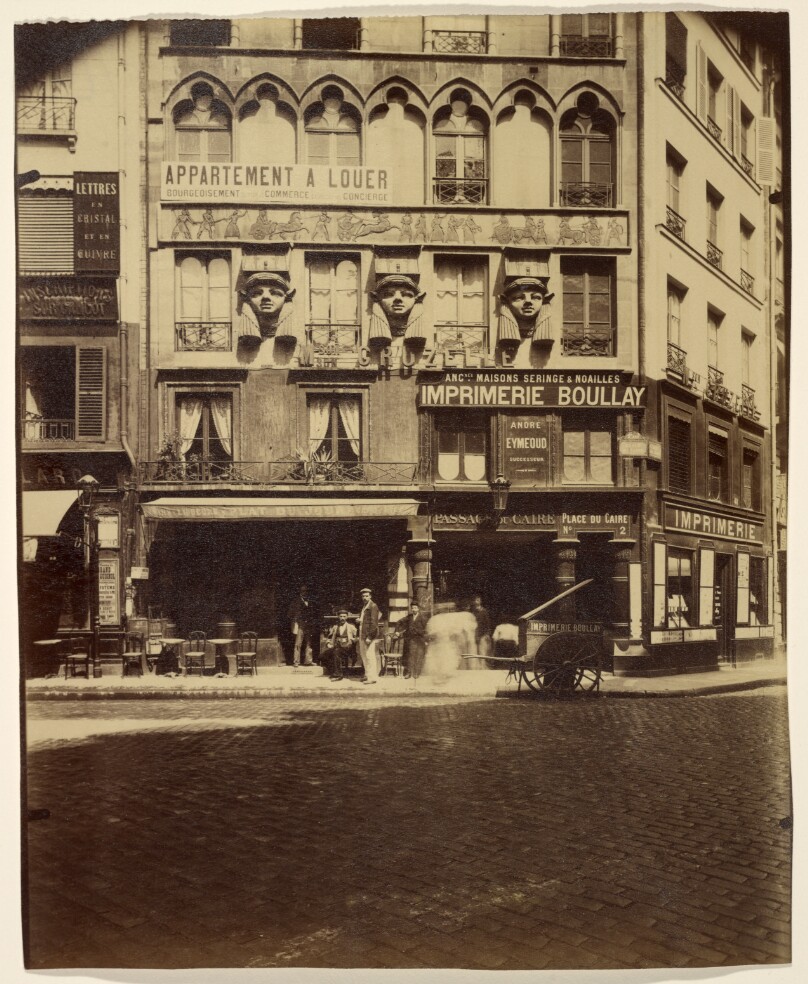
Maison Place du Caire 2 (Building, Place du Caire)
Creator
Eugène AtgetFrench Photographer · 1857–1927
All works by this person →Eugène Atget never called himself a photographer; instead he preferred "author-producer." A private, almost reclusive man, Atget first tried his hand at painting and acting, then began to photograph *vieux Paris* (Old Paris) in 1898. He photographed in part to create "documents," as he called his photographs, of architecture and urban views, but he supported himself by selling these photographs to
More on Getty ULAN- Date
- 1903
- Medium
- Albumen silver print
- Culture
- French
- Department
- Photographs
- Institution
- Getty Museum
- Object ID
- 04540d33-739a-40c1-9164-aa5d27f1bc0f
From the Getty Museum record
> An architectural fantasy rises out of the black foreground of this photograph, the curious main facade of a house built in 1799, just after the square it fronts was laid out. Its style was, no doubt, the result of an interest in things Egyptian, spurred by Napoléon's expedition to Egypt the previous year. His capture of Cairo led to the square and an adjacent street being named for that city, even though his attempt to annex the country failed. The three Hathor heads, the frieze of warriors and horse-drawn chariots, and the arched windows, which are vaguely Moorish in inspiration, are architectural oddities, attempts to appropriate ancient and alien elements to the front of a conventional building. On the ground floor there were originally six columns with lotus capitals separating the entrances to small shops and a pedestrian arcade. By Atget's day only three remained, the others having been sacrificed to commercial dictates. > > In addition to the neo-Egyptian decorations, the camera also recorded details of daily life. Evidently Eugène Atget and his camera attracted the attention of the waiter, two customers, and boy in front of the street-level restaurant on the left, as all of them are looking toward the photographer (zoom in on the central vertical glass panel in the image above.) A fast-moving woman in the center left merely a blur as a record of her passing, the result of the long exposure time. The balance of the ground floor and half the mezzanine above were occupied by the Boullay printing company; its hand-drawn delivery cart is at the curb. A large sign above the sphinxes advertises that an apartment in the building was for rent as either a comfortable dwelling or a place of business, with application being made to the concierge. > > In [2021](https://www.google.com/maps/@48.8680428,2.3487032,3a,75y,66.18h,92.26t/data=!3m6!1e1!3m4!1s6KxIukYH58oXneucDe-58A!2e0!7i16384!8i8192?hl=en), columns still demarcate the ground floor, while the three Hathor heads continue to grace the façade two floors up. > > Adapted from *Eugène Atget*, In Focus: Photographs from the J. Paul Getty Museum by Gordon Baldwin (Los Angeles: J. Paul Getty Museum, 2000), 34. ©2000, J. Paul Getty Trust.
The authoritative record is held by Getty Museum. LinkedCulture surfaces this object and its connections; it does not alter institutional metadata.
Get printable QR codesHide QR codes
Open QR codes for this object page and the museum record. They stay collapsed until needed.
Related across collections
Semantically similar works from Getty Museum and other institutions.