Getty Museum
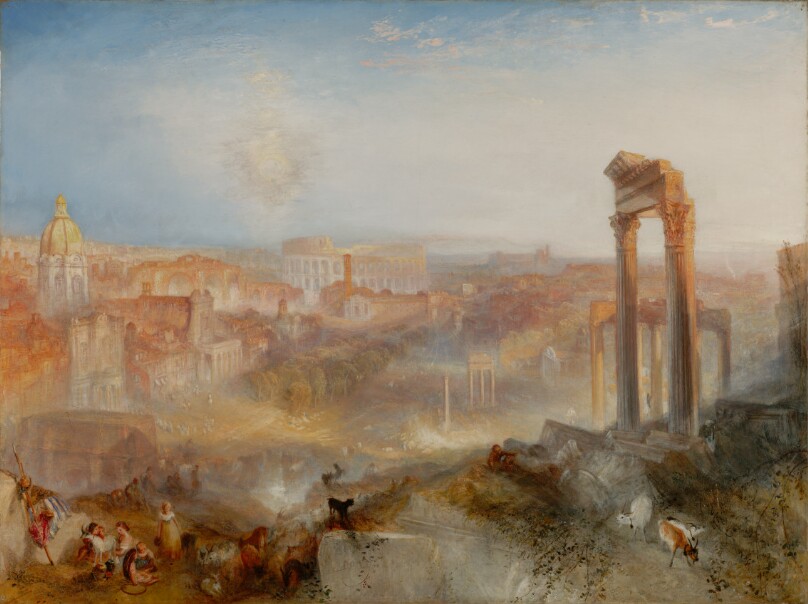
Modern Rome - Campo Vaccino
Creator
Joseph Mallord William TurnerBritish Artist · 1775–1851
All works by this person →Joseph Mallord William Turner's father, a barber and wigmaker, realized his son's artistic talents early, asserting that "my son is going to be a painter." Before enrolling in the Royal Academy, Turner gained some drawing experience in the offices several of London's leading architects. He first exhibited watercolors of architectural subjects and then experimented with scenes from literature and s
More on Getty ULAN- Date
- 1839
- Medium
- Oil on canvas
- Culture
- British
- Department
- Paintings
- Institution
- Getty Museum
- Object ID
- 04dd6563-416d-4f17-ad35-4049dbf36563
What the image shows
A panoramic view of ancient ruins and a cityscape under a blue sky.
Generated by LinkedCulture from the photograph alone, without the museum’s catalogue text (Qwen/Qwen2.5-VL-7B-Instruct), and not yet reviewed by a person. It describes the picture, not the object’s history, and it is not part of the museum’s record.
From the Getty Museum record
Ten years after his final journey to Rome, Turner envisioned the Eternal City through a veil of memory. Baroque churches and ancient monuments in and around the Roman Forum seem to dissolve in iridescent light shed by a moon rising at left and a sun setting behind the Capitoline Hill at right. Amidst these splendors, the city's inhabitants carry on with their daily activities. The picture's nacreous palette and shimmering light effects exemplify Turner at his most accomplished. When first exhibited at the Royal Academy in 1839 with its pendant, *Ancient Rome; Agrippina Landing with the Ashes of Germanicus*, the painting was accompanied by a modified quotation from Lord Byron's masterpiece, *Childe Harold's Pilgrimage* (1818): "The moon is up, and yet it is not night, / The sun as yet divides the day with her." Like the poem, Turner's painting evokes the enduring sublimity of Rome, which had been for artists throughout history less a place in the real world than one in the imagination. The painting is in a remarkable state of preservation and remains untouched since it left Turner's hands.
The authoritative record is held by Getty Museum. LinkedCulture surfaces this object and its connections; it does not alter institutional metadata.
Get printable QR codesHide QR codes
Open QR codes for this object page and the museum record. They stay collapsed until needed.
Related across collections
Semantically similar works from Getty Museum and other institutions.