Getty Museum
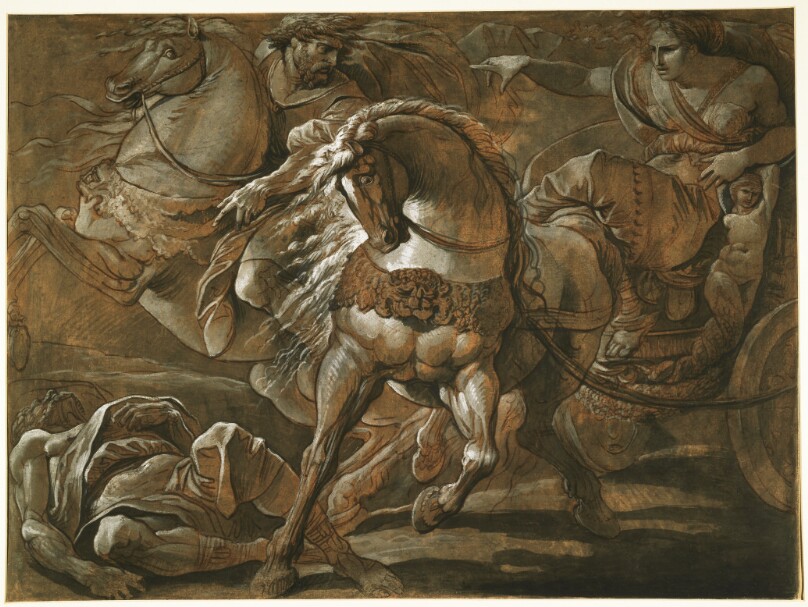
Tullia about to Ride over the Body of Her Father in Her Chariot
Creator
Giuseppe CadesItalian Artist · 1750–1799
All works by this person →Giuseppe Cades trained at Rome's Accademia di San Luca but left in 1766 when his master came to resent his excessive independence. When he received his first important commissions in the early 1770s, he employed a late Baroque classicist style inspired by Carlo Maratta. Around 1774, through his association with Johann Heinrich Fuseli's circle, he began adopting influences from Mannerist and Renais
More on Getty ULAN- Date
- about 1770–1775
- Medium
- Pen and brown ink, white and gray gouache, over black chalk, on a gray-prepared paper
- Culture
- Italian
- Department
- Drawings
- Institution
- Getty Museum
- Object ID
- 07a7fd00-bb64-4cd8-9cdd-3e5ea71aa20d
From the Getty Museum record
Tullia, daughter of the ancient Roman king Servius Tullius, orders her chariot to run over the body of her murdered father. After persuading her husband, Tarquin the Proud, to overthrow her father so that they might become king and queen, she ignored his advice to avoid the crowd surrounding her father's body in the streets of Rome. Though even her horses shy away from the deed she is about to perform, Tullia seems determined to finish the job of completely destroying her father. Focusing on the horror of the scene--taken from the Roman historian Livy--Giuseppe Cades crammed the composition full of figures and movement. The horses rear, manes streaming out, and Tullia and her groom gesture at the body of Servius, their capes billowing in the wind. The use of white heightening, which illuminates the flowing mane and muscular body of the central horse and the murdered king's body, amplifies the dramatic effect of the darkened scene. Scholars believe that Cades made the drawing to be sold as an independent work of art rather than in preparation for a painting. Other artists made such highly finished drawings for the art market in the 1700s in Italy.
The authoritative record is held by Getty Museum. LinkedCulture surfaces this object and its connections; it does not alter institutional metadata.
Get printable QR codesHide QR codes
Open QR codes for this object page and the museum record. They stay collapsed until needed.
Related across collections
Semantically similar works from Getty Museum and other institutions.