Getty Museum
Book of Hours
Creator
Gerard HorenboutFlemish Illuminator · 1465–1541
All works by this person →Gerard Horenbout, also known as Master of James IV of Scotland, worked for a wealthy, international clientele. Horenbout's early career was spent in Flanders, where he was admitted to the guild of artists and illuminators of Ghent in 1487. In his workshop he employed several apprentices and at least three of his children. In the first years of the 1500s, James IV commissioned him to produce a book
More on Getty ULAN- Date
- about 1500
- Medium
- Tempera colors and gold paint
- Culture
- Flemish
- Department
- Manuscripts
- Institution
- Getty Museum
- Object ID
- 08ea2ede-0ed7-4603-8863-0024565c42f4
From the Getty Museum record
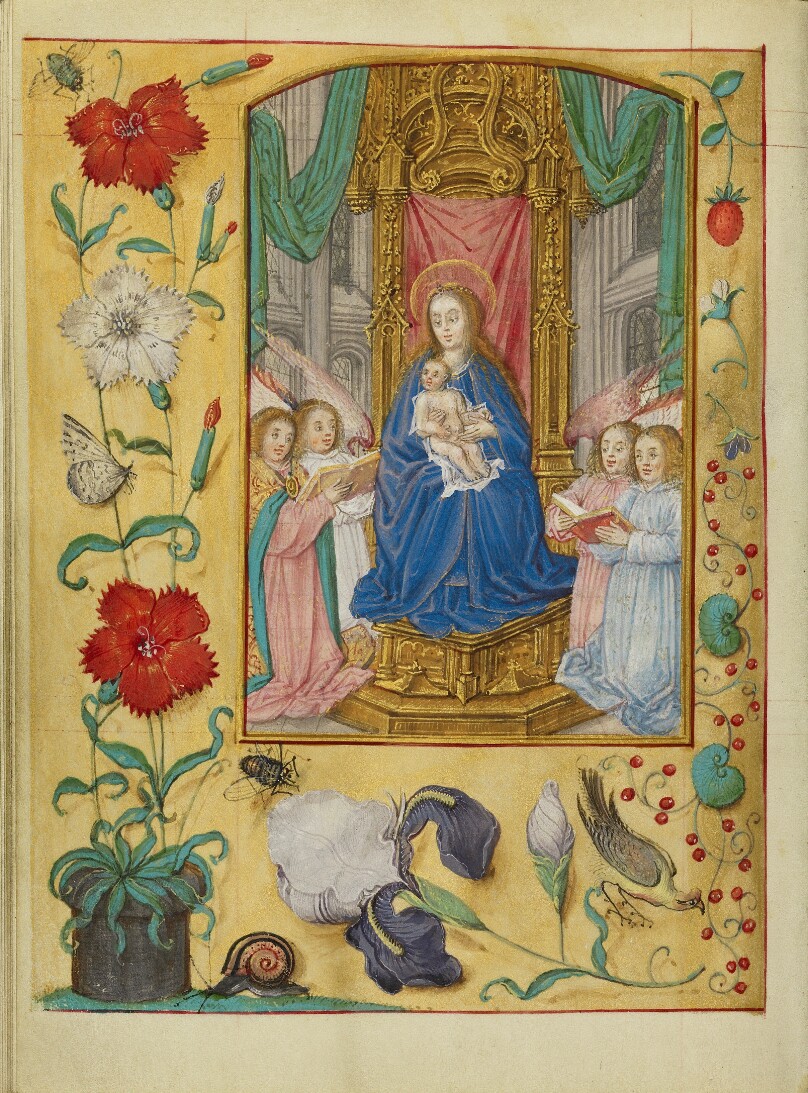
A book of hours, the most popular type of medieval devotional manuscript, provided Christians with prayers, psalms, and hymns arranged for recitation at specific times of each day. This richly illuminated book of hours contains traditional features such as the Office of the Virgin and Office of the Cross as well as distinctive elements, including a mass for the Virgin Mary, a mass for All Souls, and collections of prayers to the Virgin, Christ, and for the faithful reception of Holy Communion (a Christian ceremony in which believers receive bread and wine that are ritually transformed into Jesus’s body and blood, commemorating his sacrifice). One significant feature of this book of hours is that the texts and illuminations point to two different places of origin. The texts, primarily written in Dutch with features of the Cologne dialect, along with the presence of many Cologne saints in the Calendar and Litany (a list of petitions and prayers to various saints) point to Cologne as the production place. The coat of arms painted on fols. 86v and 87 also reveals that the patron may have been from the prominent von Aussem family in Cologne. The manuscript shows portraits of this patron—a lay woman likely with her daughter kneeling reverently at the foot of Jesus’s Crucifixion—on fol. 86v and the same woman, clothed likewise in red dress with black collar, kneeling to receive Holy Communion on fol. 113v. Reading prayers in a dialect familiar to her and seeing herself depicted in these scenes may have helped her envision Christ’s suffering more vividly and were intended to strengthen her faith in Christ’s sacramental grace. The illuminations, by contrast, are in a style associated with Flemish manuscripts of the period and are attributed to the workshop of Gerard Horenbout (c. 1465-1541), also known as Master of James IV of Scotland, who was active in Ghent. His most famous works include Getty’s own [Spinola Hours][1]. The illuminations, primarily portraying scenes from the lives of Christ and the Virgin, are enclosed in golden frames that often transform into delicate leaves and tendrils. The images are complemented by lavish depictions of plants, flowers, insects, and animals in the borders. Although no definitive record survives, it is possible that the illuminator traveled to Cologne, or that the text was first completed there and subsequently sent to Flanders for illumination, as Flemish work was highly sought-after across Europe at this time. The patron may have deliberately chosen such an arrangement in order to combine local textual traditions with the prestige of Flemish illumination. [1]: https://www.getty.edu/art/collection/object/103RVJ
The authoritative record is held by Getty Museum. LinkedCulture surfaces this object and its connections; it does not alter institutional metadata.
Get printable QR codesHide QR codes
Open QR codes for this object page and the museum record. They stay collapsed until needed.
Related across collections
Semantically similar works from Getty Museum and other institutions.