Getty Museum
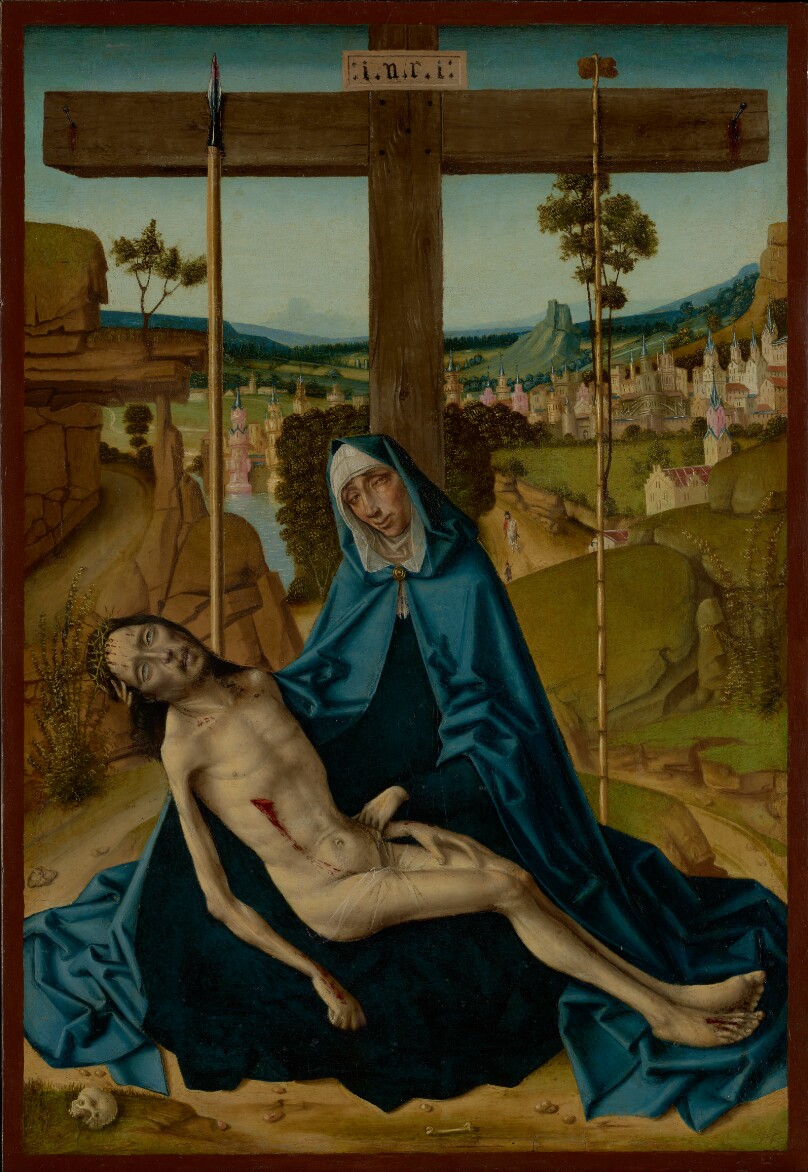
Pietà
Creator
Fernando GallegoSpanish Artist · 1440–1507
All works by this person →Fernando Gallego painted altarpieces and other religious works in Spain in the late fifteenth century. He combined the artistic traditions of his native Spain with the influence of Netherlandish painters such as Rogier van der Weyden and Dieric Bouts to produce a Hispano-Flemish style. Gallego's ability to paint dramatically intense human emotions was greatly admired in his lifetime. One of his fi
More on Getty ULAN- Date
- about 1490–1500
- Medium
- Oil on panel
- Culture
- Spanish (Castile)
- Department
- Paintings
- Institution
- Getty Museum
- Object ID
- 09225e16-0caa-4843-9165-2fbd1f7803fd
From the Getty Museum record
In this depiction of the lamentation of Christ, Fernando Gallego looked to Northern European paintings for inspiration but included distinctly Spanish elements such as a subdued palette and unidealized figures. Unlike Netherlandish artists who were interested in depicting the natural world in minute detail, Gallego concentrated on the pietà's psychological and emotional impact, eliminating extraneous or distracting elements. The Virgin Mary sits in front of the cross, gazing at her dead son in her lap. On the ground around them are several pebbles, a bone, and a skull. A lance and a rod with attached sponge, two instruments from the Passion, lean perfectly vertically against the cross, which is inscribed with the initials *i.n.r.i.* Behind the cross a rocky landscape overlooks a Gothic walled town, settled between a body of water and verdant countryside that stretches into the far distance. Gallego focused on the moment after the Crucifixion when overwhelming anguish gave way to resigned misery, the sentiment evident in the grief-stricken face of the Virgin, flushed and swollen from weeping. Christ's broken and emaciated body, his eyes unseeing, stretches awkwardly across her lap. Their exaggerated and unidealized features intensify the pathos central to the theme of the pietà.
The authoritative record is held by Getty Museum. LinkedCulture surfaces this object and its connections; it does not alter institutional metadata.
Get printable QR codesHide QR codes
Open QR codes for this object page and the museum record. They stay collapsed until needed.
Related across collections
Semantically similar works from Getty Museum and other institutions.