Getty Museum
Saint Anthony Abbot
Creator
Taddeo CrivelliItalian Illuminator · 1479–1479
All works by this person →Taddeo Crivelli was one of the illuminators who introduced the Renaissance style into manuscript painting in Ferrara. His first known miniatures date to the early 1450s. In the period roughly coinciding with the rule of Borso d'Este over Ferrara, Crivelli and his workshop were engaged in a number of projects, producing a variety of books for aristocratic patrons as well as for religious institutio
More on Getty ULAN- Date
- about 1469
- Medium
- Tempera colors, gold paint, gold leaf, and ink
- Culture
- Italian
- Department
- Manuscripts
- Institution
- Getty Museum
- Object ID
- 0aa5435c-cc77-4e30-addc-1f9f1adc76f0
From the Getty Museum record
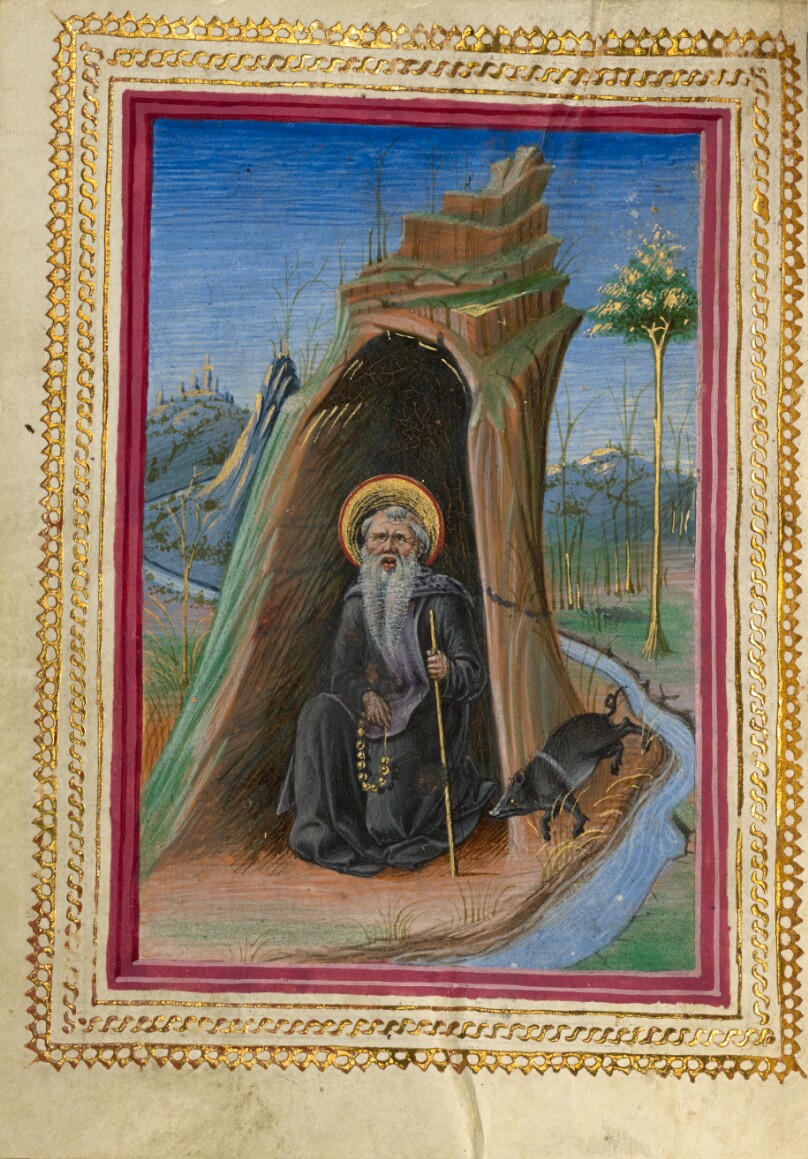
In the last miniature in the section of Suffrages, Taddeo Crivelli painted Saint Anthony Abbot, who withdrew to the Egyptian desert in the 300s. Dressed in the black robe of the Hospitallers' order, he appears with a small pig. The Hospitallers, founded in 1100 to aid the sick, took Saint Anthony as their patron saint. Given a papal dispensation that allowed their pigs to roam freely in medieval towns, the order took on the animal as its emblem. Alone in his cave, the saint holds his prayer beads. This, along with his ecstatic facial expression, suggests that he is in the midst of fervent prayer. As in the other miniatures of the saints in this book of hours, Saint Anthony serves as a devotional model for the manuscript's readers, who are stimulated toward pious meditation as they read the prayer to him on the facing page. Crivelli set Anthony's peaked cave in a fantastic landscape that bears little resemblance to northern Africa, but the leafless trees and the barren ground do suggest a bleak wilderness. A winding stream connects foreground and background, and vivid pinks and oranges heighten the mystical spirituality of the scene.
The authoritative record is held by Getty Museum. LinkedCulture surfaces this object and its connections; it does not alter institutional metadata.
Get printable QR codesHide QR codes
Open QR codes for this object page and the museum record. They stay collapsed until needed.
Related across collections
Semantically similar works from Getty Museum and other institutions.