Curtain of Trees

Getty Museum

Curtain of Trees

Creator

Gustave Le Gray

French Photographer · 1820–1884

All works by this person →
AuthorPrinterArtist

Though he was trained as a painter, Gustave Le Gray made his mark in the emerging medium of photography. An experimenter and technical innovator, Le Gray pioneered the use of the paper negative in France and developed a waxed-paper negative that produced sharper-focus prints. In 1851 he began to use collodion on glass negatives, which further increased the clarity of his images. He became one of t

More on Getty ULAN

Object Description · Getty Museum

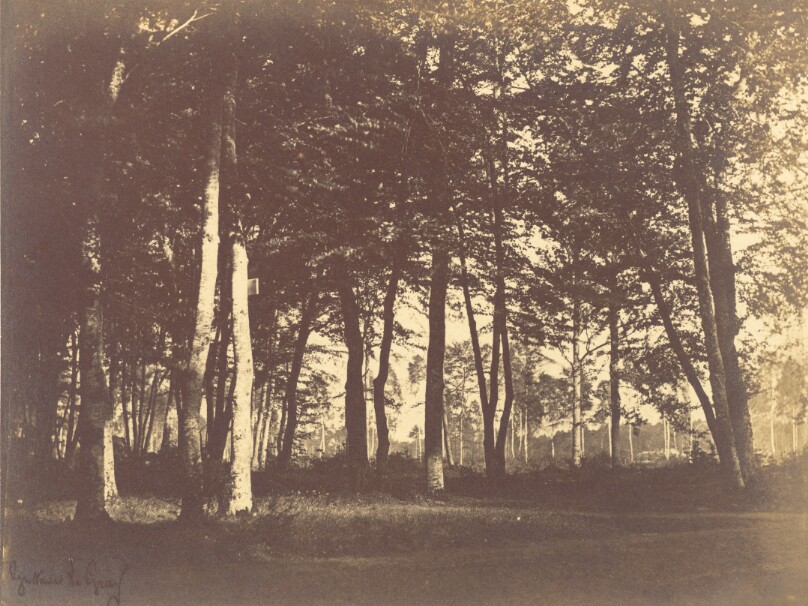
> From the late 1840s through the early 1850s Gustave Le Gray continued to expand his teaching activities, his experimentation, and his publication of new treatises on photographic processes. He also took frequent trips to the forest of Fontainebleau to create artistic views of the area. He probably made some of these expeditions in the company of other photographers such as Charles Nègre, Henri Le Secq, and his student John B. Greene. Fontainebleau and nearby Barbizon were already well-explored sites for Barbizon School painters along with Le Gray's comrades Pierre-Antoine Labouchére and Jean-Léon Gérôme from the studio of Paul Delaroche. Photo historian Sylvie Aubenas argues that Le Gray's choice of artistic subject speaks to his desire to set himself apart from commercial photographers and align himself with fine artists. > > When Le Gray made *Curtain of Trees* around 1849, the chemistry of the photographic negative was not sensitive to the color green, so the foliage appears darker in the photograph than it would have in real life. On the other hand, the light sensitive chemicals were oversensitive to blue. Le Gray cleverly chose a time of day when the sun was lower in the sky (so there was less blue in the light) and when he could take advantage of the raking angle of the sun's rays that dramatically highlighted some of the trunks. > > If one takes a close look at the brilliantly illuminated white trees on the left of the image, high upon the right side of the tree trunk is a marker for tourists, who would have been following a carefully prescribed path from a guidebook, by authors such as C. F. Denencourt, through the Forest of Fontainebleau. In the mid-nineteenth century, the forest was an extremely popular destination for artists as well as other Parisians wanting to take respite from the city. This view may, in fact, show a site quite near another Le Gray's photograph, *The Road to Chailly, Fontainebleau* ([84.XM.347.3](http://www.getty.edu/art/collection/objects/61910)); the clearing here in the distance suggests that Le Gray was not far from such a road. Adapted from getty.edu, Interpretive Content Department, 2008; Weston Naef, *The J. Paul Getty Museum Handbook of the Photographs Collection* (Los Angeles: J. Paul Getty Museum, 1995), 50, © 1995 The J. Paul Getty Museum; and Sylvie Aubanas, *Gustave Le Gray, 1820-1884* (Los Angeles: The J. Paul Getty Museum, 2002), © 2002 J. Paul Getty Trust. For more information about the author and this piece, see: Aubanas, Sylvie. *Gustave Le Gray, 1820-1884.* Los Angeles: The J. Paul Getty Museum, 2002. Parry Janis, Eugenia. *The Photography of Gustave Le Gray*. Chicago: The Art Institute of Chicago and The University of Chicago, 1987.

Getty Museum’s catalogue record

produced_by.carried_out_by[0].id
https://data.getty.edu/museum/collection/person/862e2883-221f-496f-8335-aa2809997d85
Artist/Maker
Gustave Le Gray
subject_of[Homepage].id
https://www.getty.edu/art/collection/object/104HVK
Date
about 1849
Medium
Salted paper print from a paper negative
Culture
French
Object Type
Print

Taken from LinkedCulture’s stored copy of Getty Museum’s record. A fresh capture of the museum’s own record has not been made for this object yet.

What the image shows

A dense forest with tall trees and dappled sunlight filtering through the canopy.

Generated by LinkedCulture from the photograph alone, without the museum’s catalogue text (Qwen/Qwen2.5-VL-7B-Instruct), and not yet reviewed by a person. It describes the picture, not the object’s history, and it is not part of the museum’s record.

The authoritative record is held by Getty Museum. LinkedCulture surfaces this object and its connections; it does not alter institutional metadata. The fields above are the museum’s, under its own labels. LinkedCulture’s derived fields are listed separately below and marked as ours.

Get printable QR codes

Open QR codes for this object page and the museum record. They stay collapsed until needed.

Open this page QR destination: https://linkedculture.org/q/q1.4Oo6TRSZYOG-I87W.28zzCFYvOcCecq7upkzGeUGoAqi7gJf7hqGwrNFQodBrUPh6IbPm4_qEgrUAhL4OPtoh5dM5Q2dId2C8V3gy9KtVXjw8vSfbstRtp7BgBVxtC1XCPd_jpNHIg2Fl5heVdoX5jZfQAd-Bhwt-wApGylxCasO6rvDrYU4Uo8x76g-DHJubxiHCQhW1z9PuSA3od0MEbOluD86tRqcjBt6qE_ZjMBydOUM-33t_rNKaBLK9GYb9c3Z5Wuog2CSQhPGQDH50lWZoepmQ4lcAE08ASBGb8565EGNjqopLDtTEkDE3pBmwXpRKkFRS7caOjYo6CCVh2CQCSVVvL72ZhMz2cz2eIqKr3YoYj6EMRgGzdvRJboUwBcW0SREbOjahCQPf5Jh0aymkCUOPjts52Gf8See at Getty Museum QR destination: https://linkedculture.org/q/q1.w9it9rHHk5RfwFy7.Pl8N5gMZAMhP-j08WKZjCsIE2GnQ_4cpduO4JQDKV0v1yvtvEv5V4s3cQtqD2Y0aBKrJjbNNZru2o_oWF7AkU3x3wXPXh1uHn3b_U8QZRMzeuC97F4NdJHfWV5g-Otj47jR45qNgb6GRvjKvsenquvgm87OUssAhdhNw6RmmvyLcmkx5e_hTClXJz9nWKaJM3sp-C6D7BqNLVPU3ZD9YgzDvC8Pg1Cb2sJa61rpKeCEh6oDJfHcSBJTFpHsBhXSsJIVBY8sBNWw6SFlxBEYNecuTjmA02wZ3DUhYLdyN3OCIwSgj28NSESz4nVcyUJ94Bs3mJ4GXU3gzetxl0yaULrn8hsaSee0uU2xFp-LDExi2v95vlw7YwjZvlGk
Open this page
See at Getty Museum
How LinkedCulture maps this record

To search objects from different museums together, LinkedCulture reads each museum’s record into a common set of fields. The values below are LinkedCulture’s, under LinkedCulture’s names. They are not Getty Museum’s wording; the museum’s own record is shown above under its own labels.

Object ID
0ad5010c-bfa7-43bd-a67a-6439541d95d6
Object Type
Print
  • Getty Museum field “Object Type” · copied as is
Creator
Gustave Le Gray
  • Getty Museum field “Artist/Maker” · copied as is
Culture
French
  • Getty Museum field “Culture” · copied as is
Medium
Salted paper print from a paper negative
  • Getty Museum field “Medium” · copied as is
Department
Photographs
  • Getty Museum field “Department” · derived by LinkedCulture from the museum field · Getty's classification category is stored as department.
Credit Line
The J. Paul Getty Museum, Los Angeles
  • Getty Museum field “Standard Credit Line” · the first available of several museum fields
  • Getty Museum field “Source Credit Line” · the first available of several museum fields
Date
about 1849
  • Getty Museum field “Date” · copied as is
Begin Year
1849
  • Getty Museum field “produced_by.timespan.begin_of_the_begin” · derived by LinkedCulture from the museum field
End Year
1849
  • Getty Museum field “produced_by.timespan.end_of_the_end” · derived by LinkedCulture from the museum field

The museum’s own record has not been captured for this object yet, so the museum fields shown above are limited to values LinkedCulture stored unchanged.

Related across collections

Semantically similar works from Getty Museum and other institutions.