Getty Museum
Sphinx
Creator
Auguste RodinFrench Sculptor · 1840–1917
All works by this person →Few sculptors have been more mythologized in their own time than Auguste Rodin. His most iconic works, such as *The Thinker* , *The Kiss* , *and the Burghers of Calais* are well known through multiple versions and numerous reproductions. At the same time, Rodin was an extremely gifted and prolific draftsman. Some of his drawings relate to his sculpture, while others are independent of it. The draw
More on Getty ULAN- Date
- about 1898–1900
- Medium
- Graphite and brown wash
- Culture
- French
- Department
- Drawings
- Institution
- Getty Museum
- Object ID
- 0b3bc612-9576-4739-a78c-e37abf399238
What the image shows
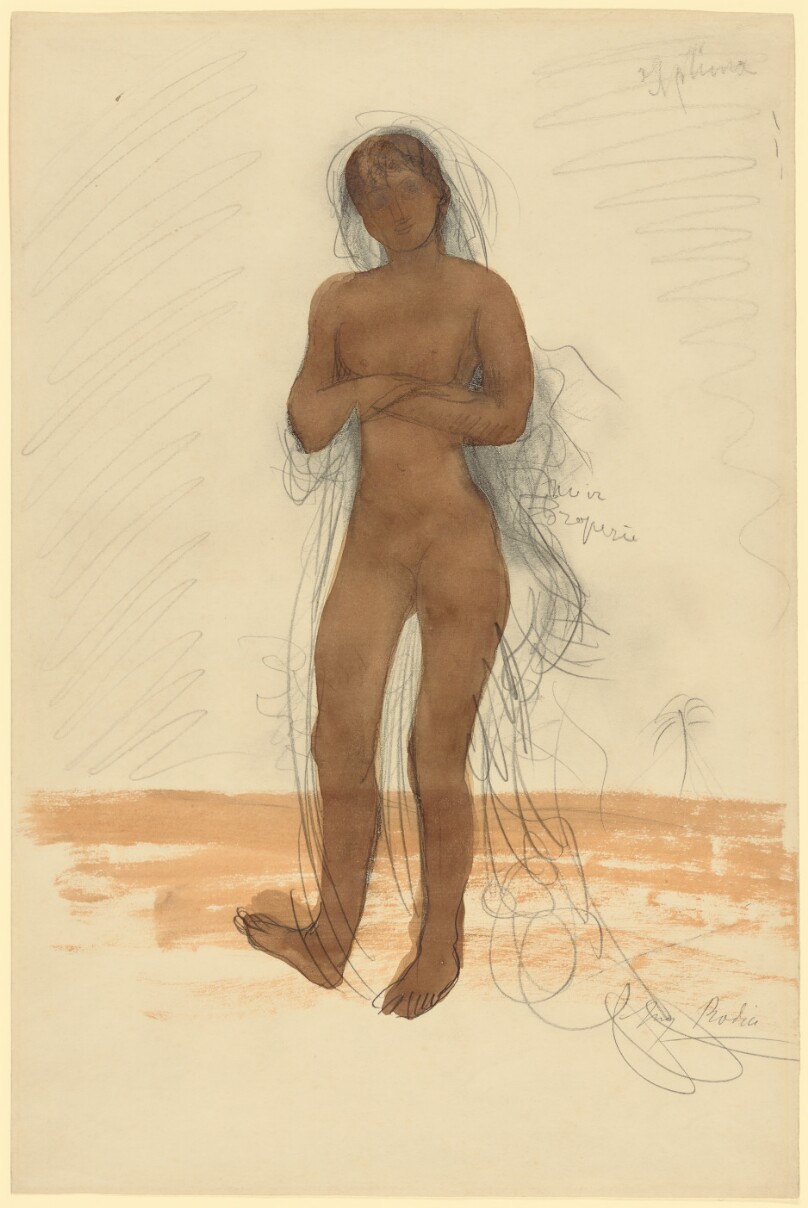
A nude figure stands with arms crossed, draped with a sheer fabric.
Generated by LinkedCulture from the photograph alone, without the museum’s catalogue text (Qwen/Qwen2.5-VL-7B-Instruct), and not yet reviewed by a person. It describes the picture, not the object’s history, and it is not part of the museum’s record.
From the Getty Museum record
In ancient mythology, the sphinx embodies an amalgam of human, lion, and hawk body parts. The subject of this watercolor by Auguste Rodin, titled Sphinx, doesn't literally represent such a beast. Instead, the artist drew a young woman, who is standing frontally, with her arms folded. Rodin's title implies on a metaphorical level that she--or "woman" more generally--is like the sphinx, an enigmatic creature. Rodin made this drawing late in his life, during a period of prodigious output. As is common in those drawings, sketchy pentimento lines appear to suggest a figure in motion. Here, though, the scribbly pencil marks may indicate that the model was partially clothed, because of the artist's inscription, "noir draperie" (black drapery). Rodin usually sketched his models without taking his eyes off the figure or looking down at the sheet of paper. In this case, the artist first incised the figure's silhouette--notably the hips and elbows--before using the pencil or the brush. Although the figure appears hastily sketched, the drawing as a whole reflects Rodin's considerable abilities as a draftsman. Details, such as the model's perfectly turned right ankle and knee, belie his considerable skills of observation. Carefully applied watercolor washes reveal Rodin's mastery of technique.
The authoritative record is held by Getty Museum. LinkedCulture surfaces this object and its connections; it does not alter institutional metadata.
Get printable QR codesHide QR codes
Open QR codes for this object page and the museum record. They stay collapsed until needed.
Related across collections
Semantically similar works from Getty Museum and other institutions.