Getty Museum
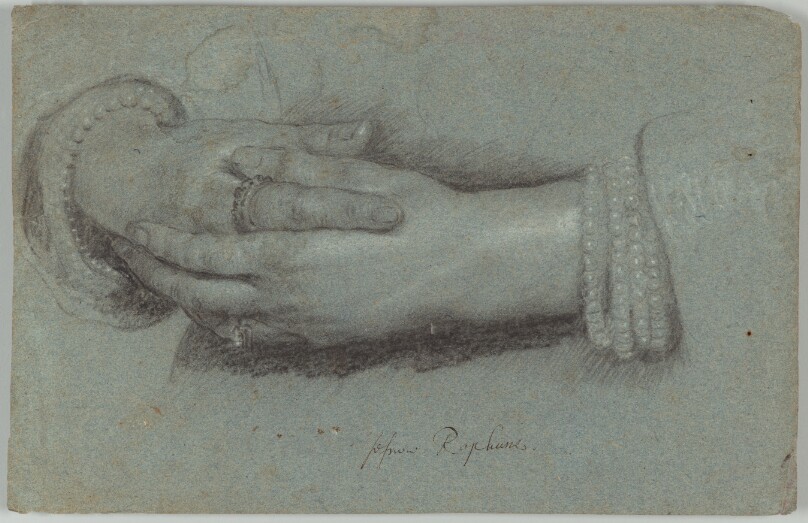
Study of a Woman's Hands
Creator
Cornelis Jansen van Ceulen (Cornelius Jonson)British Artist · 1593–1661
All works by this person →Born of Dutch parents who fled to London to escape religious persecution, Cornelis Jansen van Ceulen probably trained in the northern Netherlands. Around 1618 he established himself as a portrait painter in London. His signed or monogrammed portraits number several hundred; he is the first English-born painter known to have made so many. Anthony van Dyck's dazzling manner influenced him, but Janse
More on Getty ULAN- Date
- 1646
- Medium
- Black chalk heightened with white chalk, on blue paper
- Culture
- Dutch
- Department
- Drawings
- Institution
- Getty Museum
- Object ID
- 0b7d0ce7-11b7-4272-8cd6-a3ffcab22435
From the Getty Museum record
Using broadly applied black chalk, Cornelis Janssens van Ceulen suggested deep shadows at the waist, where this young woman folds her soft hands. Subtle highlights pick up the gleam of the pearl strands looped around her wrists and the shimmering highlights on her skin and sleeves. With few strokes, only two colors, and much use of blank paper, Janssens effectively rendered both texture and volume. Janssens probably learned the technique of drawing hand studies in chalks on blue paper from Anthony van Dyck while both artists were in London. The pinholes along the drawing's outer edge suggest that he attached the sheet of paper to a board or easel as he drew the sitter's hands from life. He made this study in preparation for a half-length portrait painting. Scholars know little about the subject, referred to as "Jefrow Raphune" in the inscription at the bottom of the drawing. She must have been a married woman from the northern Netherlands; it was the custom in that area to wear one's wedding ring on the right index finger, as she does. The two elaborate rings and expensive pearls suggest that she was a relatively wealthy member of the landed gentry.
The authoritative record is held by Getty Museum. LinkedCulture surfaces this object and its connections; it does not alter institutional metadata.
Get printable QR codesHide QR codes
Open QR codes for this object page and the museum record. They stay collapsed until needed.
Related across collections
Semantically similar works from Getty Museum and other institutions.