Getty Museum
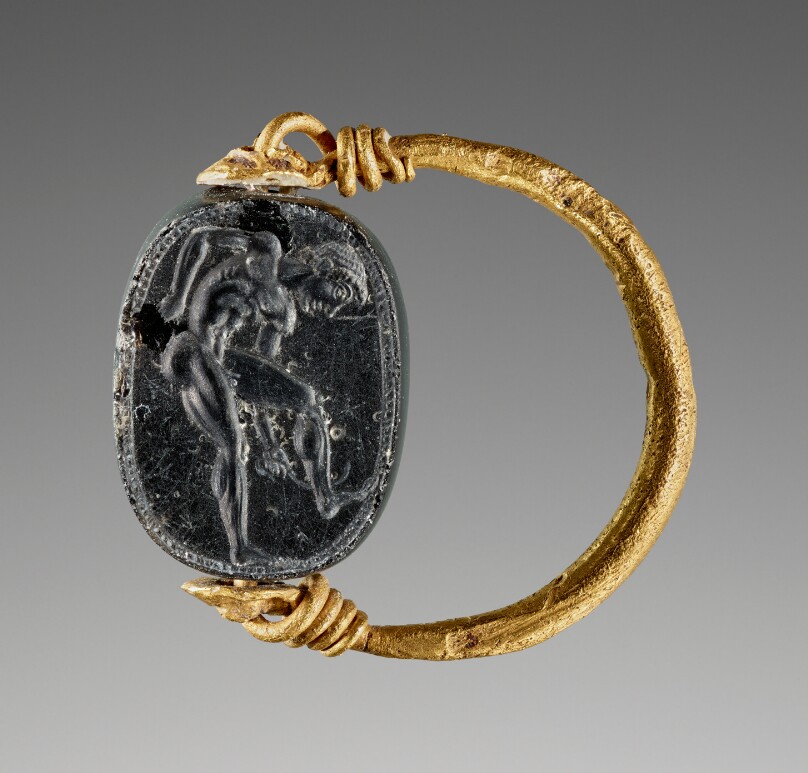
Engraved Scaraboid with Athlete
Creator
EpimenesGreek Artist
All works by this person →While the signature "Epimenes made (it)" survives today on only one engraved gem, four other gems can be attributed to him on stylistic grounds. Epimenes worked in the period around 500 B.C. in the Cyclades, carving both scarabs and scaraboids. His work is distinctive: his gems are decorated with nude youths with the musculature clearly defined and naturalistically rendered. Epimenes was also note
More on Getty ULAN- Date
- about 500 B.C.
- Medium
- Obsidian set in a modern gold ring
- Culture
- Greek
- Department
- Jewelry
- Institution
- Getty Museum
- Object ID
- 0e823682-5995-4c28-a8e4-4a50e92ca6de
From the Getty Museum record
Standing in left profile with one leg raised, a nude athlete bends forward to scrape his shin with a curved blade called a strigil. His upper body is shown in three-quarter view, and his hair is detailed with a row of pellets representing curls. After training, Greek athletes coated themselves in oil and used a strigil to scrape off the sweat and dirt. Depictions of athletes were popular on gems of the late 500s B.C., reflecting the interests of the men who owned them. The pose of this figure, shown standing but leaning forward while engaged in some activity, was also a favorite for gems in this period, in part because it fills the oval space well. The difficult three-quarter view of the youth, the rendering of the musculature, and details such as the duck's head decorating the end of the strigil, however, display this artist's unique skills. Another four gems have been attributed to the same engraver, Epimenes (including [81.AN.76.22](http://www.getty.edu/art/collection/objects/9499/attributed-to-epimenes-engraved-scarab-greek-about-500-bc/)), all of which show nude youths engaged in similar activities with the same careful depiction of the body. Only one of these gems is signed: the letter forms of the signature suggest that the artist was from one of the Cycladic Islands, where there was a long tradition of gem engraving. A scaraboid is a simplified scarab, with a plain curved back and an intaglio design decorating the flat underside. The form gradually replaced the scarab in Greece in the 400s B.C. Like scarabs, they were typically pierced and worn either as a ring or pendant. When attached to a metal hoop and worn as a ring, the curved side faced out and the intaglio surface rested against the finger. When needed as a seal, the ring was removed, the gem swiveled, and the intaglio design was pressed into soft clay or wax to identify and secure property. The ring in which this scaraboid is set is modern.
The authoritative record is held by Getty Museum. LinkedCulture surfaces this object and its connections; it does not alter institutional metadata.
Get printable QR codesHide QR codes
Open QR codes for this object page and the museum record. They stay collapsed until needed.
Related across collections
Semantically similar works from Getty Museum and other institutions.