Getty Museum
Gospel Book
- Date
- about 826–838
- Medium
- Tempera colors
- Culture
- Carolingian
- Department
- Manuscripts
- Institution
- Getty Museum
- Object ID
- 0f07419a-ba29-4621-8a07-5e0a782481d6
From the Getty Museum record
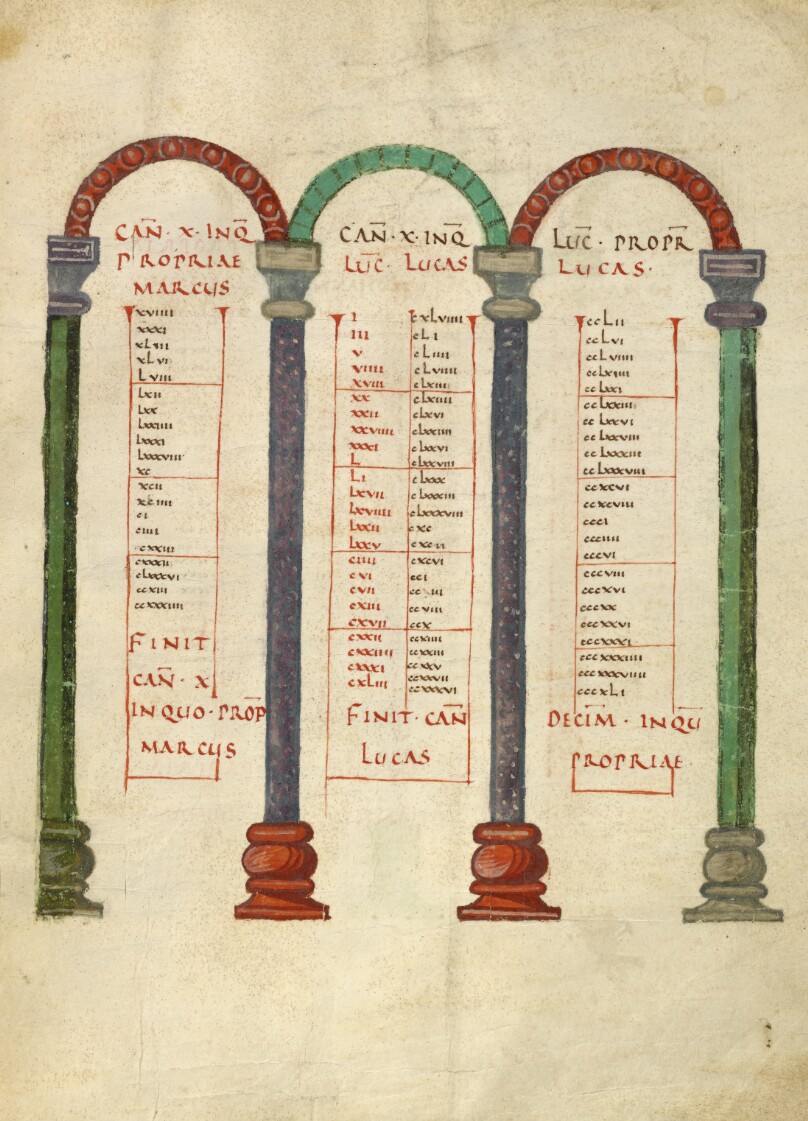
This Christian manuscript, a copy of the four Gospels, features a restrained but aesthetically pleasing decorative program, including architectural elements, small crosses, and gold and red letters executed in a neat hand. A set of multicolored arcades, evocative of the ancient marble columns frequently re-used in church architecture during this period, spans twelve pages. These pages feature the Eusebian canon tables, a system for showing correspondences between the four Gospel texts that was developed by the bishop of Caesarea, Eusebius (d. c. 340). This manuscript was copied by a monk named Valhram, who included his name in a cipher on folio 3v. There, each golden cross-shaped monogram abbreviates a word, and together they form a sentence that translates as follows: "Bishop Folcwich ordered Valhram to write." Folcwich was a bishop in Worms, a town near Lorsch where this manuscript was made, from 826 to 838. Although this manuscript is over 1,200 years old, it is in almost pristine condition, save for several leaves showing some discoloration, probably evidence of water damage. Parchment, which is made from highly processed animal skin, is susceptible to changes in humidity, but otherwise is a very sturdy writing support.
The authoritative record is held by Getty Museum. LinkedCulture surfaces this object and its connections; it does not alter institutional metadata.
Get printable QR codesHide QR codes
Open QR codes for this object page and the museum record. They stay collapsed until needed.
Related across collections
Semantically similar works from Getty Museum and other institutions.