Getty Museum
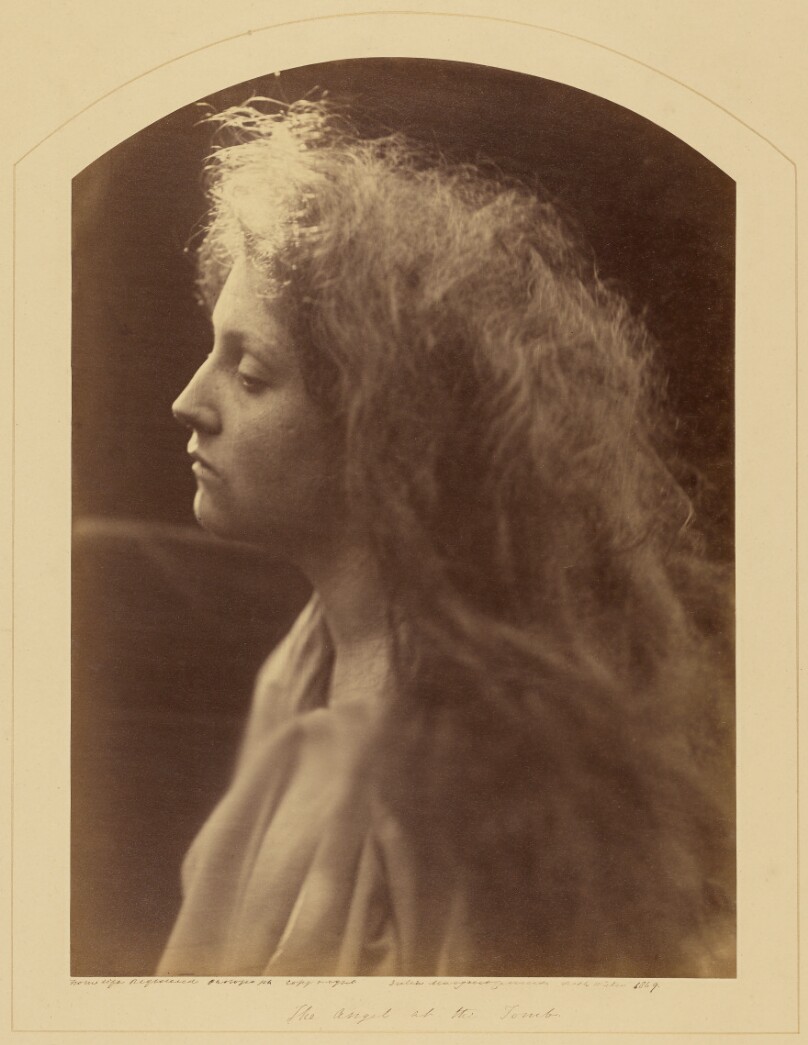
The Angel at the Tomb
Creator
Julia Margaret CameronBritish Photographer · 1815–1879
All works by this person →After receiving a camera as a gift, Julia Margaret Cameron began her career in photography at the age of forty-eight. She produced the majority of her work from her home at Freshwater on the Isle of Wight. By the coercive force of her eccentric personality, she enlisted everyone around her as models, from family members to domestic servants and local residents. The wife of a retired jurist, Camero
More on Getty ULAN- Date
- 1869
- Medium
- Albumen silver print
- Culture
- British
- Department
- Photographs
- Institution
- Getty Museum
- Object ID
- 0f20d858-32ef-48e0-be8d-bd9185881bfb
From the Getty Museum record
> This serene study illustrates a key scene in the story of Christ’s resurrection: “For the angel of the Lord descended from heaven, and came and rolled back the stone from the door, and sat upon it. His countenance was like lightning, and his raiment white as snow” (Matthew 28:2-3). Julia Margaret Cameron chose to employ a female in the traditionally male role of guardian of the Holy Sepulchre. She used her most familiar and trustworthy model, Mary Hillier (1847-1936) (see [84.XZ.186.31](https://www.getty.edu/art/collection/objects/58609/julia-margaret-cameron-faith-british-1864/), [84.XZ.186.76](https://www.getty.edu/art/collection/objects/58654/julia-margaret-cameron-mary-madonna-british-1864/), [84.XZ.186.40](https://www.getty.edu/art/collection/objects/58618/julia-margaret-cameron-the-five-wise-virgins-british-1864/), [84.XZ.186.41](https://www.getty.edu/art/collection/objects/58619/julia-margaret-cameron-the-five-foolish-virgins-british-1864/), [84.XM.443.65](https://www.getty.edu/art/collection/objects/58885/julia-margaret-cameron-the-communion-british-1870/)), whose handsome profile and abundant tresses seem in keeping with the drama of Saint Matthew’s gospel. A remarkable, otherworldly light floods in from above, causing a halo effect. A print in the collection of the George Eastman Museum bears an inscription in Cameron’s hand: “God’s glory smote her on the face/a coruscation of spiritual unearthly light is playing over the head in mystic lightning flash of glory.” > > As Mike Weaver explains in his book *Whisper of the Muse,* the figure at the tomb also represents the type of Mary Magdalene, whose principal attribute is her hair, with which she concealed her nakedness as a fallen woman and in her humility used to dry the feet of Christ. The picture therefore combines the pure and impure, the sacred and profane. Cameron’s use of Hillier—“Mary Madonna”—as Mary Magdalene reinforces this dichotomous theme ([84.XZ.186.76](https://www.getty.edu/art/collection/objects/58654/julia-margaret-cameron-mary-madonna-british-1864/)). > > A review of Cameron’s photographs in the *Intellectual Observer* of February 1867 drew attention to her skillful rendering of hair: “Beautiful hair, left free, is one of the most poetic of nature’s productions, and very subtle and sympathetic are the combinations of light and shade which it exhibits, and which defy the efforts of ordinary artists to reproduce.” > > The Getty has two prints of this image ([84.XM.443.69](https://www.getty.edu/art/collection/objects/58889/julia-margaret-cameron-hypatia-british-1867/)). > > Julian Cox. *Julia Margaret Cameron*, In Focus: From the J. Paul Getty Museum (Los Angeles: J. Paul Getty Museum, 1996), 78. ©1996 The J. Paul Getty Museum.
The authoritative record is held by Getty Museum. LinkedCulture surfaces this object and its connections; it does not alter institutional metadata.
Get printable QR codesHide QR codes
Open QR codes for this object page and the museum record. They stay collapsed until needed.
Related across collections
Semantically similar works from Getty Museum and other institutions.