Getty Museum
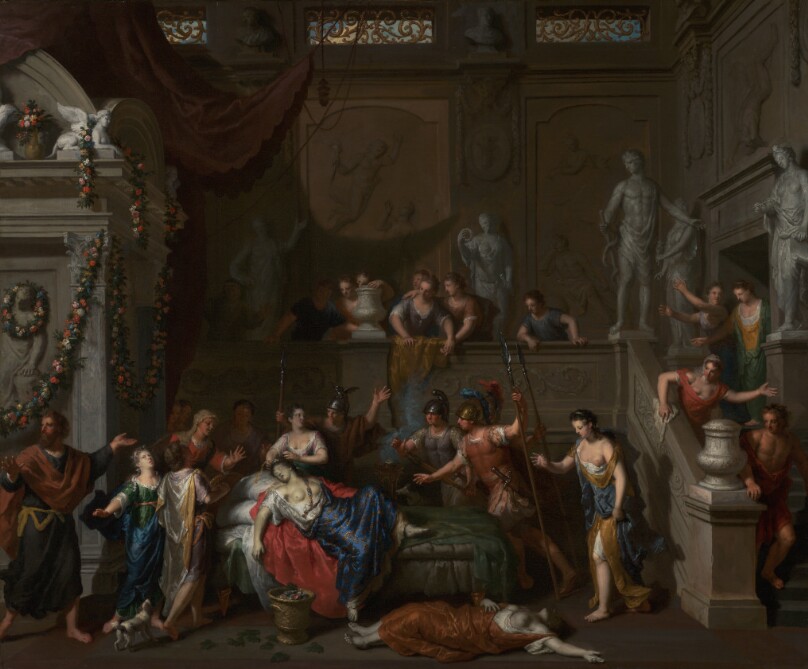
The Death of Cleopatra
Creator
Gerard HoetDutch Artist · 1648–1733
All works by this person →Gerard Hoet trained with his father and with a pupil of Cornelis van Poelenburgh. Van Poelenburgh was an Italianate landscape painter who was one of the first Dutch painters to incorporate into his paintings the romantic ruins and fragments of antique statuary he had seen in Italy. In 1672 Hoet moved to The Hague, then spent a year in Paris, returning to the Netherlands via Brussels. Settling in U
More on Getty ULAN- Date
- about 1700–1710
- Medium
- Oil on canvas
- Culture
- Dutch
- Department
- Paintings
- Institution
- Getty Museum
- Object ID
- 10dbf610-f206-4513-a83d-3c19d713f761
From the Getty Museum record
Cleopatra, Queen of Egypt, partially clad in an opulent blue and gold embroidered gown, sprawls across a sumptuous bed at the center of a splendid palace decorated with reliefs and marble statues. She has expired from the poisonous bite of an asp hidden in a basket of figs, thus thwarting Caesar's plans for her. Her attendant Iras lies dead in the foreground. Another maid, Charmion, makes final adjustments to Cleopatra’s diadem. Hoet closely followed Plutarch's account in "Antony'" (*The Lives of Noble Grecians and Romans*, 44:83) and portrayed the dramatic verbal exchange between Charmion and Caesar's messengers immediately following Cleopatra's death. In response to their angry demand "Was this well done of your lady Charmion?," she turned and replied "extremely well, and as became the descendant of so many kings," thereby characterizing her mistress' suicide as noble self-sacrifice. The soldiers sent by Caesar to confirm Cleopatra's death surround the bed, while palace officials, serving women and others rush into the chamber, their stricken faces and animated gestures conveying their agitation. The enormous tomb of Cleopatra's lover, the Roman soldier and politician Mark Anthony, occupies the left side of the composition. A leading Dutch painter of history subjects around 1700, Hoet often painted pairs of related scenes. The *Death of Cleopatra* is the pendant to the Museum's [*The Banquet of Cleopatra*](http://www.getty.edu/art/collection/objects/536/gerard-hoet-the-banquet-of-cleopatra-dutch-late-17th-early-18th-century/), and the subjects present complimentary scenes of festive and tragic spectacle. A number of features link the two paintings: Cleopatra wears the same magnificent brocade gown, jeweled girdle and crown, and both scenes are set in similar interiors decorated with relief panels and a red and gray marble floor. Hoet's delicate brushwork and jewel-like palette combined with an array of eloquent gestures and expressions from the artist’s illustrated treatise on painting, enliven the scene.
The authoritative record is held by Getty Museum. LinkedCulture surfaces this object and its connections; it does not alter institutional metadata.
Get printable QR codesHide QR codes
Open QR codes for this object page and the museum record. They stay collapsed until needed.
Related across collections
Semantically similar works from Getty Museum and other institutions.