Getty Museum
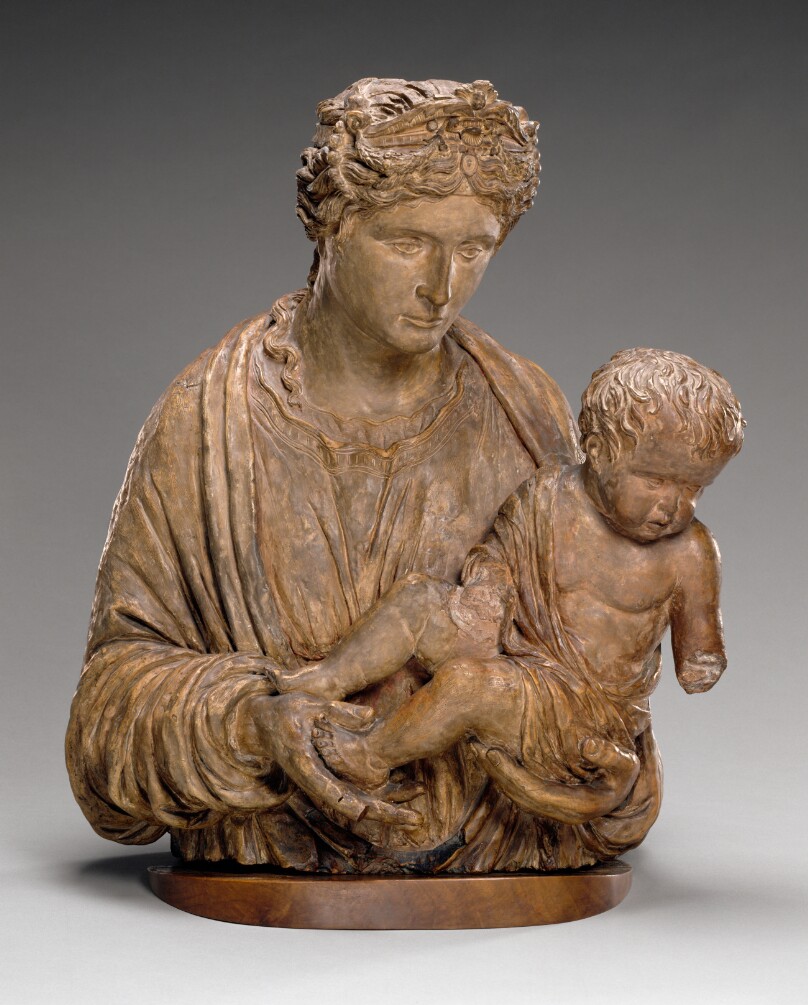
Virgin and Child
Creator
Riccio (Andrea Briosco)Italian Artist · 1470–1532
All works by this person →Andrea Briosco, also known by his nickname Riccio (curly head), first trained as a goldsmith with his father, Ambrogio di Cristoforo Briosco. Riccio later shifted his emphasis to bronze sculpting, studying with a student of Donatello. Riccio commonly embellished everyday objects, such as candlesticks, bells, inkwells, and incense burners, with mythological creatures, and also made sphinxes, griffi
More on Getty ULAN- Date
- about 1520–1525
- Medium
- Terracotta with traces of polychromy
- Culture
- Italian
- Department
- Sculpture
- Institution
- Getty Museum
- Object ID
- 120bddb5-5a31-44fb-9564-39bdccf88893
From the Getty Museum record
The Virgin, depicted both as a gentle, human mother and as an immortal, heavenly queen, cradles the Christ child in her arms. Andrea Briosco, called Riccio, made this sculpture while living in Padua, home to a thriving intellectual community and one of the most renowned universities in Europe. The study of ancient Greece and Rome was quite popular at the time, and Riccio combined a refined knowledge of antiquity with the Christian present, much to the delight of his contemporaries. The Virgin's dress and delicate features recall ancient Roman representations of deities. Shells, pearls, a winged putto, and a cameo decorate the crown atop her intricately arranged hair. Displaying the restless nature typical of small children, the infant Christ twists away from his mother to face the viewer. Though *Virgin and Child* was originally a full-length statue, only the upper half now survives. Because the figures' heads are angled downward, scholars believe that Riccio made the sculpture as the devotional centerpiece of a raised altar. Now largely stripped of color, *Virgin and Child* was once vibrantly painted. Originally, both figures had dark brown hair and pale skin. The Virgin wore a blue cloak over a red gown, while the Christ child wore a yellow garment. Scholars believe that traces of red on the Virgin's crown may be the remains of a preparatory ground for gold, suggesting that it was once gilded.
The authoritative record is held by Getty Museum. LinkedCulture surfaces this object and its connections; it does not alter institutional metadata.
Get printable QR codesHide QR codes
Open QR codes for this object page and the museum record. They stay collapsed until needed.
Related across collections
Semantically similar works from Getty Museum and other institutions.