Getty Museum
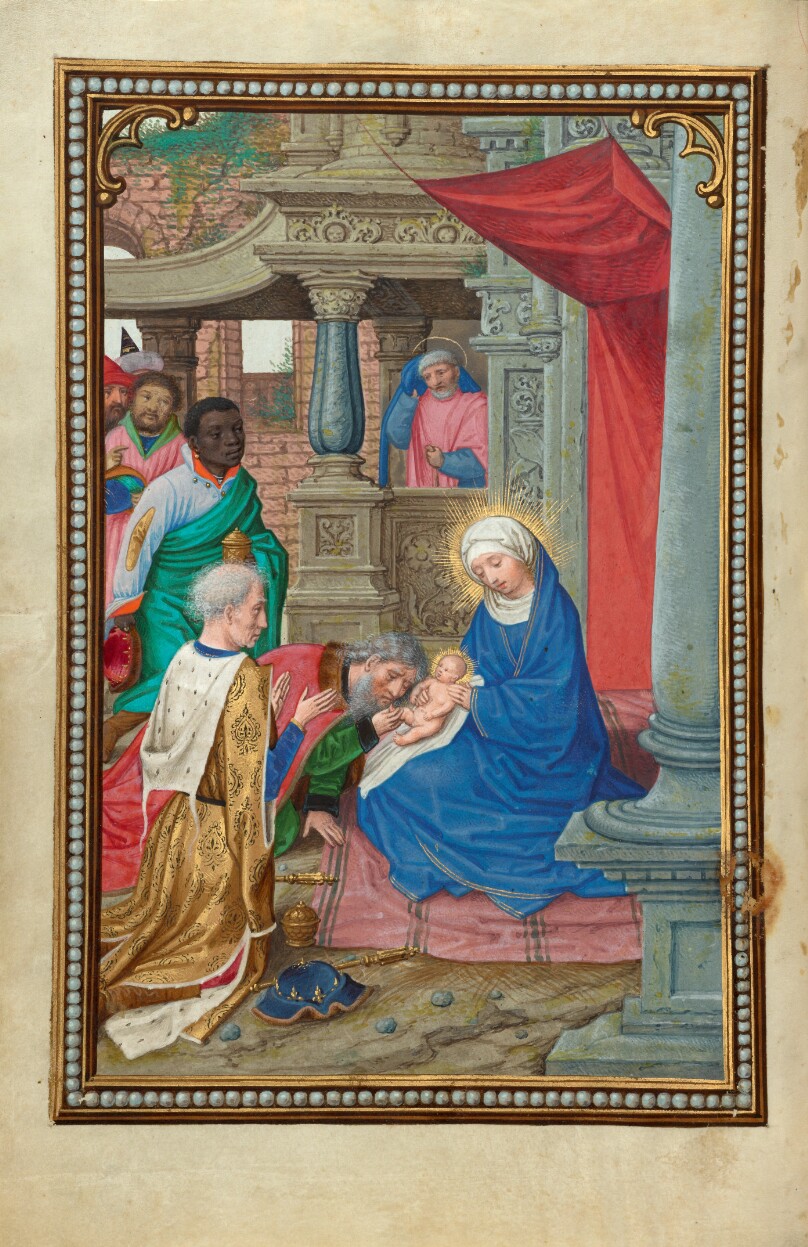
The Adoration of the Magi
Creator
Simon BeningFlemish Illuminator · 1483–1561
All works by this person →One of the most celebrated painters of Flanders in the 1500s, Simon Bening was hailed by Portuguese art critic Francisco da Hollanda as the greatest master of illumination in all of Europe. In addition to producing books for powerful aristocrats such as Cardinal Albrecht of Brandenburg, Bening worked for a group of international royal patrons including Emperor Charles V and Don Fernando, the Infan
More on Getty ULANObject Description · Getty Museum
Getty Museum’s catalogue record
- produced_by.carried_out_by[0].id
- https://data.getty.edu/museum/collection/person/0cd6b215-35d1-4a2e-bfe7-aa5e8e4ec2bc
- Artist/Maker
- Simon Bening
- subject_of[Homepage].id
- https://www.getty.edu/art/collection/object/103S8C
- Date
- about 1525–1530
- Medium
- Tempera colors, gold paint, and gold leaf
- Culture
- Flemish
- Object Type
- Folio
Taken from LinkedCulture’s stored copy of Getty Museum’s record. A fresh capture of the museum’s own record has not been made for this object yet.
What the image shows
A religious scene depicting the Adoration of the Magi, with Mary holding the baby Jesus and three kings presenting gifts.
Generated by LinkedCulture from the photograph alone, without the museum’s catalogue text (Qwen/Qwen2.5-VL-7B-Instruct), and not yet reviewed by a person. It describes the picture, not the object’s history, and it is not part of the museum’s record.
The authoritative record is held by Getty Museum. LinkedCulture surfaces this object and its connections; it does not alter institutional metadata. The fields above are the museum’s, under its own labels. LinkedCulture’s derived fields are listed separately below and marked as ours.
Get printable QR codesHide QR codes
Open QR codes for this object page and the museum record. They stay collapsed until needed.
How LinkedCulture maps this record
To search objects from different museums together, LinkedCulture reads each museum’s record into a common set of fields. The values below are LinkedCulture’s, under LinkedCulture’s names. They are not Getty Museum’s wording; the museum’s own record is shown above under its own labels.
- Object ID
- 12b7220f-ee33-4a6b-b6fb-aabdc2361507
- Object Type
- Folio
- Getty Museum field “Object Type” · copied as is
- Creator
- Simon Bening
- Getty Museum field “Artist/Maker” · copied as is
- Culture
- Flemish
- Getty Museum field “Culture” · copied as is
- Medium
- Tempera colors, gold paint, and gold leaf
- Getty Museum field “Medium” · copied as is
- Department
- Manuscripts
- Getty Museum field “Department” · derived by LinkedCulture from the museum field · Getty's classification category is stored as department.
- Credit Line
- The J. Paul Getty Museum, Los Angeles, Ms. Ludwig IX 19, fol. 36v
- Getty Museum field “Standard Credit Line” · the first available of several museum fields
- Getty Museum field “Source Credit Line” · the first available of several museum fields
- Date
- about 1525–1530
- Getty Museum field “Date” · copied as is
- Begin Year
- 1525
- Getty Museum field “produced_by.timespan.begin_of_the_begin” · derived by LinkedCulture from the museum field
- End Year
- 1530
- Getty Museum field “produced_by.timespan.end_of_the_end” · derived by LinkedCulture from the museum field
The museum’s own record has not been captured for this object yet, so the museum fields shown above are limited to values LinkedCulture stored unchanged.
Related across collections
Semantically similar works from Getty Museum and other institutions.