Getty Museum
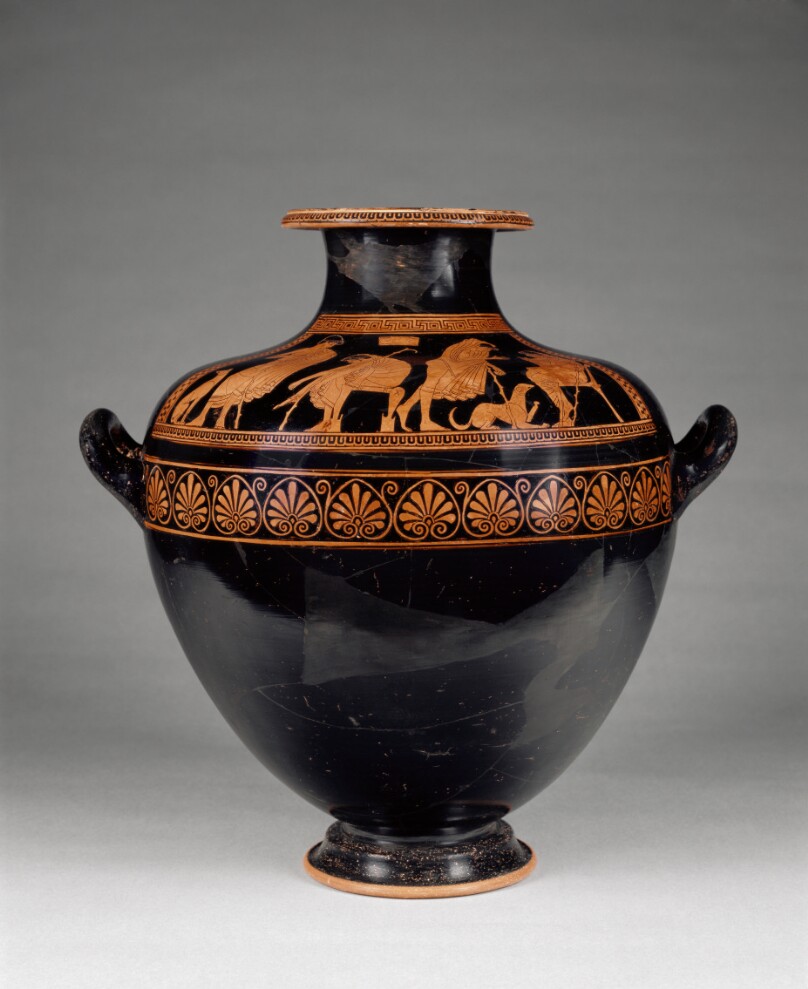
Attic Red-Figure Kalpis
Creator
Kleophrades PainterPainter
All works by this person →Working in Athens in the period from about 505 to 475 B.C, the Kleophrades Painter was a prolific vase-painter--more than one hundred vases attributed to him survive. He very likely was the pupil of Euthymides, one of the group of the red-figure Pioneers. He primarily worked in the red-figure technique but occasionally used the black-figure technique with enough facility that he may have been trai
More on Getty ULAN- Date
- 500–480 B.C.
- Medium
- Terracotta
- Culture
- Greek (Attic)
- Department
- Vessels
- Institution
- Getty Museum
- Object ID
- 19071518-5176-44ea-b775-476bed42e0e4
From the Getty Museum record
The panel on the shoulder of this Athenian red-figure kalpis (water jar) shows a group of youths in conversation. On the left, a young man watches his seated counterpart tying his sandal (marked with added red), while at right a second pair gestures at one another, perhaps in the act of bargaining. The youth seated on a chair raises two fingers and a thumb from his tightly-wrapped *himation*, while his companion leans on a staff and extends his right hand with outstretched fingers. In his left hand he holds a round object, perhaps a purse or a treat for the attentive hound below. A second dog crouches at far left with tail curled. Above the group hangs a writing tablet, a marker of youth, and all four figures show hints of facial hair. At the upper right is an inscription in red: *kalos* (“beautiful”); what appears to be a second *kalos* (the letters are rather ill-formed) runs vertically in front of the sandal-tying youth. The kalpis was a new vase shape in the early 400s B.C. The rounded profile replaced the older, more angular form of hydria, or water jar. Early in his career, the Kleophrades Painter decorated the angular form of hydria, but he later switched to the kalpis. Other features, such as the type of ornament framing the panel, also suggest that this vase comes from the later phase of the Kleophrades Painter's career.
The authoritative record is held by Getty Museum. LinkedCulture surfaces this object and its connections; it does not alter institutional metadata.
Get printable QR codesHide QR codes
Open QR codes for this object page and the museum record. They stay collapsed until needed.
Related across collections
Semantically similar works from Getty Museum and other institutions.