Getty Museum
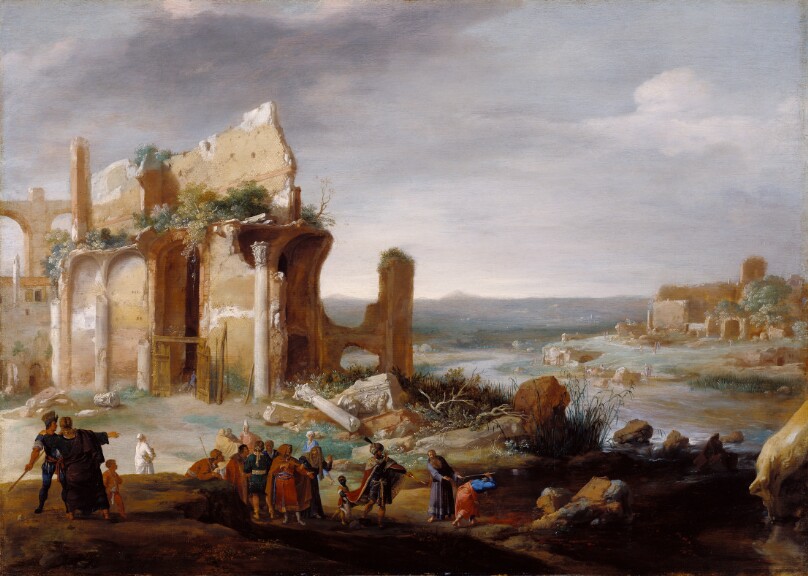
Moses and Aaron Changing the Rivers of Egypt to Blood
Creator
Bartholomeus BreenberghDutch Artist · 1598–1657
All works by this person →Bartholomeus Breenbergh was probably first apprenticed in Amsterdam, but it was his years in Italy that were decisive. At about age twenty, Breenbergh went to Rome, where he lived with Flemish landscapist Paul Brill and was influenced by the intimate, deeply poetic landscapes of German expatriate Adam Elsheimer. Breenbergh belonged to the first generation of Dutch Italianates, artists who traveled
More on Getty ULAN- Date
- 1631
- Medium
- Oil on panel
- Culture
- Dutch
- Department
- Paintings
- Institution
- Getty Museum
- Object ID
- 1a693923-283a-4c25-8800-5f81ceb02099
From the Getty Museum record
Bartholomeus Breenbergh set the story of God's first plague against the Egyptians in a luminous, spacious Italian countryside, filled with romantic classical ruins inspired by examples he had studied in Rome. In a vast vista of space, the highlighted ruins stand starkly against the sky in the central ground. Using translucent layers of sensitive brushstrokes, Breenbergh masterfully fused figures and scenery, giving his imaginary setting a role equal to that of the narrative. Despite their small size, the gestures of the figures in the foreground tell the story. In the center, Moses points toward Aaron, who stretches his rod and turns the Egyptian waters into blood in order to convince the pharaoh to permit the Israelites to leave Egypt. The pharaoh, wearing a Roman tunic, an Oriental turban, and European ermine-lined cape, observes in astonishment as the hideous miracle unfolds. Dutch landscape painters often took their narrative subjects from the Old Testament, but they rarely depicted this incident.
The authoritative record is held by Getty Museum. LinkedCulture surfaces this object and its connections; it does not alter institutional metadata.
Get printable QR codesHide QR codes
Open QR codes for this object page and the museum record. They stay collapsed until needed.
Related across collections
Semantically similar works from Getty Museum and other institutions.