Getty Museum
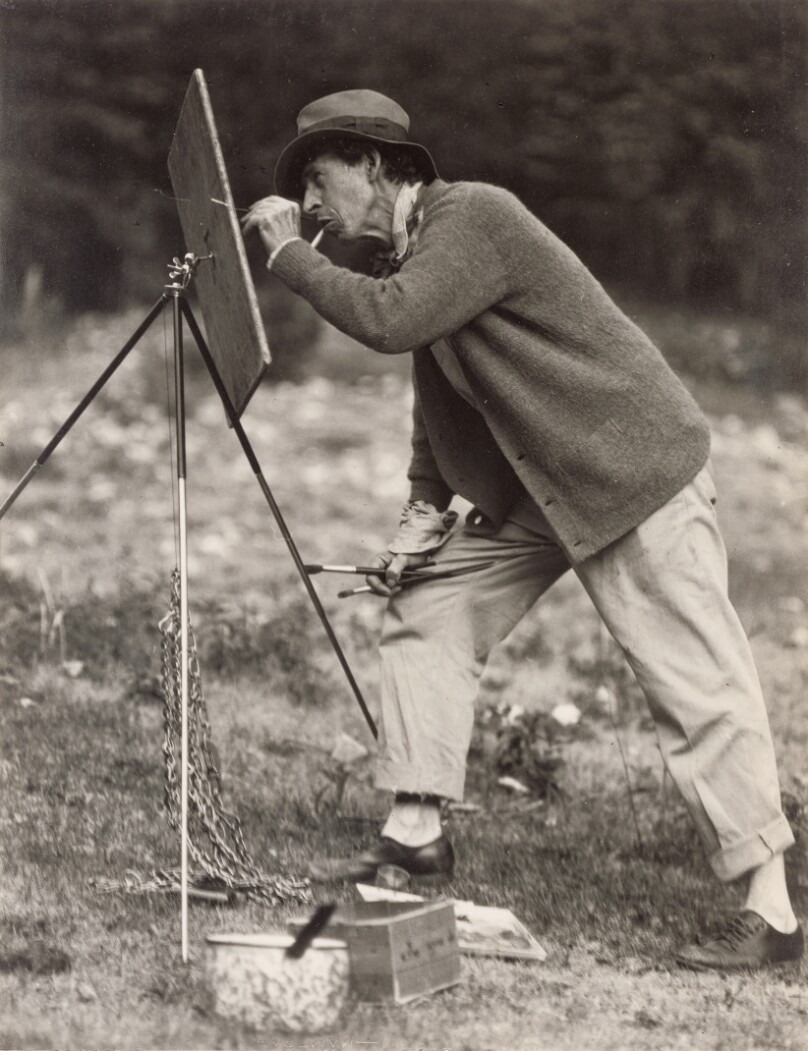
John Marin
Creator
Paul StrandAmerican Photographer · 1890–1976
All works by this person →Paul Strand began photographing in New York in the 1910s. During the early 1920s he received recognition for both his painting and his photography. He visited New Mexico in 1926 and, beginning in 1930, returned for three consecutive summers, making portraits of artist friends and acquaintances. It was there, amidst a community of visual artists and writers, that Strand began to develop his belief
More on Getty ULAN- Date
- 1930
- Medium
- Gelatin silver print
- Culture
- American
- Department
- Photographs
- Institution
- Getty Museum
- Object ID
- 1b811f41-7ac2-4ea6-a3e9-3b55a989f0ce
From the Getty Museum record
A member of Alfred Stieglitz’ circle and close personal friend of Paul Strand, John Marin (1870-1953) was influenced by the late watercolors of Paul Cézanne (1839-1906) in addition to Cubism. During the 1920s Strand wrote a number of articles on Marin, who is shown here painting outdoors at Taos, New Mexico. Around this time many artists headed there at the invitation of Mabel Dodge Luhan (1879-1962), the great patron of the arts who resided in the Southwest. Strand first met her in 1926 and visited the region from 1930 to 1932. Like Marin and many of the artists gathered there, Strand was inspired by the vast landscape, which was so different from that of the eastern seaboard. As he became engaged with the Southwest, Strand was slowly becoming disengaged from Stieglitz (1864-1946). The relationship between the two men had begun deteriorating in the late 1920s and eventually came to an end by the spring of 1932, after Strand exhibited prints at Stieglitz's An American Place. Strand felt that Stieglitz had not successfully promoted the exhibition, which included paintings on glass by his wife Rebecca Salsbury, and was apparently not wholly supportive of the work on display. It was the end of a friendship and an era. Strand was no longer looking to Stieglitz as the important, omnipotent voice in photography. As Stieglitz's work became more introspective, Strand was seeking to represent the world at large. Enlivened by new ideas and people, he turned for advice to Harold Clurman (1901-1980), director of the Group Theatre in New York. The company was inspired by the Moscow Art Theatre and developed a collective approach to acting, in addition to addressing contemporary social issues in its plays. Originally published in _Paul Strand_, In Focus: Photographs from the J. Paul Getty Museum by Anne M. Lyden (Los Angeles: J. Paul Getty Museum, 2005), 42. ©2005, J. Paul Getty Trust.
The authoritative record is held by Getty Museum. LinkedCulture surfaces this object and its connections; it does not alter institutional metadata.
Get printable QR codesHide QR codes
Open QR codes for this object page and the museum record. They stay collapsed until needed.
Related across collections
Semantically similar works from Getty Museum and other institutions.