Getty Museum
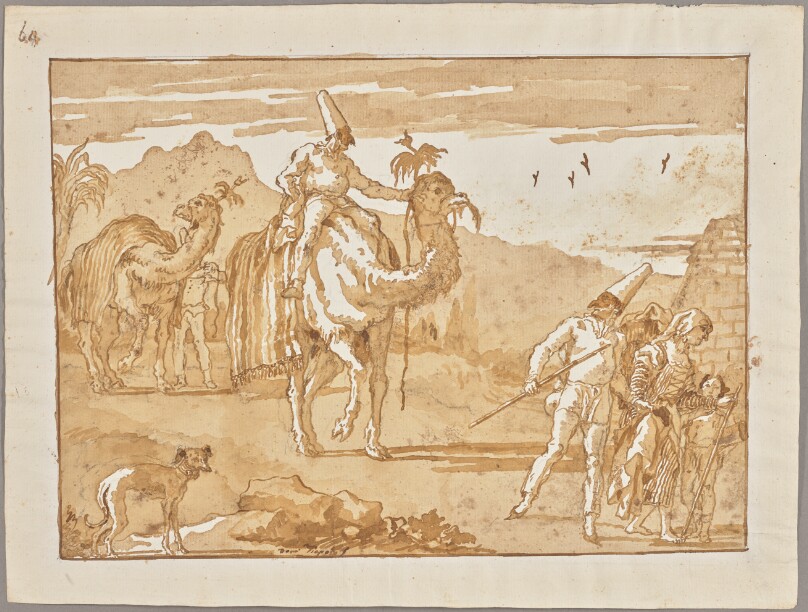
The Punchinello Riding a Camel at the Head of a Caravan
Creator
Giovanni Domenico TiepoloItalian Artist · 1727–1804
All works by this person →Although very successful as a painter and engraver, Giovanni Domenico Tiepolo made some of his most provocative works as drawings. He trained in the studio of his famous father, Giovanni Battista Tiepolo, and was independently producing works for his own commissions by the age of twenty. He continued to work with his father while at times executing his own designs, until his father's death in 1770
More on Getty ULAN- Date
- late 1790s
- Medium
- Brush and brown ink over black chalk, on laid paper
- Culture
- Italian
- Department
- Drawings
- Institution
- Getty Museum
- Object ID
- 1c4a0176-0dd1-4466-aa9b-17841ca9c607
From the Getty Museum record
The eldest surviving son of the celebrated 18th-century Venetian painter, Giovanni Battista Tiepolo (1696-1770), Giovanni Domenico (Giandomenico) Tiepolo achieved fame in his own right with a series of 104 large drawings that illustrate the colorful life and death of Punchinello, a character from the popular Commedia dell’Arte. From an album entitled Divertimenti per li Ragazzi (Entertainments for Children), these drawings depict Punchinello and his attendants’ inclination towards childish behavior, which makes them at once vulnerable and ridiculous. No known literary text forms the basis for these drawings. The stories were most likely handed down orally, in accordance with the tradition of popular theater, in which actors extemporized and embroidered at will. In all of the depictions, Punchinello, a sly, lazy antihero, wears a white costume, a ruff about his neck, a conical hat, and a black mask with a beaked nose. The drawing portrays at its center the vain-glorious Punchinello seated atop a dromedary with one arm akimbo and the other holding a decorative staff. As he proudly leads a caravan of camels across an arid landscape, Punchinello scouts ahead to a pyramid-like structure which locates this theatrical procession in the Egyptian desert. Punchinello’s companion at right looks back at his master as he ushers along a basket-laden woman and her small child. Meanwhile a mangy dog at left looks out at the viewer as if in disbelief at this procession of fools. By his careful application of golden ink on a brilliant white sheet of paper, Domenico conveys the bright sunlight of the foreign locale, made all the more exotic with the inclusion of palm trees. Using his own etching of the Flight into Egypt as the basis for the composition, Giandomenico draws a playful relationship between the comic scene of Punchinello and the solemn biblical episode. Made at the end of his career and executed solely for his own pleasure and that of others, the sheet is one of the finest examples of Domenico’s ability to render compelling farcical diversions that both mock and charm in the same moment.
The authoritative record is held by Getty Museum. LinkedCulture surfaces this object and its connections; it does not alter institutional metadata.
Get printable QR codesHide QR codes
Open QR codes for this object page and the museum record. They stay collapsed until needed.
Related across collections
Semantically similar works from Getty Museum and other institutions.