Getty Museum
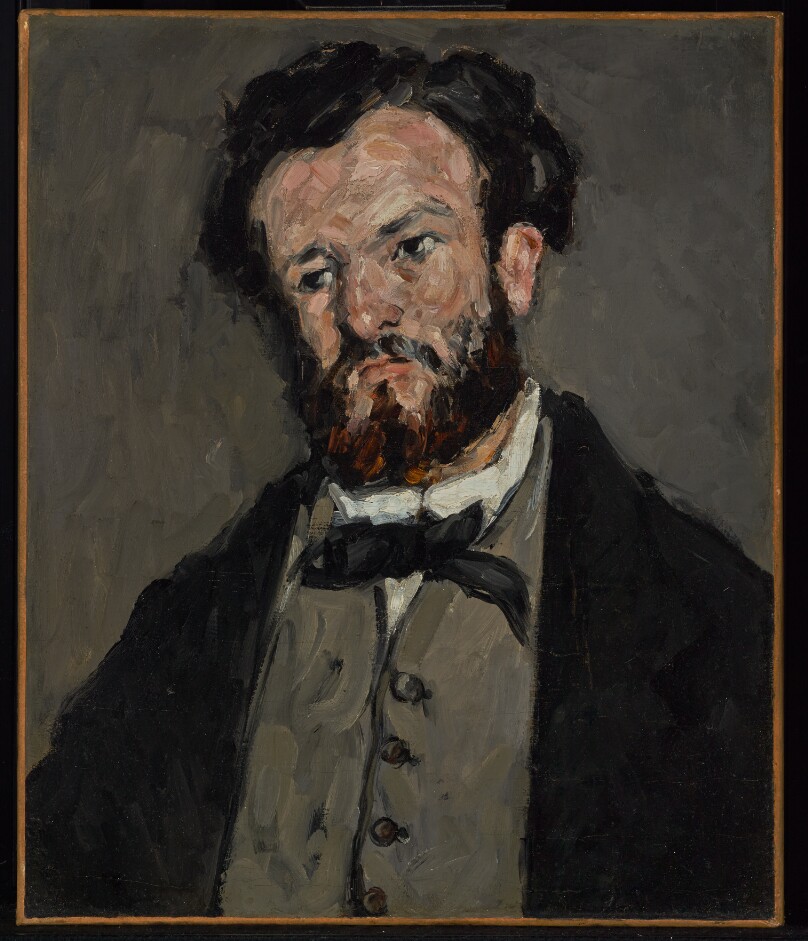
Portrait of Anthony Valabrègue
Creator
Paul CézanneFrench Artist · 1839–1906
All works by this person →When Paul Cézanne moved to Paris from Aix-en-Provence in 1862, his art was strongly influenced by Eugène Delacroix and Gustave Courbet. He used thick slabs of paint to give his early works a sculptural presence and intensity. He soon met the Impressionists and exhibited with them three times to scarring reviews, after which he stopped exhibiting for thirteen years. In 1872 Camille Pissarro introdu
More on Getty ULAN- Date
- 1869–1871
- Medium
- Oil on canvas
- Culture
- French
- Department
- Paintings
- Institution
- Getty Museum
- Object ID
- 1e747e6c-74f8-4a40-86de-9a1c751db887
From the Getty Museum record
When a jury member at the Paris Salon of 1866 saw Paul Cézanne’s portrait of the poet and critic Antony Valabrègue, he exclaimed that the portrait was not painted with a palette knife but with a pistol. The coarse appearance created by Cezanne’s bold, almost violent technique led Valabrègue, a longtime friend of the artist, to complain to the writer Zola: “He has given me such a fierce complexion that it reminds me of the statue of Champfleury when it was stained with squashed blackberries.” Valabrègue nonetheless posed several more times for Cézanne, including for the present portrait, thought to have been painted around 1869 to 1871. By this point the painter had substituted brushes for palette knives but was still using them to similar effect. With broad brushes Cézanne applied a limited range of colors in thick, successive layers, practically sculpting his friend’s face, hair and beard in paint. The result was a deliberately crude, rough-hewn likeness that deviated sharply from the decorous conventions of bourgeois portraiture during this period.
The authoritative record is held by Getty Museum. LinkedCulture surfaces this object and its connections; it does not alter institutional metadata.
Get printable QR codesHide QR codes
Open QR codes for this object page and the museum record. They stay collapsed until needed.
Related across collections
Semantically similar works from Getty Museum and other institutions.