Getty Museum
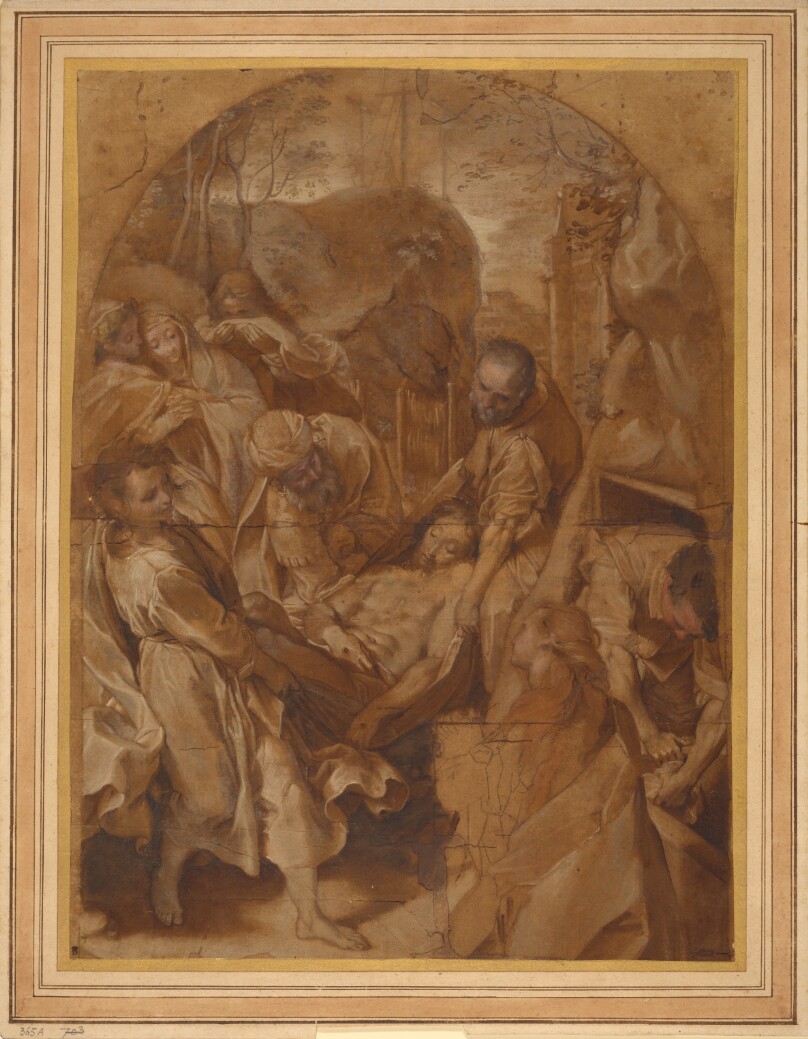
The Entombment
Creator
Federico BarocciItalian Artist · 1535–1612
All works by this person →As one of Italy's leading altarpiece painter in the late 1500s, Federico Barocci exerted a profound influence on his contemporaries. He moved beyond the linear style of his teacher Battista Franco around 1563, when he discovered Correggio's *sfumato* effects, which made the defining lines of forms appear to dissolve into delicately colored, smoky mists. Barocci's decorations for the Casino of Pope
More on Getty ULAN- Date
- about 1579–1582
- Medium
- Black chalk and oil paint, on oiled paper
- Culture
- Italian
- Department
- Drawings
- Institution
- Getty Museum
- Object ID
- 1ea7c3d2-e028-4480-8632-347503d0f574
From the Getty Museum record
Federico Barocci made this oil study, the first of two, for an altarpiece in the Church of Santa Croce in Senigallia, Italy. Before beginning this sketch, he oiled the paper, perhaps to eliminate the "halo" the paint's oil would have created as it seeped into the dry paper. Here Barocci studied tonal values for the painting, building a largely monochrome composition from rich, dark browns with brilliant bluish-white highlights in the figures' robes, especially that of the figure on the left who supports Christ's legs. He left the kneeling figure of Saint Mary Magdalene unfinished in the right foreground, though she appears in a similar pose and position in the later, more colorful oil sketch and the finished painting. Barocci commonly used an elaborate preparatory method for planning his pictures. After determining the form of a composition, he made several chalk studies for each figure, including separate studies of the limbs and head. He then drew one or more fully worked-up sketches of the composition, such as this one, and finally moved onto the full-sized cartoon.
The authoritative record is held by Getty Museum. LinkedCulture surfaces this object and its connections; it does not alter institutional metadata.
Get printable QR codesHide QR codes
Open QR codes for this object page and the museum record. They stay collapsed until needed.
Related across collections
Semantically similar works from Getty Museum and other institutions.