Getty Museum
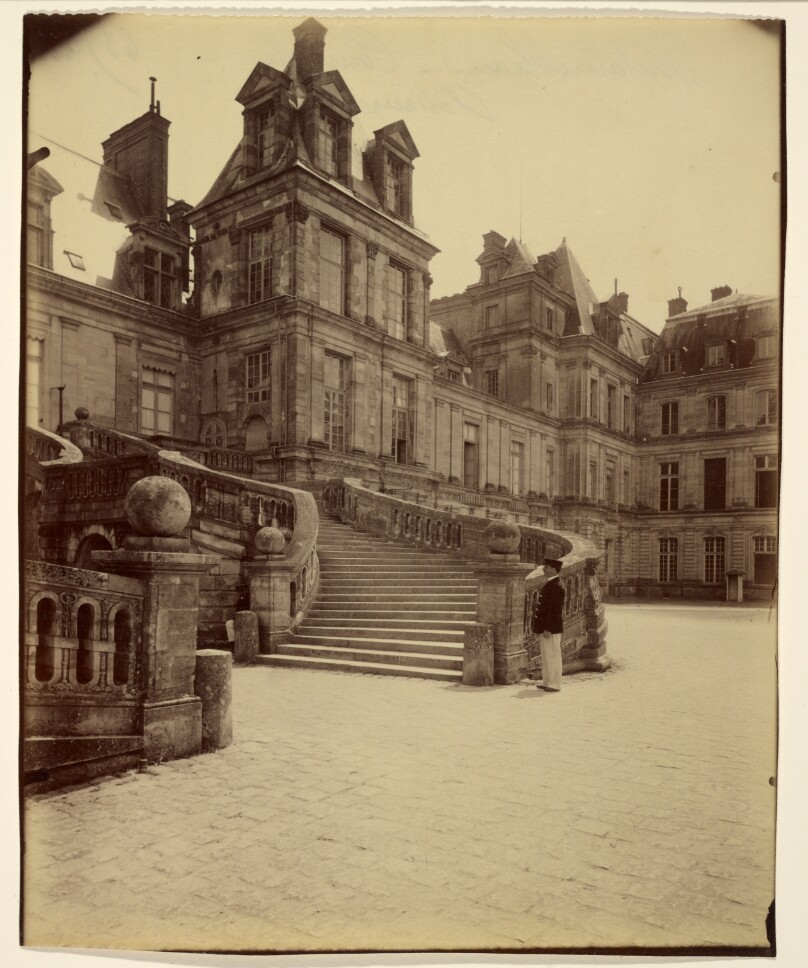
Fountainebleau - Cour des Adieux
Creator
Eugène AtgetFrench Photographer · 1857–1927
All works by this person →Eugène Atget never called himself a photographer; instead he preferred "author-producer." A private, almost reclusive man, Atget first tried his hand at painting and acting, then began to photograph *vieux Paris* (Old Paris) in 1898. He photographed in part to create "documents," as he called his photographs, of architecture and urban views, but he supported himself by selling these photographs to
More on Getty ULAN- Date
- 1903
- Medium
- Albumen silver print
- Culture
- French
- Department
- Photographs
- Institution
- Getty Museum
- Object ID
- 1fc3e69c-5cef-4286-ac18-cd233fc30662
From the Getty Museum record
> This photograph depicts the famous horseshoe-shaped staircase that sweeps up to what was once the principal entrance of the royal château of Fontainebleau. The palace, forty miles outside Paris, was erected, enlarged, and embellished by a succession of monarchs over a period of more than three hundred years. Only Versailles and the Louvre are larger. The stairway was built by Jean Du Cerceau (1585-1649) in 1632 to replace one on the verge of collapse. It stands at the head of a long enclosure, called either the Courtyard of the White Horse, because of an equestrian statue that once stood in it, or the Courtyard of Farewells, because of Napoléon's emotional 1814 farewell address there to his imperial guard after his first abdication. The man in the dark jacket and light trousers at the foot of the stairs, no doubt a state employee, waits for tourists to appear. > > Eugène Atget rarely made such specific views of royal palaces, although they can often be seen in the backgrounds of his numerous photographs of their surrounding gardens. Perhaps his many pictures of the staircases in Parisian houses (see [90.XM.64.140](https://www.getty.edu/art/collection/objects/63575/eugene-atget-hotel-de-la-brinvilliers-l'empoisonneuse-rue-charles-v-12-french-1900/), [94.XM.108.5](https://www.getty.edu/art/collection/objects/101148/eugene-atget-cite-trebert-porte-d'asnieres-french-1912/), [90.XM.124.1](https://www.getty.edu/art/collection/objects/64707/eugene-atget-staircase-montmartre-french-1921/), [2002.37.18](https://www.getty.edu/art/collection/objects/172750/eugene-atget-staircase-rue-saint-jacques-254-french-1907-1908/), and [90.XM.64.198](https://www.getty.edu/art/collection/objects/63632/eugene-atget-hotel-de-fleury-28-rue-des-saints-peres-french-1905/)) led him to this subject. The steeply angled perspective of his view and the compression created by the lens make the building loom above the expanse of paving stones. The presence of the guide and the open windows in the château give life to what might otherwise have been an image of frigid majesty. > > Originally published in *Eugène Atget*, In Focus: Photographs from the J. Paul Getty Museum by Gordon Baldwin (Los Angeles: J. Paul Getty Museum, 2000), 36. ©2000, J. Paul Getty Trust.
The authoritative record is held by Getty Museum. LinkedCulture surfaces this object and its connections; it does not alter institutional metadata.
Get printable QR codesHide QR codes
Open QR codes for this object page and the museum record. They stay collapsed until needed.
Related across collections
Semantically similar works from Getty Museum and other institutions.