Getty Museum
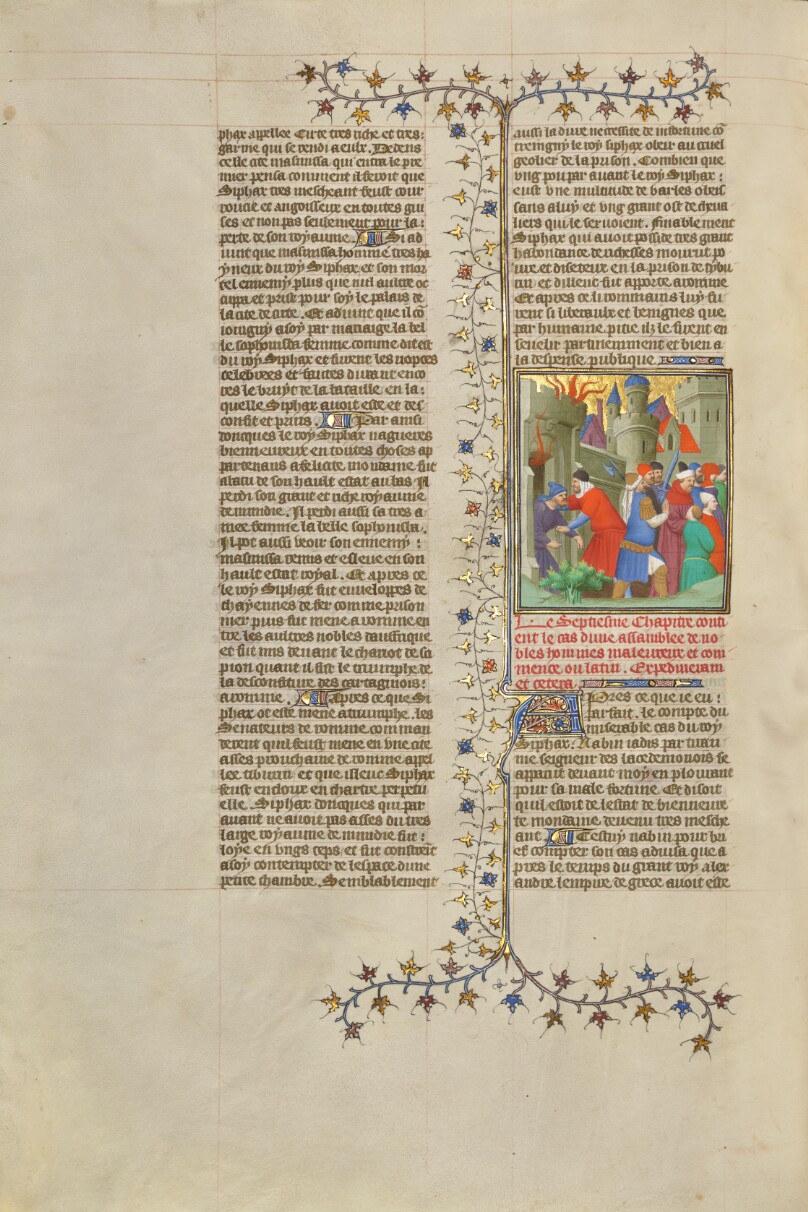
Prisoners Led from a Defeated City
Creator
Boucicaut MasterFrench Illuminator · 1390–1430
All works by this person →In the early 1400s, the Boucicaut Master was the leading master of manuscript illumination in Paris and one of the most influential artists working in the International style in northern Europe. The Boucicaut Master appears to have supervised a talented team of artists who produced manuscripts commissioned by the king of France, high-ranking aristocrats, and the wealthy bourgeoisie. He probably al
More on Getty ULANObject Description · Getty Museum
Getty Museum’s catalogue record
- produced_by.carried_out_by[0].id
- https://data.getty.edu/museum/collection/person/1dd43e3b-2b83-43ed-9c16-710ba2c0fe95
- Artist/Maker
- Boucicaut Master
- subject_of[Homepage].id
- https://www.getty.edu/art/collection/object/107TYE
- Date
- about 1413–1415
- Medium
- Tempera colors, gold leaf, gold paint, and ink
- Culture
- French
- Object Type
- Folio
Taken from LinkedCulture’s stored copy of Getty Museum’s record. A fresh capture of the museum’s own record has not been made for this object yet.
The authoritative record is held by Getty Museum. LinkedCulture surfaces this object and its connections; it does not alter institutional metadata. The fields above are the museum’s, under its own labels. LinkedCulture’s derived fields are listed separately below and marked as ours.
Get printable QR codesHide QR codes
Open QR codes for this object page and the museum record. They stay collapsed until needed.
How LinkedCulture maps this record
To search objects from different museums together, LinkedCulture reads each museum’s record into a common set of fields. The values below are LinkedCulture’s, under LinkedCulture’s names. They are not Getty Museum’s wording; the museum’s own record is shown above under its own labels.
- Object ID
- 22d2bedd-0a7f-497b-b174-b5c6f06976d0
- Object Type
- Folio
- Getty Museum field “Object Type” · copied as is
- Creator
- Boucicaut Master
- Getty Museum field “Artist/Maker” · copied as is
- Culture
- French
- Getty Museum field “Culture” · copied as is
- Medium
- Tempera colors, gold leaf, gold paint, and ink
- Getty Museum field “Medium” · copied as is
- Department
- Manuscripts
- Getty Museum field “Department” · derived by LinkedCulture from the museum field · Getty's classification category is stored as department.
- Credit Line
- The J. Paul Getty Museum, Los Angeles, Ms. 63, fol. 147v
- Getty Museum field “Standard Credit Line” · the first available of several museum fields
- Getty Museum field “Source Credit Line” · the first available of several museum fields
- Date
- about 1413–1415
- Getty Museum field “Date” · copied as is
- Begin Year
- 1413
- Getty Museum field “produced_by.timespan.begin_of_the_begin” · derived by LinkedCulture from the museum field
- End Year
- 1415
- Getty Museum field “produced_by.timespan.end_of_the_end” · derived by LinkedCulture from the museum field
The museum’s own record has not been captured for this object yet, so the museum fields shown above are limited to values LinkedCulture stored unchanged.
Related across collections
Semantically similar works from Getty Museum and other institutions.