Getty Museum
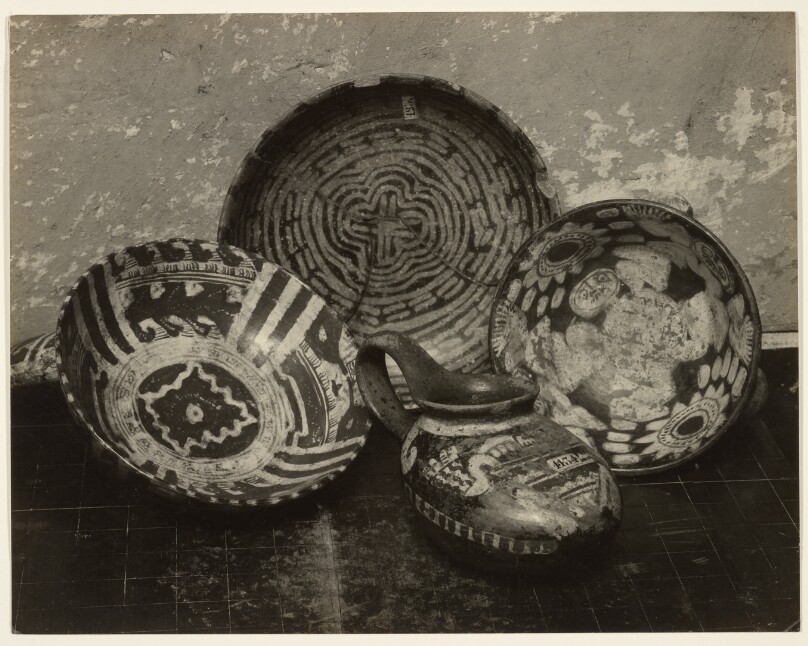
Tarascan Pottery, Morelia (84.XM.229.57)
Creator
Edward WestonAmerican Photographer · 1886–1958
All works by this person →> To clearly express my feeling for life with photographic beauty, present objectively the texture, rhythm, form in nature, without subterfuge or evasion in technique or spirit, to record the quintessence of the object or element before my lens, rather than an interpretation, a superficial phase, or passing mood--this is my way in photography. It is not an easy way. > > --Edward Weston In the spri
More on Getty ULAN- Date
- July–August 1926
- Medium
- Gelatin silver print
- Culture
- American
- Department
- Photographs
- Institution
- Getty Museum
- Object ID
- 2339697b-972f-4dae-9244-18cd544ce7f5
From the Getty Museum record
> Jean Charlot (1899-1979), Edward Weston's friend and fellow artist, was fascinated by the abstract qualities of pre-Columbian and folk art and maintained a large collection of the latter, which Weston saw in 1924. Charlot's interests might have inspired the photographer's own assortment of *juguetes* (toys), which Weston took to photographing (see [84.XM.229.52](http://www.getty.edu/art/collection/objects/37737/edward-weston-horseman-of-woven-palm-leaves-american-probably-february-1926/)). The idea to photograph objects such as these may have been partly practical; experimenting with the toys in his studio meant that Weston was available when clients called for portrait sittings. But his direct approach to these common still-life subjects and his emphasis on heightened texture and form became hallmarks of his later, well-known compositions involving shells, fruits, and vegetables. > > Concurrent with the development of Weston's personal interest in folk art, he received his first major commission, to make pictures of artifacts for Anita Brenner's book Idols Behind Altars (1929), on Mexican popular art found between Oaxaca and Guadalajara. He received two thousand pesos (roughly one thousand dollars) to make photographs of four hundred objects that Brenner (1905-1974) selected. The project entailed some fifteen weeks of travel for Weston, who was accompanied by Tina Modotti (1896-1942) and his son Brett (1911-1993), and proved to be simultaneously liberating and constraining in its scope. He was able to travel to places and photograph things he would not otherwise have had the chance to see, but his views were largely restricted by the list of objects, such as the pre-Columbian pottery in this image, that he was sent to document. But in Xanicho (Janitzio), an island in Lake Pátzcuaro, the church Weston was sent to photograph was locked, so he turned his camera toward the town and lake, which appeared a “sheet of silver” below the storm clouds above (link to 89.XM.70.3). The Brenner commission accounted for over half of all the prints Weston made in Mexico. > > Adapted from Brett Abbott. *Edward Weston*, In Focus: Photographs from the J. Paul Getty Museum (Los Angeles: J. Paul Getty Museum, 2005), 42. ©2005, J. Paul Getty Trust.
The authoritative record is held by Getty Museum. LinkedCulture surfaces this object and its connections; it does not alter institutional metadata.
Get printable QR codesHide QR codes
Open QR codes for this object page and the museum record. They stay collapsed until needed.
Related across collections
Semantically similar works from Getty Museum and other institutions.