Getty Museum
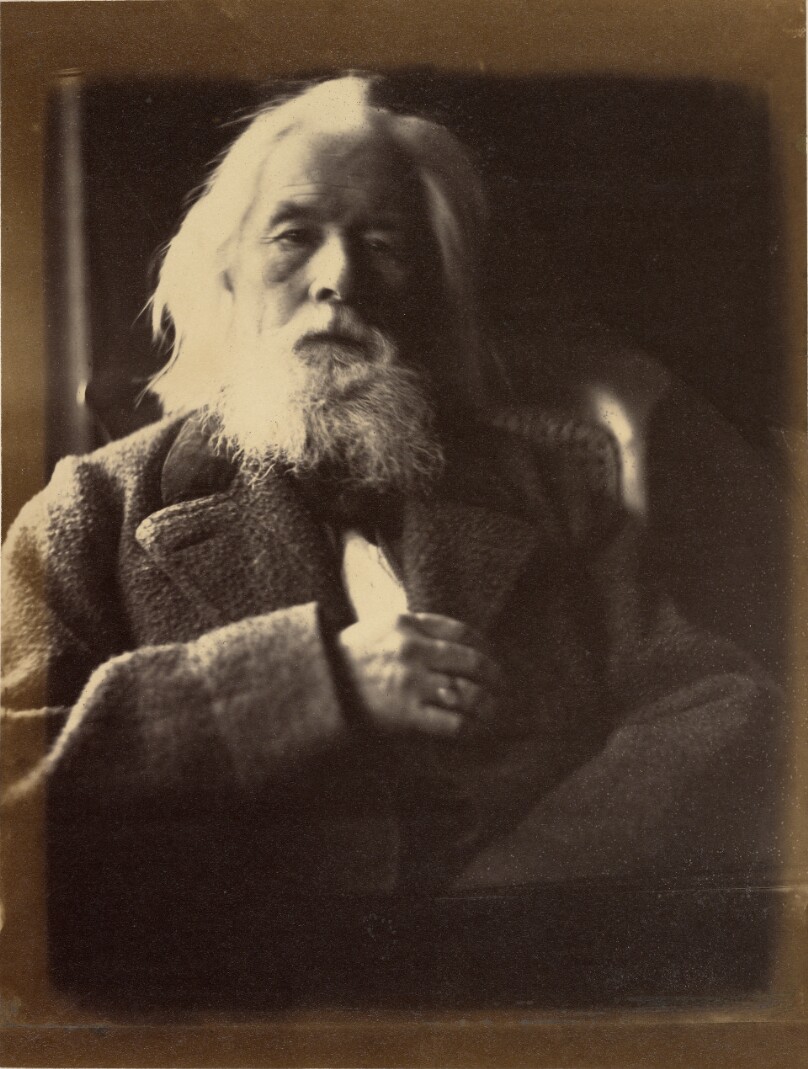
Charles Hay Cameron
Creator
Julia Margaret CameronBritish Photographer · 1815–1879
All works by this person →After receiving a camera as a gift, Julia Margaret Cameron began her career in photography at the age of forty-eight. She produced the majority of her work from her home at Freshwater on the Isle of Wight. By the coercive force of her eccentric personality, she enlisted everyone around her as models, from family members to domestic servants and local residents. The wife of a retired jurist, Camero
More on Getty ULAN- Date
- 1864
- Medium
- Albumen silver print
- Culture
- British
- Department
- Photographs
- Institution
- Getty Museum
- Object ID
- 233b0594-d026-4e8d-8c35-4e8ca447f1c2
From the Getty Museum record
> Charles Hay Cameron (1795-1880), once described by Alfred, Lord Tennyson as “a philosopher with his beard dipped in moonlight,” was educated at Eton College and Oxford University. An accomplished scholar, he had a highly distinguished career as a civil servant in the judiciary in India. He was fiercely devoted to legal reform and a proponent of education in the colonies. In 1835 he was elected as the British member on the Indian Law Commission and while in Calcutta served on the Supreme Council of India. He pursued his scholarly work without the benefit of institutional support, an example that surely stimulated his wife’s endeavors. > > When Julia Margaret Cameron met her future husband in 1835, he was writing his “Essay on the Sublime and Beautiful,” a thoughtful text that explores many of the concepts that were to be fundamental to her art. The aesthetics of the human figure, the interrelationship of sight and touch in the creation of works of art, and the metaphysical properties of language are some of the issues that are discussed. > > When he retired to the Isle of Wight in 1860, Charles Cameron led a sedentary existence, withdrawing from the customary throng of household visitors to the isolation of his bedchamber and the solace of Homer, Virgil, Shakespeare, Milton, and Keats. He was photographed only on a few occasions by his wife, most notably when he performed the roles of King Lear and Merlin in her illustrations for Tennyson’s *Idylls of the King* (see [84.XO.732.1.1.5](https://www.getty.edu/art/collection/objects/58904/julia-margaret-cameron-vivien-and-merlin-british-1874/), [84.XO.732.6](https://www.getty.edu/art/collection/objects/59436/eadweard-j-muybridge-the-pacific-coast-of-central-america-and-mexico-the-isthmus-of-panama-guatemala-and-the-cultivationshipment-of-coffee-1876/)). > > In this early portrait Cameron chose to picture her husband in an engaging, frontal pose, seated in an armchair in his overcoat, bathed in dramatic side lighting. The grandiose and yet tender nature of the study recalls the sentiments expressed by Cameron toward him in a prayer she wrote in 1838, when quickened with her first child: “Most blessed Lord . . . Thou alone dost know how fondly dear This my husband is to me, how great is his tenderness, how true is his love.” > > Julian Cox. *Julia Margaret Cameron*, In Focus: From the J. Paul Getty Museum (Los Angeles: J. Paul Getty Museum, 1996), 14. ©1996 The J. Paul Getty Museum.
The authoritative record is held by Getty Museum. LinkedCulture surfaces this object and its connections; it does not alter institutional metadata.
Get printable QR codesHide QR codes
Open QR codes for this object page and the museum record. They stay collapsed until needed.
Related across collections
Semantically similar works from Getty Museum and other institutions.