Getty Museum
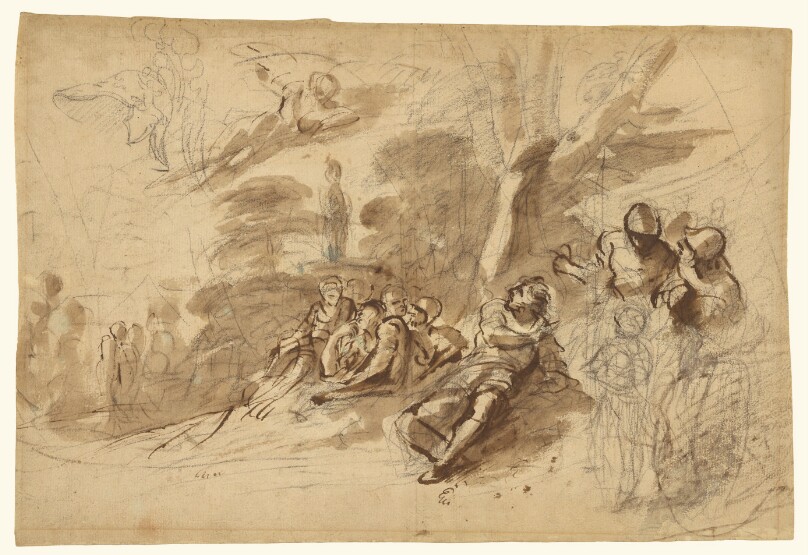
Iris appearing to Turnus; study of a Helmet (recto); Alternative design for the recto composition (verso)
Creator
Pier Francesco MolaItalian Artist · 1612–1666
All works by this person →An architect's son, Pier Francesco Mola developed his mature style after leaving Rome and traveling in Bologna and Venice between 1633 and 1647. He studied under a former assistant of Annibale Carracci and Domenichino and was profoundly influenced by Guercino's soft modeling. In 1647 Mola moved back to the family residence in Rome, where he painted romantic works in chiaroscuro. In Rome he receive
More on Getty ULAN- Date
- 1658–1659
- Medium
- Brush and brown ink over black chalk; (verso) black chalk
- Culture
- Italian
- Department
- Drawings
- Institution
- Getty Museum
- Object ID
- 24153f17-038e-462c-9cc1-f067055e0064
From the Getty Museum record
In Virgil's *Aeneid,* Iris, goddess of the rainbow that trails behind her faintly drawn in black chalk, comes to Turnus, leader of the Rutuli nation, as a messenger from Juno. Iris tells Turnus to attack Aeneas's invading army now, for Aeneas has left camp. Ultimately, however, Aeneas killed Turnus and founded a city, which became Rome. The black chalk study of a Roman helmet in the upper left probably relates to the verso sketch of groups of ancient Roman soldiers. Pier Francesco Mola displayed his distinctive talent for incorporating figures into lush, windswept landscapes that enhance the scene's drama. He usually mixed pen and chalk as he did here, first quickly laying down the composition's essentials using black chalk, then picking out the most important lines in pen and ink. His characteristic fluid dark washes increase the sense of movement and tension. Mola made this study for a fresco on the vault of a room in a prince's summer palace. After a dispute with the prince, Mola left the project unfinished and it was later destroyed.
The authoritative record is held by Getty Museum. LinkedCulture surfaces this object and its connections; it does not alter institutional metadata.
Get printable QR codesHide QR codes
Open QR codes for this object page and the museum record. They stay collapsed until needed.
Related across collections
Semantically similar works from Getty Museum and other institutions.