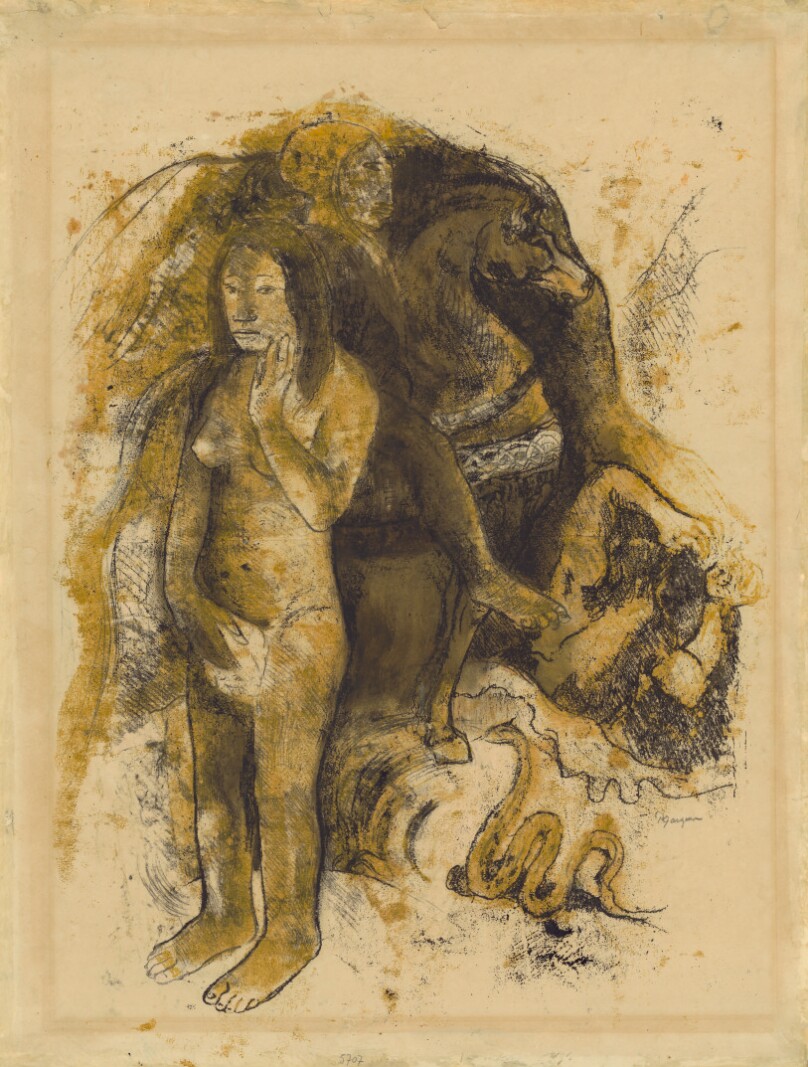
Eve ['The Nightmare'] (recto); Eve ['The Nightmare'] (verso)

Getty Museum

Eve ['The Nightmare'] (recto); Eve ['The Nightmare'] (verso)

Creator

Paul Gauguin

French Artist · 1848–1903

All works by this person →

> May the day come soon when I'll be myself in the woods of an ocean island! To live there in ecstasy, calmness and art.... There in Tahiti I shall be able to listen to the sweet murmuring music of my heart's beating in the silence of the beautiful tropical nights. > > --Paul Gauguin > > Writing to his wife in 1887, Paul Gauguin expressed his desire to seek an earthly paradise in the South Seas. H

More on Getty ULAN

Object Description · Getty Museum

>If my work must be limited to watercolor, pastel, or anything else all the spirit goes out of it ... I have at this moment a series of experimental drawings that I'm fairly pleased with. I'm sending you a small specimen; it's like an impression and yet it isn't. Thick ink replaces pencil, that's all... > >--Paul Gauguin Near the end of his life in isolated French Polynesia, Gauguin invented his own technique to produce this unique, double-sided image. Both sides depict a young Tahitian woman as Eve in the Garden of Eden, surrounded by the Devil as a snake, a dark figure on horseback, and a fallen Adam. One side of the drawing consists of fine blue and black lines. Those markings are not only flipped or mirrored on the other side, but appear thicker and darker amid murky patches of black and ocher ink. This more colorful and detailed side was probably what Gauguin intended viewers to see. On its surface, Gauguin's experimental drawing looks primitive and casually made. However, its rough appearance belies a very sophisticated work, with nuanced mark-making and carefully aligned applications of color. The closest analogy to Gauguin's process might be the act of writing or drawing on carbon paper, which transfers marks to underlying pages. Gauguin coated a piece of paper with printer's ink. He placed another sheet of paper--what was to become this drawing--on top of it and drew the initial composition with black pencil. Then he blocked-in shading with ocher ink. Third, he strengthened the outlines with blue crayon. The pressure applied by the drawing instruments transferred ink to the underside of the sketched paper. For these successive "printings," Gauguin had to change out the original sheet of inked paper and allow the drawing to dry, at least partially, between passes of ink. Last, he took a brush dipped in solvent and blended some areas of the drawing, most notably behind the figure of Eve. Gauguin's long-term obsession with the biblical story of "the fall of man" enabled him to explore dual themes such as good and evil in a single work. As with many of his images, the way that Gauguin used symbols--their context and juxtaposition--complicate interpretation. For example, although Eve gazes directly at the viewer, it is difficult to tell whether her expression is confident or baleful. Her awkward gestures, one hand holding a cloth to her genitals and the other against her cheek, perhaps indicate shameful awareness of her sinful actions. This particular Eve and the head of a hooded figure behind her originate from a drawing Gauguin made at least eight years earlier. He repeatedly incorporated these exact motifs into subsequent paintings and woodcuts. In this case also, the horse behind Eve may be inspired by a frieze design from the Parthenon, which Gauguin had in his collection of source materials brought from Europe. The hooded rider incorporates some of Gauguin's own features, and may also symbolize Death.

Getty Museum’s catalogue record

produced_by.carried_out_by[0].id
https://data.getty.edu/museum/collection/person/377460df-c088-4b22-a5dd-8c54685c7d50
Artist/Maker
Paul Gauguin
subject_of[Homepage].id
https://www.getty.edu/art/collection/object/109B5V
Date
about 1899–1900
Medium
Black printer's ink, ochre ink, and liquid solvent (recto); Graphite and blue crayon pencil with traces of a diluted oil medium (verso), on wove paper
Culture
French
Object Type
Drawing

Taken from LinkedCulture’s stored copy of Getty Museum’s record. A fresh capture of the museum’s own record has not been made for this object yet.

The authoritative record is held by Getty Museum. LinkedCulture surfaces this object and its connections; it does not alter institutional metadata. The fields above are the museum’s, under its own labels. LinkedCulture’s derived fields are listed separately below and marked as ours.

Get printable QR codes

Open QR codes for this object page and the museum record. They stay collapsed until needed.

Open this page QR destination: https://linkedculture.org/q/q1.0iQUrqoLVAYYmB2_.qrpAqxuELNLljT4vz2TOzOYyH9Hlpd1sjav6_4tu1oXjbb5YP84Ku0OtPLeaSfy75yETlsIQrZi7I9jRFBufKR5F-kTx04M3FXkDekbinpuzXUZIqvS7XRC7jP-Co7TBKwdXGQci8rskbdgozlrB0EtT3j6MhguuXRDUdFbNZvmLe7eg80UsCxu4hFmPR5YXeyreuYnCGw9pR2uQ2s0Y5EbaRNNs--emqG5w8_gbmXqELsivJbZ1hIaLtUL-swcT-scbpJDG3vx6LIbIv-oW88cMdWonCyuNYr7HP2CkvRsIq_JeryHnerfnpQx85aINVq9uTiwvbVNvV7VnHNCFcokWYviS4gUvtyeGx9McPriKqTB-g3GLZnzSgrrP6aPtRd_56p8i1CHvf3g9A7eJSee at Getty Museum QR destination: https://linkedculture.org/q/q1.ANOgt1_TZwPbs-ea.wtP9WyG7clxj4KvHkWl2xVufYIJfob5zfSMLEvSJaCS5QyqFTebF6zKzg2fYoCvk1_IeB_Gg9csZ5bi8mNkagC2GLcwnipPlryvoqbTt1UU3eWiGX9lwK1TMT8hSHlBpBd1NI_w9BTQ53qrR04jR38Q4I-9eT2_yGIKZOGUVKJ-K5WtiGJZnLKE40Tyw8du4fDqAv_nXJp0O8YMGgqZ0ewE7ZAiAIPIqGGCRpmq2iGUyQK7HOmQ9t_K5J55kmzcqfrL63g-K7nL7hSS683Fupl6F0ag-j03J0LgckhET2Lr09LF-9BXqCNj6yefesoFUKFfHk3C-yHGPpOeFq8NWArwnAqitepyS8EdqpOInx9e5WwQZVie1O8AYrPI
Open this page
See at Getty Museum
How LinkedCulture maps this record

To search objects from different museums together, LinkedCulture reads each museum’s record into a common set of fields. The values below are LinkedCulture’s, under LinkedCulture’s names. They are not Getty Museum’s wording; the museum’s own record is shown above under its own labels.

Object ID
24f7de0f-e8b7-421b-b07d-ff36948ee4ed
Object Type
Drawing
  • Getty Museum field “Object Type” · copied as is
Creator
Paul Gauguin
  • Getty Museum field “Artist/Maker” · copied as is
Culture
French
  • Getty Museum field “Culture” · copied as is
Medium
Black printer's ink, ochre ink, and liquid solvent (recto); Graphite and blue crayon pencil with traces of a diluted oil medium (verso), on wove paper
  • Getty Museum field “Medium” · copied as is
Department
Drawings
  • Getty Museum field “Department” · derived by LinkedCulture from the museum field · Getty's classification category is stored as department.
Credit Line
The J. Paul Getty Museum, Los Angeles
  • Getty Museum field “Standard Credit Line” · the first available of several museum fields
  • Getty Museum field “Source Credit Line” · the first available of several museum fields
Date
about 1899–1900
  • Getty Museum field “Date” · copied as is
Begin Year
1899
  • Getty Museum field “produced_by.timespan.begin_of_the_begin” · derived by LinkedCulture from the museum field
End Year
1900
  • Getty Museum field “produced_by.timespan.end_of_the_end” · derived by LinkedCulture from the museum field

The museum’s own record has not been captured for this object yet, so the museum fields shown above are limited to values LinkedCulture stored unchanged.

Related across collections

Semantically similar works from Getty Museum and other institutions.