Getty Museum
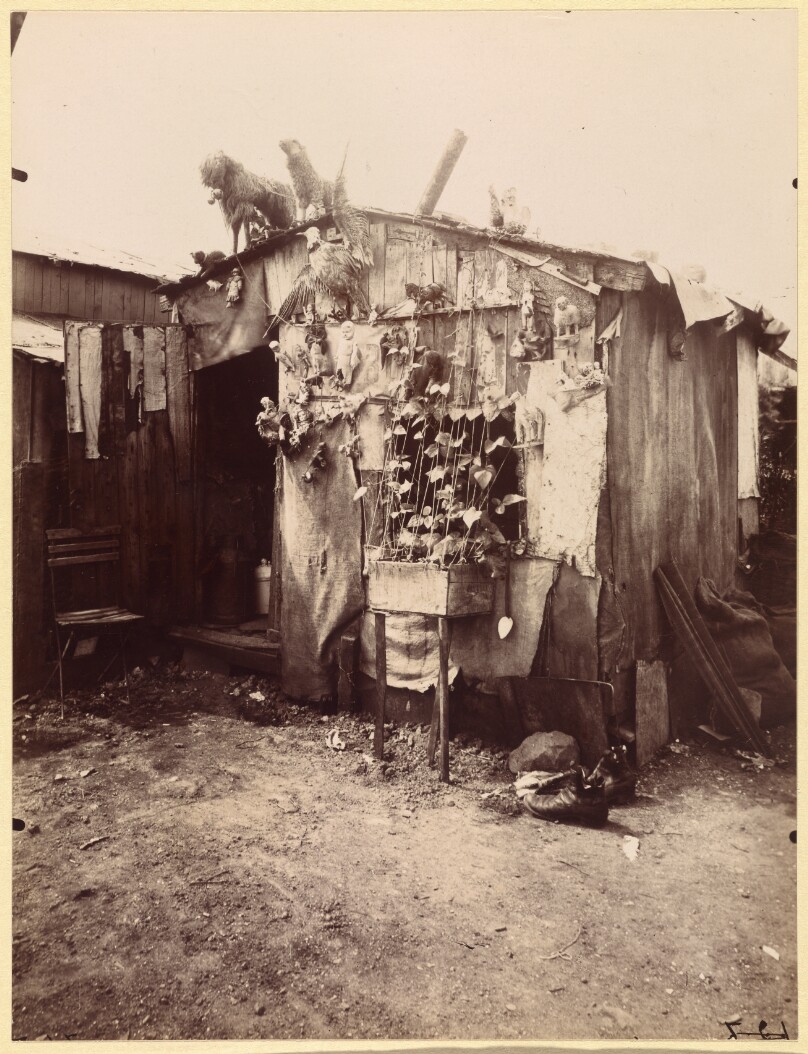
Villa d'un Chiffonnier
Creator
Eugène AtgetFrench Photographer · 1857–1927
All works by this person →Eugène Atget never called himself a photographer; instead he preferred "author-producer." A private, almost reclusive man, Atget first tried his hand at painting and acting, then began to photograph *vieux Paris* (Old Paris) in 1898. He photographed in part to create "documents," as he called his photographs, of architecture and urban views, but he supported himself by selling these photographs to
More on Getty ULAN- Date
- 1912
- Medium
- Albumen silver print
- Culture
- French
- Department
- Photographs
- Institution
- Getty Museum
- Object ID
- 2a2f671f-0a4e-4647-91b6-8243abe14349
From the Getty Museum record
> Although Eugène Atget's subject matter, insofar as it concerns daily life in Paris, centers around the middle class, he did not ignore the poor, whether their appearance on the streets or the places where they lived and worked. Among the most poverty-stricken Parisians were the chiffonniers (ragpickers; see [90.XM.127.4](https://www.getty.edu/art/collection/objects/64726/eugene-atget-chiffonier-french-1899-1901/) and [90.XM.46.4](https://www.getty.edu/art/collection/objects/63398/eugene-atget-and-berenice-abbott-ragpickers'-camp-french-negative-1913-print-about-1950/)), who combed the city for trash that might be collected and resold. (Recycled rags, for example, could be made into paper.) In Atget's time there were more than five thousand people involved in this form of trade, which was broken down into hierarchies according to the type of refuse that was amassed. Many of these fiercely independent individuals inhabited decrepit and decaying buildings, but others lived in gypsy wagons and ramshackle huts that they had assembled from their street findings. These flimsy shelters were to be found in outlying areas of Paris, set up on the ground where the metropolis's outmoded, mid-nineteenth-century defensive walls had been razed. > > The structure that Atget photographed here was atypically picturesque, its poverty partially masked by the decorations of detritus affixed to its sides and roof and the vines growing from a crude window box up onto strings across the window opening. The discards reused as architectural embellishment include several woebegone dolls and a variety of stuffed animals, including a sheep and woolly dog. Despite the cheerful bravado of these adornments, close examination shows that the walls were burlap tacked over crude shingles and that heat was supplied by some sort of stove, evident from the crooked pipe that protrudes from the roof. Running water was certainly not available. The pair of worn boots left outside at one corner of the rude habitation is a poignant indication of the impoverished state of whomever lived there (zoom in on the ground to the right of the plant box). It is remarkable that Atget was allowed to so closely infringe on a stranger's dwelling. > > Originally published in *Eugène Atget*, In Focus: Photographs from the J. Paul Getty Museum by Gordon Baldwin (Los Angeles: J. Paul Getty Museum, 2000), 58. ©2000, J. Paul Getty Trust.
The authoritative record is held by Getty Museum. LinkedCulture surfaces this object and its connections; it does not alter institutional metadata.
Get printable QR codesHide QR codes
Open QR codes for this object page and the museum record. They stay collapsed until needed.
Related across collections
Semantically similar works from Getty Museum and other institutions.