Getty Museum
Marine Gods Paying Homage to Love
Creator
Eustache Le SueurFrench Artist · 1616–1655
All works by this person →Eustache Le Sueur's father, a woodworker and sculptor, placed his son Eustache in Simon Vouet's studio when he was about sixteen. Unlike many of his peers, Le Sueur never went to Rome, instead finding his classicizing influence in Vouet's Baroque style. Primarily a painter of religious subjects for churches in Paris and its environs, he was said to have little use for immoral excesses and to have
More on Getty ULAN- Date
- about 1636–1638
- Medium
- Oil on canvas
- Culture
- French
- Department
- Paintings
- Institution
- Getty Museum
- Object ID
- 2cc6fd32-7752-434c-8949-1e5c53206aec
From the Getty Museum record
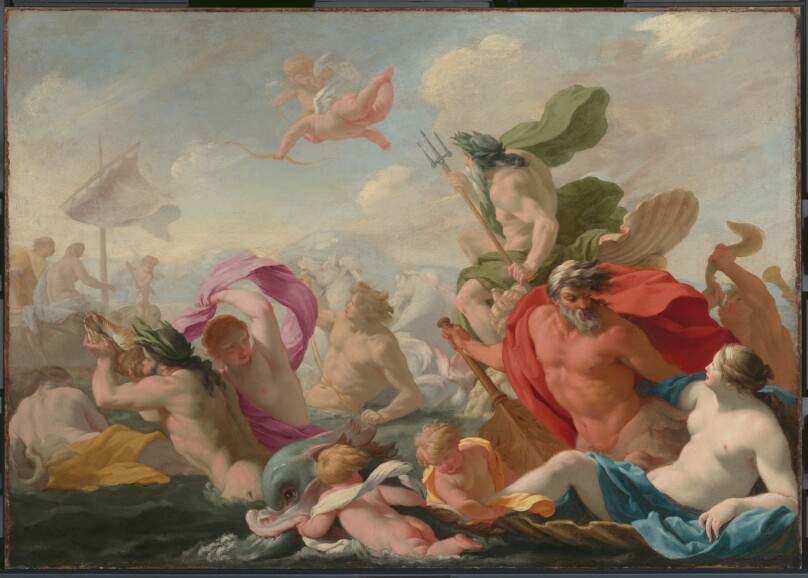
Classically proportioned sea gods and goddesses, partially clad in intensely colored drapery, form a dramatic procession against a light blue sky. This painting illustrates an episode in Francesco Colonna's *Hypnerotomachia Poliphili* (Strife of Love in a Dream of Polyphilus), an extravagant Renaissance tale of a dream-journey through antiquity. To the left, the lovers Polyphilus and Polia are ferried to Cythera, the island of love. The sea goddess Amphitrite, reclining in a shell at the lower right, and Neptune, seated high on a shell and holding his triton, watch the boat depart from amid a crowd of figures. Although it was first published in 1499, Colonna's book enjoyed immense popularity in seventeenth-century France. *Marine Gods Paying Homage to Love* is one of Eustache Le Sueur's eight canvases illustrating the *Hypnerotomachia Poliphili;* it was painted as a model for a Gobelins tapestry that was never executed.
The authoritative record is held by Getty Museum. LinkedCulture surfaces this object and its connections; it does not alter institutional metadata.
Get printable QR codesHide QR codes
Open QR codes for this object page and the museum record. They stay collapsed until needed.
Related across collections
Semantically similar works from Getty Museum and other institutions.