Getty Museum
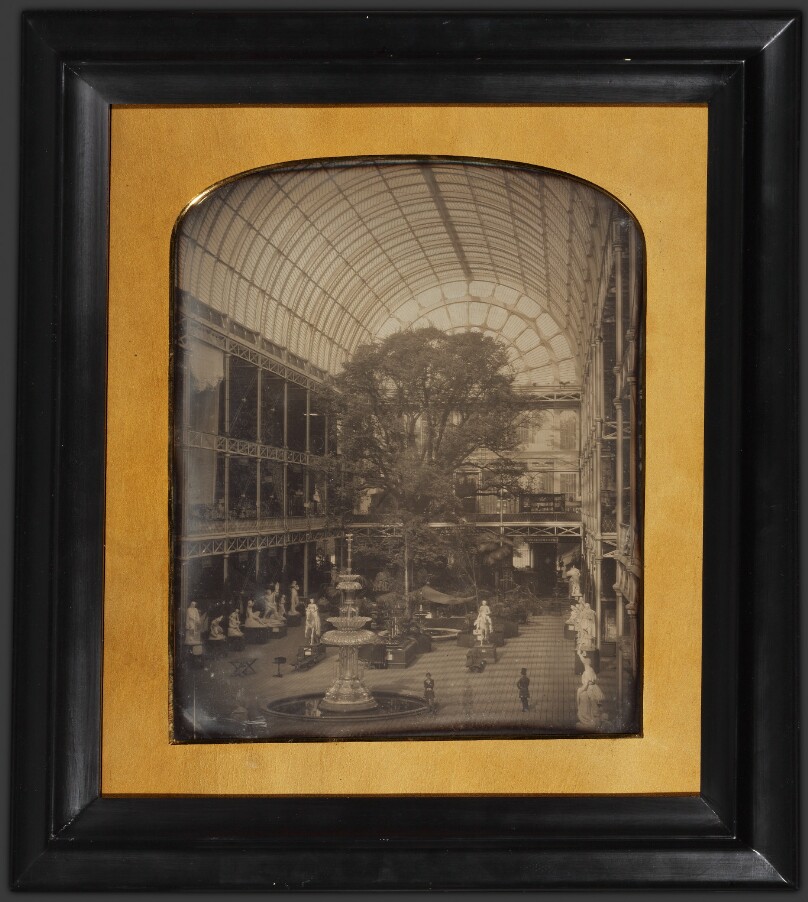
The Crystal Palace at Hyde Park, London
Creator
John Jabez Edwin MayallPhotographer · 1813–1901
All works by this person →After serving as the proprietor of a daguerreotype studio and a chemistry lecturer in Philadelphia, Pennsylvania, John Jabez Edwin Mayall relocated to London in 1846. He promptly obtained a daguerreotypist's license from Richard Beard, who at that time held the patent for the process in England. In April 1847 Mayall opened the American Daguerreotype Institution in London, explicitly naming it Amer
More on Getty ULAN- Date
- 1851
- Medium
- Daguerreotype
- Culture
- American
- Department
- Photographs
- Institution
- Getty Museum
- Object ID
- 2d34f035-ab9f-4d6b-906a-cd503b8d34c9
From the Getty Museum record
The Crystal Palace, an exhibition hall in Hyde Park, London, was the site of the first international exposition in 1851. The exposition was a great success, attracting more than six million visitors during the five months that it was open to the public. The impressive structure, consisting of an intricate network of slender iron rods sustaining walls of glass, was built expressly for the exposition and was not intended to be permanent. The main body of the building was 1,848 feet (563 m) long and 408 feet (124 m) wide; the central transept was 108 feet (33 m) high. The Crystal Palace established an architectural standard for later international exhibitions, several of which were likewise housed in glass conservatories. John Jabez Edwin Mayall may have made this daguerreotype from the second tier in order to encompass the scale of the building. The full-grown tree in the image's center, which does not even reach the ceiling, gives a dramatic indication of just how large the building was. An imperial plate size, the daguerreotype was one of the largest ever made. American daguerreotypes were larger than those made elsewhere; the Englishman Mayall surely saw this grandiose building as warranting equally impressive treatment.
The authoritative record is held by Getty Museum. LinkedCulture surfaces this object and its connections; it does not alter institutional metadata.
Get printable QR codesHide QR codes
Open QR codes for this object page and the museum record. They stay collapsed until needed.
Related across collections
Semantically similar works from Getty Museum and other institutions.