Getty Museum
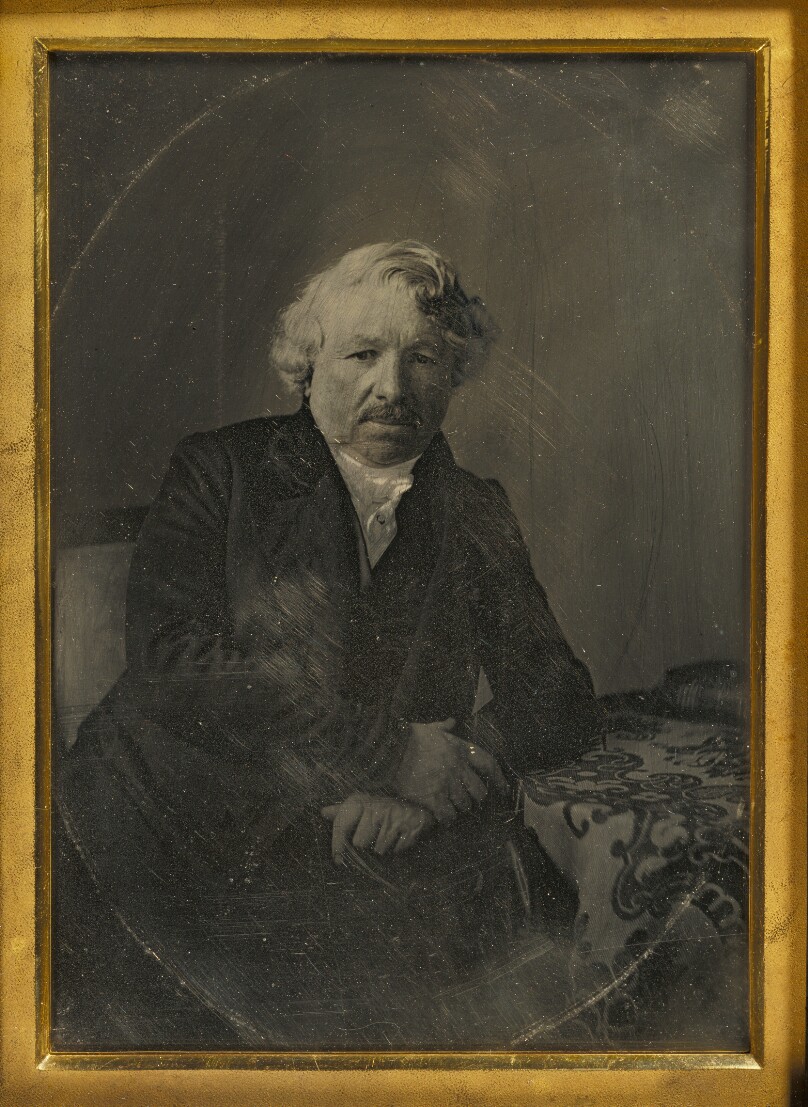
Portrait of Louis-Jacques-Mandé Daguerre
Creator
Charles Richard MeadeAmerican Photographer · 1826–1858
All works by this person →Charles Richard Meade began his photography career in Albany, New York, in 1842. After opening "Daguerrean Depots," as the studios were called, with his brother Henry in Albany, Buffalo, Troy, and Saratoga Springs, the Meade Brothers opened a grand studio on Broadway in New York City. The Broadway studio was the first combined daguerreotype studio and gallery in the United States; the brothers lat
More on Getty ULAN- Date
- 1848
- Medium
- Hand-colored daguerreotype
- Culture
- American
- Department
- Photographs
- Institution
- Getty Museum
- Object ID
- 32c21db6-c364-46c3-8722-f028837a1af7
From the Getty Museum record
> By New Year's Day of 1840—little more than one year after William Henry Fox Talbot had first displayed his photogenic drawings in London and just four to five months after the first daguerreotypes had been exhibited in Paris at the Palais d'Orsay in conjunction with a series of public demonstrations of the process—Daguerre's instruction manual had been translated into at least four languages and printed in at least twenty-one editions. In this way, his well-kept secret formula and list of materials quickly spread to the Americas and to provincial locations all over Europe. Photography became a gold rush-like phenomenon, with as much fiction attached to it as fact. > > Nowhere was the daguerreotype more enthusiastically accepted than in the United States. Charles R. Meade was the proprietor of a prominent New York photographic portrait studio. He made a pilgrimage to France in 1848 to meet the founder of his profession and while there became one of the very few people to use the daguerreotype process to photograph the inventor himself. > > A daguerreotype was (and is) created by coating a highly polished silver plated sheet of copper with light sensitive chemicals such as chloride of iodine. The plate is then exposed to light in the back of a camera obscura. When first removed from the camera, the image is not immediately visible. The plate must be exposed to mercury vapors to "bring out" the image. The image is then "fixed" (or "made permanent on the plate") by washing it in a bath of hyposulfite of soda. Finally it is washed in distilled water. Each daguerreotype is a unique image; multiple prints cannot be made from the metal plate. ([Watch a video on the daguerreotype process](https://youtu.be/N0Ambe4FwQk).) Adapted from Weston Naef, *The J. Paul Getty Museum Handbook of the Photographs Collection* (Los Angeles: J. Paul Getty Museum, 1995), 33, © 1995 The J. Paul Getty Museum; with additions by Carolyn Peter, J. Paul Getty Museum, Department of Photographs, 2019.
The authoritative record is held by Getty Museum. LinkedCulture surfaces this object and its connections; it does not alter institutional metadata.
Get printable QR codesHide QR codes
Open QR codes for this object page and the museum record. They stay collapsed until needed.
Related across collections
Semantically similar works from Getty Museum and other institutions.