Getty Museum
Taddeo's Hallucination (99.GA.6.14)
Creator
Federico ZuccaroItalian Artist · 1541–1609
All works by this person →After Titian's death in 1576, Federico Zuccaro may have been the most famous painter in Europe as well as the most influential, traveling widely and creating a huge number of works, largely of religious subjects. The son of a painter in Urbino, he absorbed Mannerism in Rome under his brother Taddeo, who was a dozen years his senior. When Taddeo died in 1566, Federico took over his flourishing prac
More on Getty ULAN- Date
- about 1595
- Medium
- Pen and brown ink, brush with brown wash, over black chalk
- Culture
- Italian
- Department
- Drawings
- Institution
- Getty Museum
- Object ID
- 36a20c7e-a769-403e-ac23-efa745907ec7
From the Getty Museum record
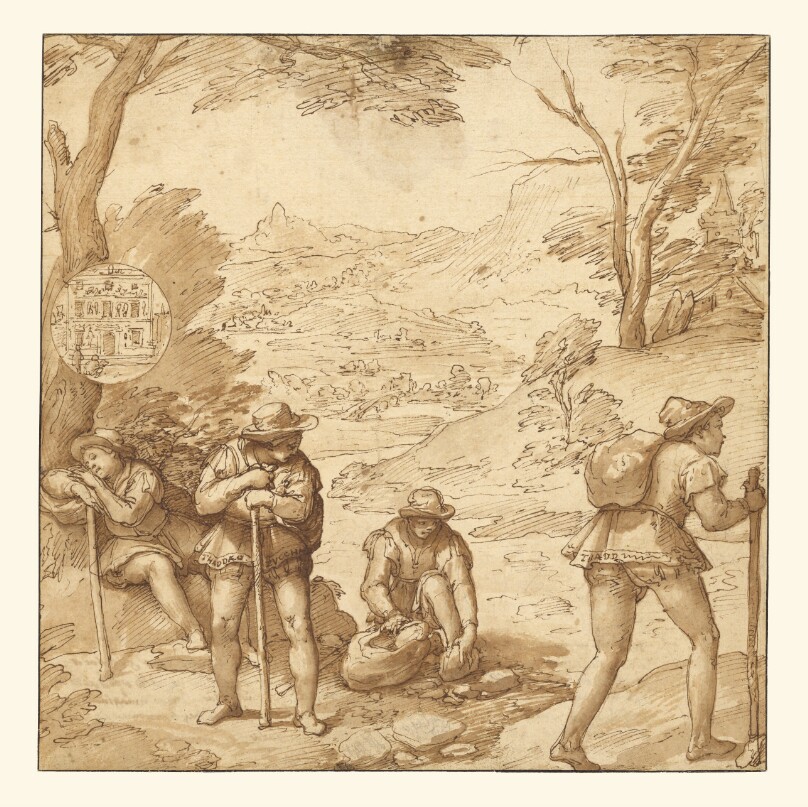
Federico Zuccaro described this scene in his notes: "One should not keep quiet to what happened to [Taddeo Zuccaro] during his return: tired of walking and suffering from fever, he stopped on the banks of a river, and waiting for someone to take him across, he rested and fell asleep; he woke up all sick from the pain he had and looking at the bank of the river, the stone and the gravel seemed as painted and historiated, similar to the facade and works of Polidoro [da Caravaggio] that he saw in Rome; this pleased him greatly. So shaken was his mind, and with the imagination he had, he really believed these to be what they seemed to be. He began his search for the stones that seemed better and more beautiful; he filled a sack, in which he carried his small things and his drawings." In a continuous narrative, Federico represented his brother four times. Taddeo falls asleep by a stream on the left and dreams in a circle above his head. In his illness he awakens to a hallucination that the river stones are painted with figures by Polidoro. He then loads his sack with these precious objects and struggles onwards.
The authoritative record is held by Getty Museum. LinkedCulture surfaces this object and its connections; it does not alter institutional metadata.
Get printable QR codesHide QR codes
Open QR codes for this object page and the museum record. They stay collapsed until needed.
Related across collections
Semantically similar works from Getty Museum and other institutions.