Getty Museum
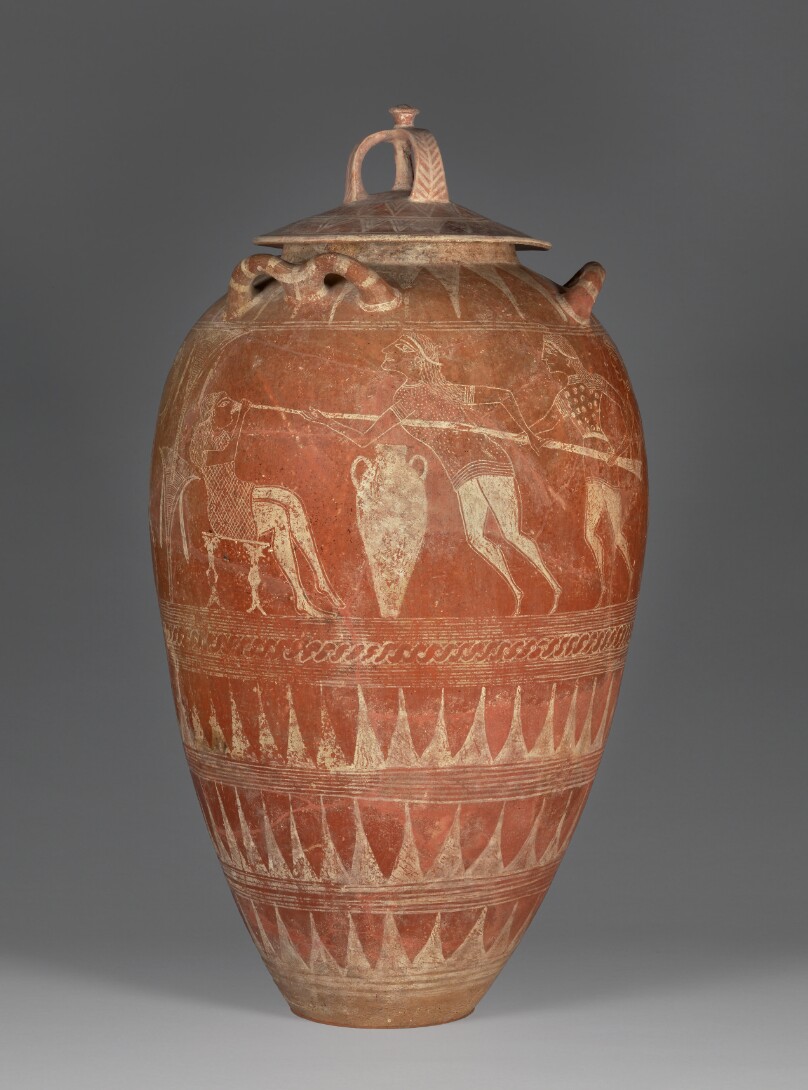
"White-on-Red" Ware pithos with Lid
- Date
- 650–625 B.C.
- Medium
- Terracotta
- Culture
- Etruscan
- Department
- Vessels
- Institution
- Getty Museum
- Object ID
- 38ddee45-bc0b-42ae-a49d-883437be8b32
From the Getty Museum record
A scene from *The Odyssey,* by the Greek poet Homer, decorates this lidded Etruscan pithos or large storage vessel. Odysseus and his men were trapped in the cave of Polyphemos, a Cyclops who was devouring them one by one. In order to escape, the Greeks got the giant drunk and then put out his single eye with a sharpened stake. The myth of Odysseus was extremely popular in Etruria. Here, the unknown artist has placed a large amphora between the Greeks and Polyphemos as a reference to the wine that Odysseus tricked the giant into drinking. He also emphasized the force of the attack by showing the Greeks leaning forward as they drive in the stake. On the back of the vase a pair of horses and a lion with its prey, a small deer, hanging from its mouth are interspersed with odd-looking plants. Pithoi were used for the storage of both liquids and dry goods. They were often sunk into the ground to make their contents more easily retrievable. Such a purely utilitarian role does not agree with the elaborate decoration of this vessel. Some scholars believe that ornate pithoi, such as this one, may have had a funerary function.
The authoritative record is held by Getty Museum. LinkedCulture surfaces this object and its connections; it does not alter institutional metadata.
Get printable QR codesHide QR codes
Open QR codes for this object page and the museum record. They stay collapsed until needed.
Related across collections
Semantically similar works from Getty Museum and other institutions.