Getty Museum
Bellum Gallicum; Bellum Civile; Bellum Alexandrinum; Bellum Africanum; Bellum Hispaniense
- Date
- about 1460–1470
- Medium
- Tempera colors, gold leaf, gold paint, and ink
- Culture
- Italian
- Department
- Manuscripts
- Institution
- Getty Museum
- Object ID
- 3b7dd7e4-6a2b-48aa-a513-83a556ef5641
From the Getty Museum record
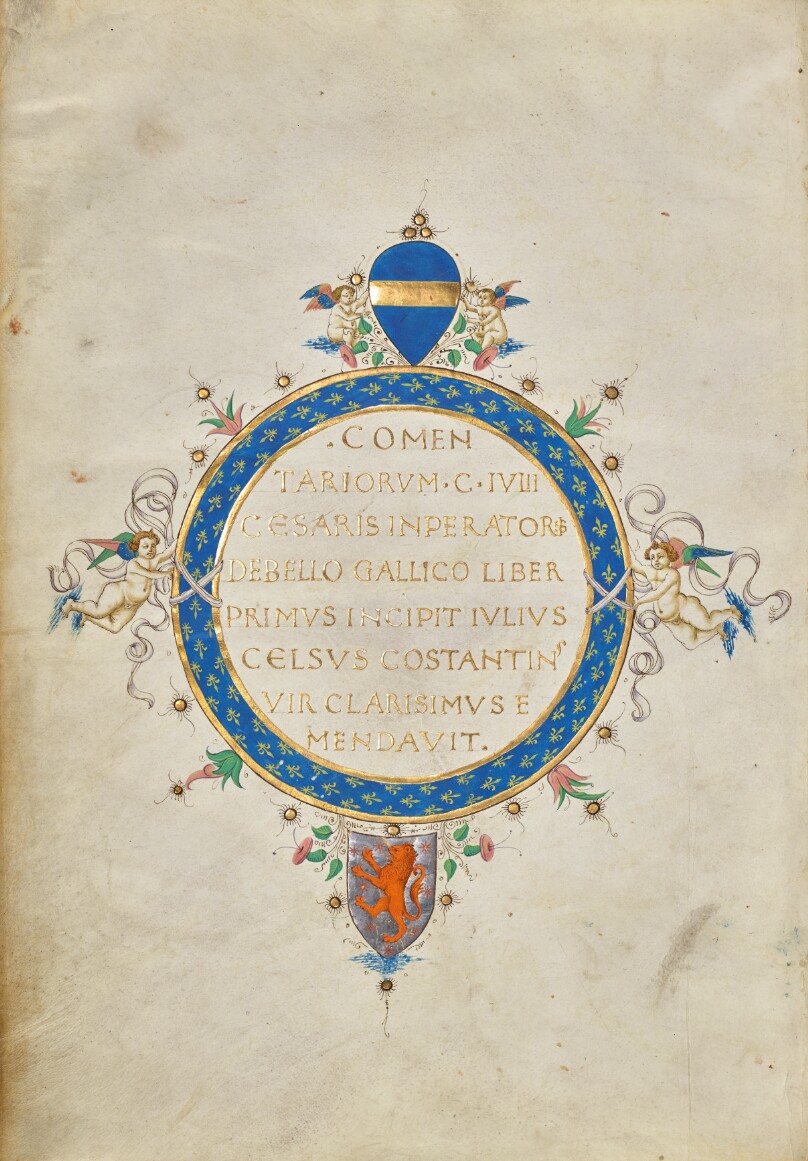
The *Corpus Caesarianum* is a collection of texts about the exploits and deeds of the Roman statesman Gaius Julius Caesar. Compiled following his assassination in 44 BCE, it includes two histories and commentaries believed to have actually been penned by Caesar himself—that of the Gallic War (58 and 52 BCE) and Civil War (49–48 BCE)—as well as works written by his followers. These additions cover the Alexandrian War (48–47 BCE), African War (47–46 BCE), and Spanish War (46–45 BCE). Histories like this were of especial value to fifteenth-century Italian humanists, intellectuals who had revived interest in Antiquity and sought to explore concepts of ethics and reason through examinations of the past. Members of the nobility in Italy would have also prized such secular works as this one for both the military knowledge and the contemporary ideals of masculinity they imparted. The decoration in this manuscript was completed by Francesco di Antonio del Chierico (1433 – 1484), a goldsmith and illuminator from Florence. He served many wealthy patrons, including the powerful de Medici and da Montefeltro families. The volume opens with a title page featuring a roundel framed by two winged figures (putti) and two coats of arms. The lower one features a red lion against a silver leaf background with stars, while the upper features a simple gold crossbar against a bright blue ground. These possibly connect the manuscript to the Baglioni family of Perugia and the Simonetti family of Bologna. Elsewhere, the manuscript includes a historiated initial, a G occupied by an equestrian portrait of Julius Caesar. The Roman dictator is styled as a fifteenth-century knight, albeit sporting a laurel wreath instead of a helm on his head. The white horse he rides just barely crosses over the stem of the G, giving the impression of three-dimensional space. Surrounding the page is also a frame ornamented with *bianchi girari*, or white vine-stem in Italian. The vines are left blank, while areas around them are filled in with color. Putti, birds, rabbits, and other creatures animatedly weave in and out of the vines. The white vine-stem technique is also used not for a frame, but for a decorated initial E, at the beginning of the fourth book in the volume.
The authoritative record is held by Getty Museum. LinkedCulture surfaces this object and its connections; it does not alter institutional metadata.
Get printable QR codesHide QR codes
Open QR codes for this object page and the museum record. They stay collapsed until needed.
Related across collections
Semantically similar works from Getty Museum and other institutions.