Getty Museum
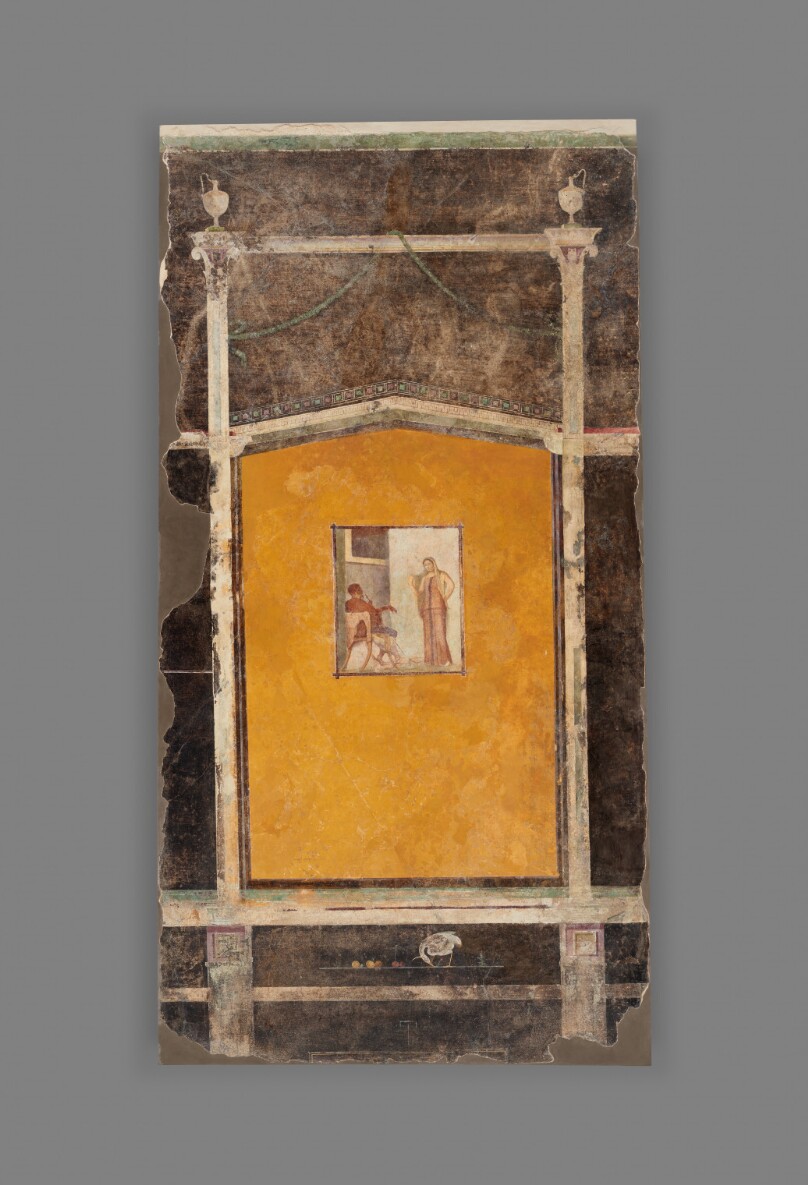
Wall Panel from a Black Ground Frescoed Room
Creator
UnknownAll works by this person →More on Getty ULAN- Date
- A.D. 1–50
- Medium
- Fresco
- Culture
- Roman
- Department
- Paintings
- Institution
- Getty Museum
- Object ID
- 3e6537e6-8532-4e40-ac1d-03aca2d428e2
From the Getty Museum record
One of three fresco panels that decorated the same room (Room 4) of the Villa of Numerius Popidius Florus at Boscoreale (see also [72.AG.79.1](https://www.getty.edu/art/collection/object/103SVJ) and [72.AG.79.2](https://www.getty.edu/art/collection/object/103SVK)), displaying fanciful architectural compositions on a black background. A figural scene on a yellow background decorates the center of this panel. The seated man’s unkempt beard, scanty clothing, bare feet, and staff suggest that he is a philosopher of the Cynic school, noted for asceticism and disregard for social norms. He converses with a woman, leading some to identify the philosopher instead as Socrates, speaking with Diotima, a character who teaches him the philosophy of love in Plato’s _Symposium_. The painting style, categorized by scholars as the Third Style of Roman wall painting, features small vignettes and elegant ornamental architecture. The Villa of Numerius Popidius Florus was built in the early first century B.C., and underwent several modifications before it was destroyed by the volcanic eruption of Mount Vesuvius in A.D. 79. A variety of objects were found in Room 4, including bronze vessels, lamps, agricultural tools and the remains of iron weaponry, suggesting that it was used for storage by the time of the eruption. Two marble plaques found in the central courtyard reveal the name of the owner, who came from a well-established family in Pompeii. In contrast to the urban houses of Pompeii and the seaside villas overlooking the Bay of Naples, however, the country estates (or villae rusticae) of Boscoreale were working farms. The estate of Numerius Popidius Florus produced wine, which was stored in large jars partially buried in the courtyard. The house itself was richly decorated with frescoes and mosaics and had a small bath complex. Excavated in 1905–1906, the site was subsequently reburied after most of the wall paintings, vessels, and other objects were removed.
The authoritative record is held by Getty Museum. LinkedCulture surfaces this object and its connections; it does not alter institutional metadata.
Get printable QR codesHide QR codes
Open QR codes for this object page and the museum record. They stay collapsed until needed.
Related across collections
Semantically similar works from Getty Museum and other institutions.