Getty Museum
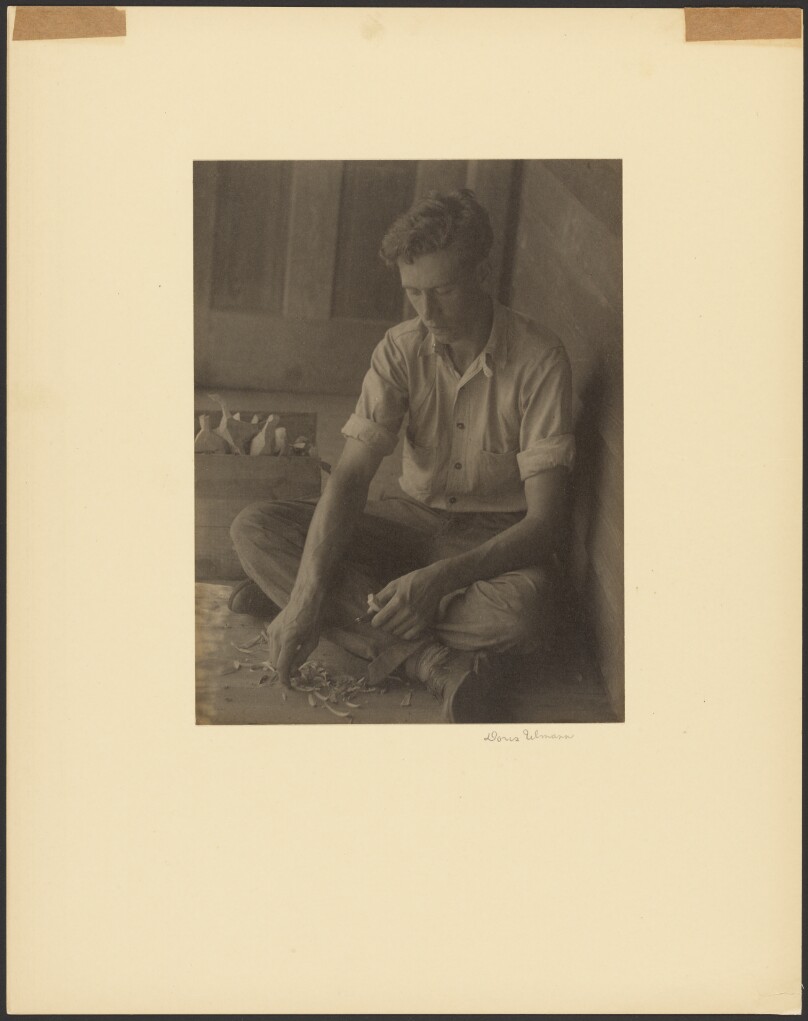
Hayden Hensley, Woodcarver, Brasstown, North Carolina
Creator
Doris UlmannAmerican Photographer · 1882–1934
All works by this person →A New Yorker by birth, Doris Ulmann preserved the rural cultures of the southeastern United States through her photographs. She worked particularly in the "Southern Highlands" of the Appalachian Mountains, creating portraits of the residents. In 1933, she contributed photographs to *Roll, Jordan, Roll*, a book by novelist Julia Peterkin about the vanishing black culture, known as Gullah, of the So
More on Getty ULAN- Date
- about 1933–1934
- Medium
- Platinum print
- Culture
- American
- Department
- Photographs
- Institution
- Getty Museum
- Object ID
- 3eebad12-9d85-4bed-bb75-ce8c0c5b3f97
From the Getty Museum record
Hayden Hensley (1911-2001), one of the first students at the John C. Campbell Folk School, was also its most talented woodcarver. Having grown up on a farm in the area, he attended the settlement school for three years and married a local girl who was working there, Bonnie Logan, whom Doris Ulmann also photographed, along with their son, John ([https://www.artic.edu/artworks](https://www.artic.edu/artworks/46035/bonnie-logan-hensley-with-baby-john-hensley)). Using his skills, Hensley built a home nearby, which he paid off with the proceeds of his carving. In *Handicrafts of the Southern Highlands* (1937), Allen Eaton (1878-1962) used another of Ulmann's portraits of Hensley, captioning it *A North Carolina Mountain Whittler* ([https://primo.getty.edu](https://primo.getty.edu/primo-explore/fulldisplay?docid=GETTY_ALMA21140498420001551&context=L&vid=GRI&lang=en_US&search_scope=COMBINED&adaptor=Local%20Search%20Engine&tab=all_gri&query=any,contains,allen%20eaton&offset=0)). Eaton criticized other historians of carpentry for not mentioning the modest pocketknife and the art of whittling. Among many crafts, woodcarving was encouraged by Olive Dame Campbell at her school (see [87.XM.89.29](https://www.getty.edu/art/collection/objects/62313/doris-ulmann-interior-of-olive-dame-campbell's-house-brasstown-north-carolina-american-1933-1934/)), where fruit wood was typically employed, along with holly and maple. For finishing, the whittled pieces were not painted or stained, but were waxed and rubbed. According to Eaton's assessment, the style of the students' carvings was "usually naturalistic, but occasionally . . . a bit futuristic." Adapted from Judith Keller. *Doris Ulmann*, In Focus: Photographs from the J. Paul Getty Museum (Los Angeles: J. Paul Getty Museum, 1996), 80. ©1996, J. Paul Getty Trust.
The authoritative record is held by Getty Museum. LinkedCulture surfaces this object and its connections; it does not alter institutional metadata.
Get printable QR codesHide QR codes
Open QR codes for this object page and the museum record. They stay collapsed until needed.
Related across collections
Semantically similar works from Getty Museum and other institutions.