Getty Museum
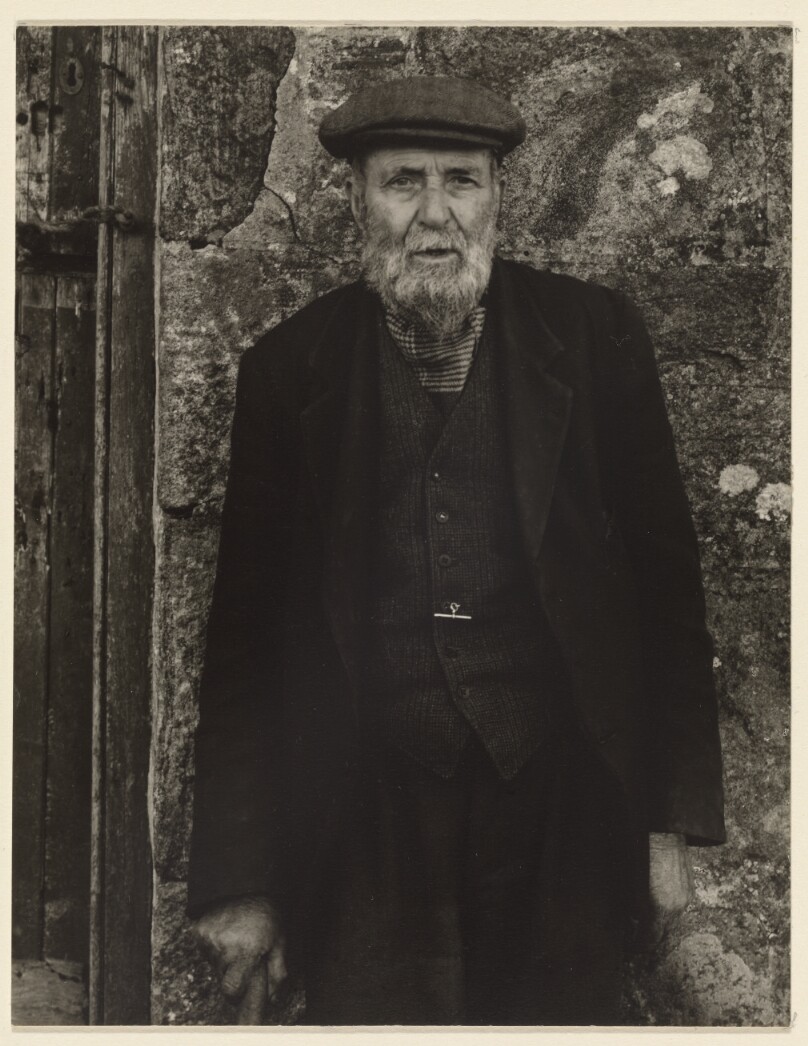
Norman Douglas
Creator
Paul StrandAmerican Photographer · 1890–1976
All works by this person →Paul Strand began photographing in New York in the 1910s. During the early 1920s he received recognition for both his painting and his photography. He visited New Mexico in 1926 and, beginning in 1930, returned for three consecutive summers, making portraits of artist friends and acquaintances. It was there, amidst a community of visual artists and writers, that Strand began to develop his belief
More on Getty ULAN- Date
- 1954
- Medium
- Gelatin silver print
- Culture
- American
- Department
- Photographs
- Institution
- Getty Museum
- Object ID
- 3f7237bc-dffd-4084-a8dd-463d27b756b1
From the Getty Museum record
By the time _Un paese: Portrait of an Italian Village_ was published in 1955, Paul Strand was already preparing his next book, based on the people of South Uist, in the Outer Hebrides of Scotland. After hearing a radio program on the Gaelic songs of the island, he wanted to find out more about this ancient culture and set off to spend three months getting to know the land and its inhabitants. The resulting book, _Tlr a'Mhurain: Outer Hebrides_, was published in 1962 with Strand's pictures accompanied by text from the cultural historian Basil Davidson (1914-2010). The pattern was now a familiar one; in both _La France de Profil_ (1952) and _Un paese: Portrait of an Italian Village_ (1955) the writer retraced the steps of the photographer and, putting words to the images, revealed the lives and stories of the native islanders who had previously stood before Strand's camera. The Scottish portraits, like the French and Italian ones before them, are heroic in nature. According to Strand, the individuals not only represent themselves but also are part of a culture that through its simple yet precarious existence was at risk of being shattered, or worse, eradicated through the pernicious impact of the modern world. When he made these photographs in 1954, the population of South Uist was fewer than four thousand; as of 2011 the population had declined to less than two thousand, perhaps validating Strand’s underlying premise of a threatened community. In these portraits Strand places each individual in the center of the composition, the sole subject set against the background of a weathered wall. The structure comes to symbolize the backdrop of life—an existence equally as rough as the stones themselves. A stabilizing force in Strand's execution of the image, this support offers a very practical element of an impromptu studio setting and functions as a common denominator. Whether in France, Italy, or Scotland, each wall is an appendage to the existence of the people featured in the photographs, individuals who represent the universal struggle of humanity ([86.XM.686.2](https://www.getty.edu/art/collection/object/106NTM), [86.XM.683.30](https://www.getty.edu/art/collection/object/106NRV), [86.XM.683.39](https://www.getty.edu/art/collection/object/106NS4)). Adapted from _Paul Strand_, In Focus: Photographs from the J. Paul Getty Museum by Anne M. Lyden (Los Angeles: J. Paul Getty Museum, 2005), 88. ©2005, J. Paul Getty Trust.
The authoritative record is held by Getty Museum. LinkedCulture surfaces this object and its connections; it does not alter institutional metadata.
Get printable QR codesHide QR codes
Open QR codes for this object page and the museum record. They stay collapsed until needed.
Related across collections
Semantically similar works from Getty Museum and other institutions.