Getty Museum
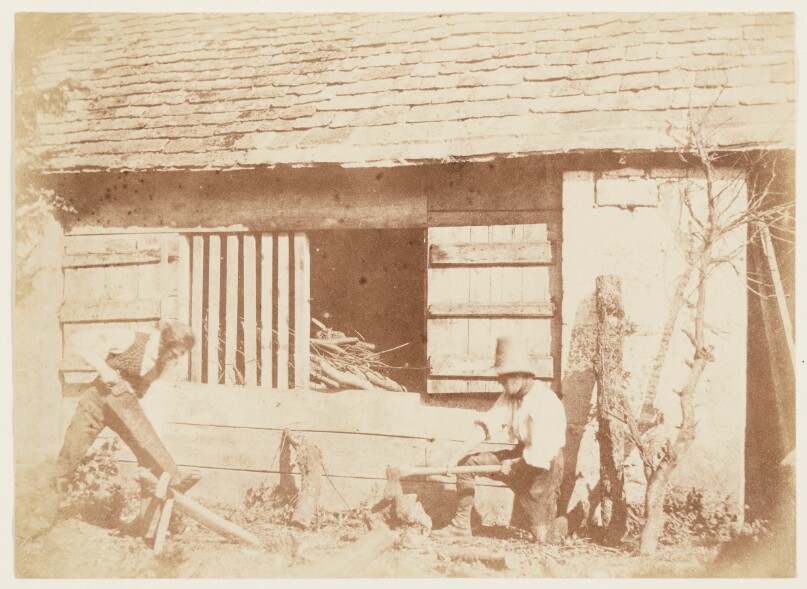
The Woodcutters
Creator
William Henry Fox TalbotPhotographer · 1800–1877
All works by this person →In 1833, after failed attempts at drawing using the camera lucida, an optical tool, William Henry Fox Talbot wrote: "[H]ow charming it would be if it were possible to cause these natural images to imprint themselves durably, and remain fixed upon the paper!" Talbot, a scientist, mathematician, and author, is credited with being one of the inventors of photography. In mid-1834 he began to experimen
More on Getty ULAN- Date
- probably 1845
- Medium
- Salted paper print from a paper negative
- Culture
- British
- Department
- Photographs
- Institution
- Getty Museum
- Object ID
- 4056bca3-f62c-4095-b908-3f1179e48c0f
From the Getty Museum record
> In his illustrated treatise on photography, *The Pencil of Nature* (1844-46), William Henry Fox Talbot commented that > > > > > “one advantage of the discovery of the Photographic Art will be, that it will enable us to introduce into our pictures a multitude of minute details which add to the truth and reality of the representation, but which no artist would take the trouble to copy faithfully from nature. Contenting himself with a general effect, he would probably deem it beneath his genius to copy every accident of light and shade. . . . Nevertheless . . . these minutiæ . . . will sometimes be found to give an air of variety beyond expectation to the scene represented.” > > > > > > > This image features Talbot’s former assistant, Nicolaas Henneman, and another man posed in a re-creation of a typical scene on a country estate. Henneman had become the proprietor of the first photographic printing firm, the Reading Establishment, which oversaw the publication of *The Pencil of Nature* in 1844*.* This photograph gathers its “truth and reality” not only from their actions but also from the “multitude of minute details” and “accident[s] of light and shade.” In fact, however, the men are not captured in motion, but are carefully holding still for the duration of the exposure. Additionally, one accident of shade was eliminated. In the original negative, the gathering late afternoon shadow of Lacock Abbey presses strongly into the foreground area. After printing the negative in this state, Talbot must have decided that the shadow dominated the scene more than he wished, so he trimmed off the lower part of the negative, leading to this composition. A modern photographer would have done this cropping in the darkroom or on the computer, and with a print, not permanently with the negative. Talbot’s approach with the scissors was confidently final; only the survival of the earlier print (National Science and Media Museum, Bradford, UK) reveals what the negative once was. > > Adapted from Larry Schaaf, *William Henry Fox Talbot*, In Focus: Photographs from the J. Paul Getty Museum (Los Angeles: Getty Publications, 2002), 90. ©2002 J. Paul Getty Trust.
The authoritative record is held by Getty Museum. LinkedCulture surfaces this object and its connections; it does not alter institutional metadata.
Get printable QR codesHide QR codes
Open QR codes for this object page and the museum record. They stay collapsed until needed.
Related across collections
Semantically similar works from Getty Museum and other institutions.