Getty Museum
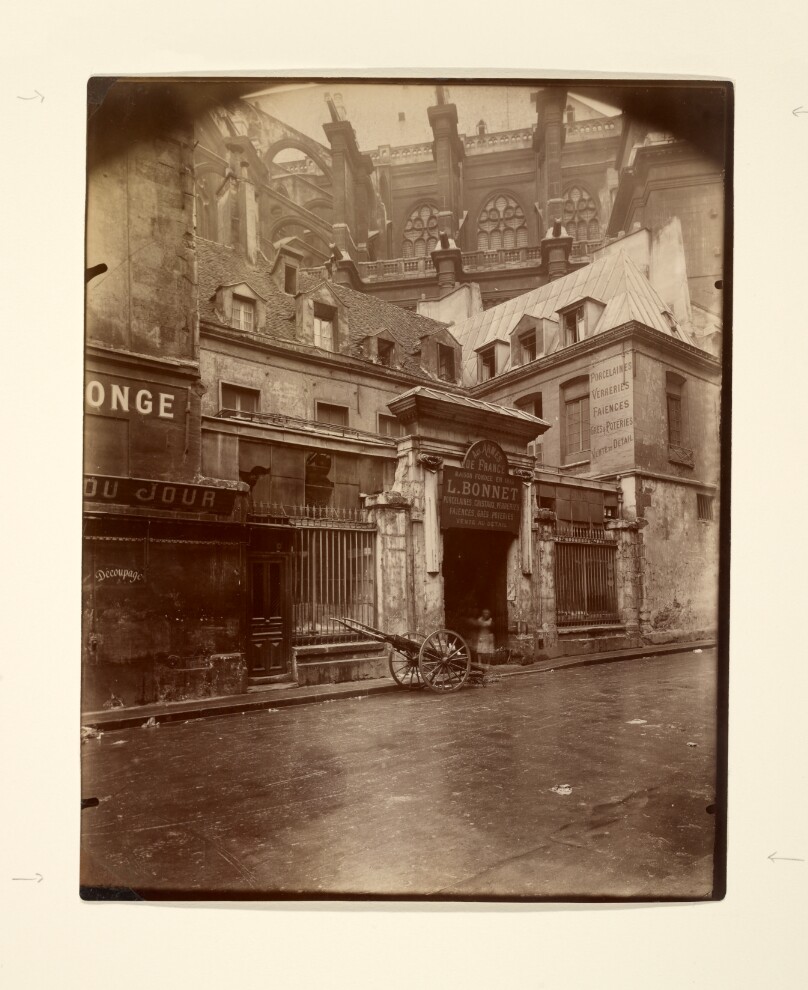
Rue du Jour
Creator
Eugène AtgetFrench Photographer · 1857–1927
All works by this person →Eugène Atget never called himself a photographer; instead he preferred "author-producer." A private, almost reclusive man, Atget first tried his hand at painting and acting, then began to photograph *vieux Paris* (Old Paris) in 1898. He photographed in part to create "documents," as he called his photographs, of architecture and urban views, but he supported himself by selling these photographs to
More on Getty ULAN- Date
- 1925
- Medium
- Gelatin silver chloride printing-out paper print
- Culture
- French
- Department
- Photographs
- Institution
- Getty Museum
- Object ID
- 41262db2-b02f-43c3-a9e2-eb4c68c9dcc9
From the Getty Museum record
> The Paris dwellings of the rich were traditionally shaped around a forecourt, with the principal rooms located in the block farthest from the street. Such was the case with the building in the foreground of this photograph, the Hôtel de Royaumont, which was constructed in 1612 for a high-ranking French churchman. It stood immediately next to and in the shadow of the large and important church of Saint-Eustache, which was still under construction when the house was built. Rented for years to secular tenants, the mansion was confiscated by the state after the French Revolution. By 1860 it was occupied by a crockery and porcelain merchant, whose wares were advertised by signs painted on the exterior walls. The arch of the entrance gateway was covered by more signage, and the noble edifice was in decrepit condition. The building now on this site has the same volumes as the ancient residence and similar details but was constructed in 1950; hence its [present appearance](http://parisdansmonoeilen.weebly.com/blog-photo/the-htel-de-royaumont) is pristine by comparison with the structure in 1925. > > Eugène Atget rarely made a grittier photograph than this, which is highly expressive of urban density and decay. The short focal length of his lens produced a compression of the architecture of the manse and church, so it is difficult to separate the uniformly grime-coated elements of each building. The shadowy little girl in the doorway, who moved away in the course of the exposure, seems nearly as dirty as the stone. One wonders if her life was as deprived as the setting would suggest. The tilted barrow and the litter in the street add further forlorn notes to a depressing scene of squalor, in which even the letters of the truncated sign at left, although the brightest tones in the photograph, become ominous. > > Originally published in *Eugène Atget*, In Focus: Photographs from the J. Paul Getty Museum by Gordon Baldwin (Los Angeles: J. Paul Getty Museum, 2000), 72. ©2000, J. Paul Getty Trust.
The authoritative record is held by Getty Museum. LinkedCulture surfaces this object and its connections; it does not alter institutional metadata.
Get printable QR codesHide QR codes
Open QR codes for this object page and the museum record. They stay collapsed until needed.
Related across collections
Semantically similar works from Getty Museum and other institutions.