Getty Museum
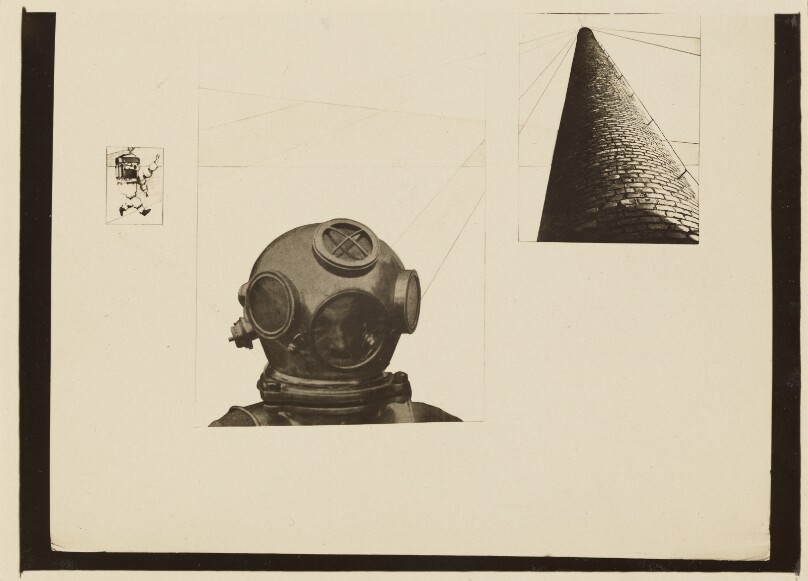
Der Wasserkopf
Creator
László Moholy-NagyAmerican Photographer · 1895–1946
All works by this person →> The reality of our century is technology: the invention, construction and maintenance of machines. To be a user of machines is to be of the spirit of this century. Machines have replaced the transcendental spiritualism of past eras. > > --László Moholy-Nagy > > Perhaps more than any other artist in the Getty Museum collection, László Moholy-Nagy would have delighted in the presentation of his im
More on Getty ULAN- Date
- 1925
- Medium
- Gelatin silver print
- Culture
- American
- Department
- Photographs
- Institution
- Getty Museum
- Object ID
- 4195095d-90e6-4452-b4ff-d2d735bb6277
From the Getty Museum record
> This image may be an oblique attack on Albert Renger-Patzsch, a contemporary of László Moholy-Nagy who was the leader of the New Objectivity movement in German photography. Renger-Patzsch’s *Factory Smokestack* was reproduced by Moholy-Nagy in his 1925 book *Maleri, Photographie, Film*, (Painting, photography, film*).* In the context of this montage, however, Moholy-Nagy seems to use the receding form of the smokestack and the constricted view through the diver’s helmet to suggest tunnel vision on the part of Renger-Patzsch, who spoke out against the Bauhaus approach. The title, with its slang reference to stupidity and hydrocephalus (an abnormal accumulation of fluid in the cranial cavity that results in the expansion of the skull and atrophy of the brain) reinforces the negative visual message. The other diver, a cartoonlike buffoon, continues this idea. > > Like Moholy-Nagy, Renger-Patzsch was deeply involved in issues of vision and perception and interested in using the medium of photography to record form and detail in order to give a fresh view of the familiar. Feeling that nature needed little improvement, however, he made photographs that celebrated the inherent beauty of trees as well as railroads and smokestacks, whereas Moholy advocated freeing the camera from reproducing nature. Renger-Patzsch’s work was rejected by many of his colleagues for not being revolutionary enough, but he countered that much of contemporary photography consisted of “looking up/looking down,” a reference to the exaggerated perspective favored at the Bauhaus and by Moholy-Nagy. Both extremes of vision seem to be represented here, from looking up at the smokestack to looking down into the deep. The open white space in this composition is a bold departure from Moholy’s earlier montages, in which he created stage sets for his images. Here the three pictorial elements are connected only by thin pencil lines. > > Katherine Ware, *László Moholy-Nagy*, In Focus: Photographs from the J. Paul Getty Museum (Los Angeles: J. Paul Getty Museum, 1995), 42. © 1995 The J. Paul Getty Museum.
The authoritative record is held by Getty Museum. LinkedCulture surfaces this object and its connections; it does not alter institutional metadata.
Get printable QR codesHide QR codes
Open QR codes for this object page and the museum record. They stay collapsed until needed.
Related across collections
Semantically similar works from Getty Museum and other institutions.