Getty Museum
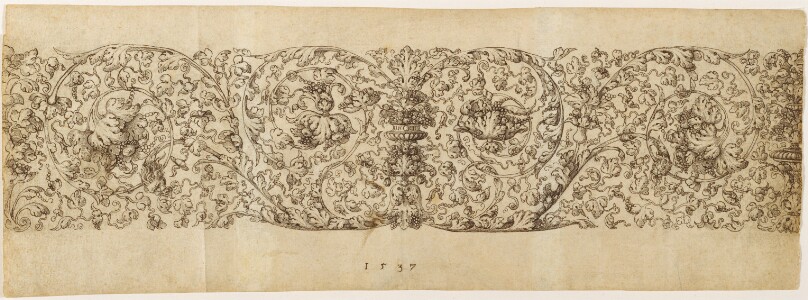
Design for a Frieze of Grapevines
Creator
Virgil SolisGerman Artist · 1514–1562
All works by this person →With an output of over 2,000 prints and drawings, Virgil Solis was one of Nuremberg's most prolific printmakers and book illustrators. His origins and training are unclear, though his father may have been a painter. He became a master in 1539 and often signed himself as a painter, but no evidence of that career exists. Solis aimed to produce popular, commercially successful prints on many subjects
More on Getty ULAN- Date
- 1537
- Medium
- Pen and black ink, horizontal stylus indentation lines above and below the length of the design
- Culture
- German
- Department
- Drawings
- Institution
- Getty Museum
- Object ID
- 428557bf-aa94-4aba-b9d6-9c21a03e41b7
From the Getty Museum record
Virgil Solis organized this design for lush, interlaced foliage symmetrically, dividing it with a central urn from which sprout curling grapevines. Four large, drooping flowers and two tiny masks, whose wavy hair and beards echo the scrolling vines, hang from the ends of several of the vines. In antiquity, leafy designs such as this one, known as rinceaux, were popular motifs for ornamenting a variety of forms from furniture to architecture. Such motifs copied from ancient Greek and Roman art fascinated designers in the 1500s. Although both sides of the drawing have been cut off, leaving only the edge of an urn on the right, Solis probably intended to show the beginning of the same repeating pattern. Other artists and craftsmen could then have copied this continuous decorative frieze to ornament a panel on a variety of objects. The horizontal incised lines above and below the design could have been used to transfer the image onto another surface.
The authoritative record is held by Getty Museum. LinkedCulture surfaces this object and its connections; it does not alter institutional metadata.
Get printable QR codesHide QR codes
Open QR codes for this object page and the museum record. They stay collapsed until needed.
Related across collections
Semantically similar works from Getty Museum and other institutions.