Getty Museum
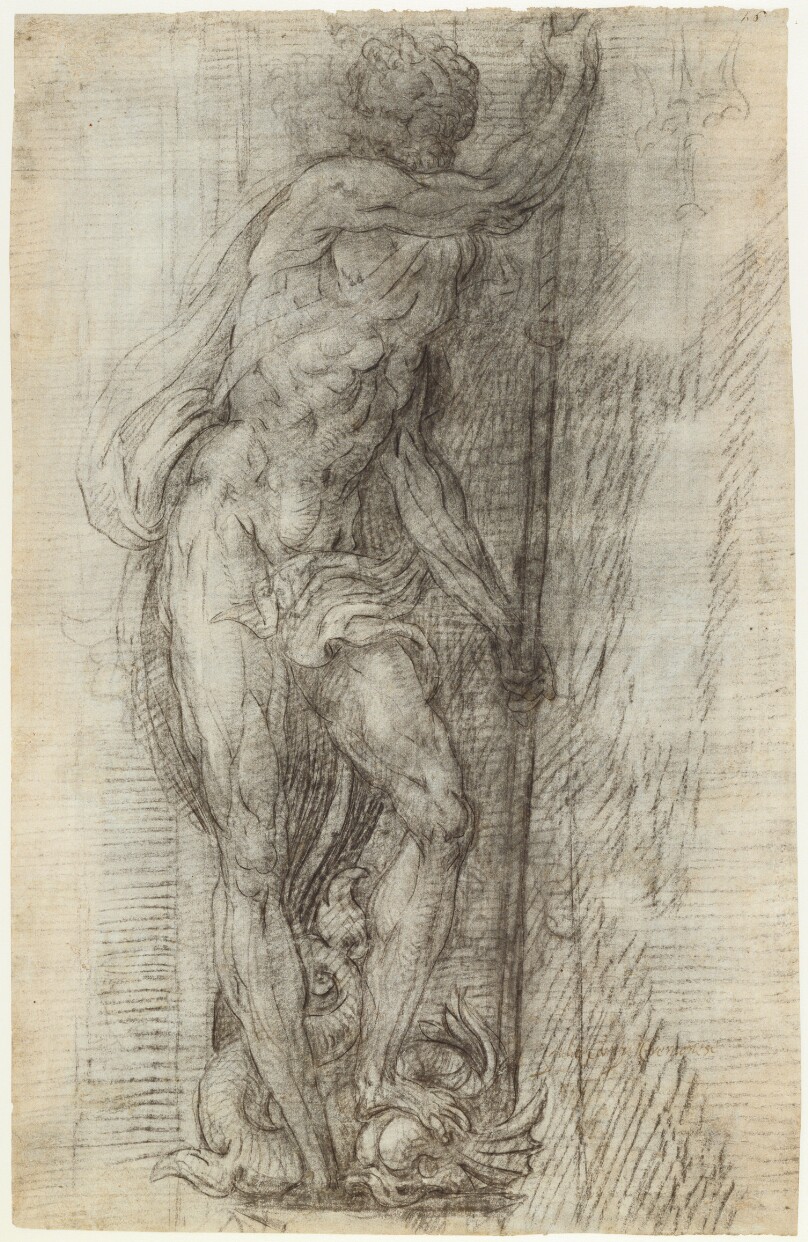
Neptune
Creator
Giulio CampiItalian Artist · 1508–1573
All works by this person →Leading member of an artistic dynasty in Cremona, Giulio Campi trained his much younger brother, with whom he sometimes collaborated; his own sons; and a group of pupils who dominated Cremonese painting in the last half of the 1500s. According to Giorgio Vasari, Campi learned painting from his father, though his early creations were also indebted to Pordenone's Mannerist style. Around 1539, Campi
More on Getty ULAN- Date
- 1541
- Medium
- Black chalk, the principle lines indented (recto); Rubbed with black chalk for transfer (verso)
- Culture
- Italian
- Department
- Drawings
- Institution
- Getty Museum
- Object ID
- 43fd01bf-4ae6-4195-8da7-178659fe7ff1
From the Getty Museum record
Neptune, the Roman god of the sea, grasps his trident while resting one foot on the scaly head of a dolphin. He stands on a pedestal against a pilaster, the base of which is mainly defined by the dolphin's body. On each side are the hastily drawn lines of a vertical piece of architecture, while farther to the right are the dark shadows of his arms and trident. Giulio Campi probably produced this sketch as a preparatory study for the decoration of one of the triumphal arches erected in Cremona on the occasion of Emperor Charles V's entry into the city on August 18, 1541. Decorated with statues and representations of his famous deeds and insignia, these arches marked the ruler's route through the city gates to his lodgings. The number of pentimenti in this rapidly drawn work suggests to scholars that Campi completed the drawing in some haste, probably working under a tight deadline. For example, he produced two further alternatives for the position of the head, both in profile and tilted farther back, but he did not bother to reinforce either in darker chalk.
The authoritative record is held by Getty Museum. LinkedCulture surfaces this object and its connections; it does not alter institutional metadata.
Get printable QR codesHide QR codes
Open QR codes for this object page and the museum record. They stay collapsed until needed.
Related across collections
Semantically similar works from Getty Museum and other institutions.