Getty Museum
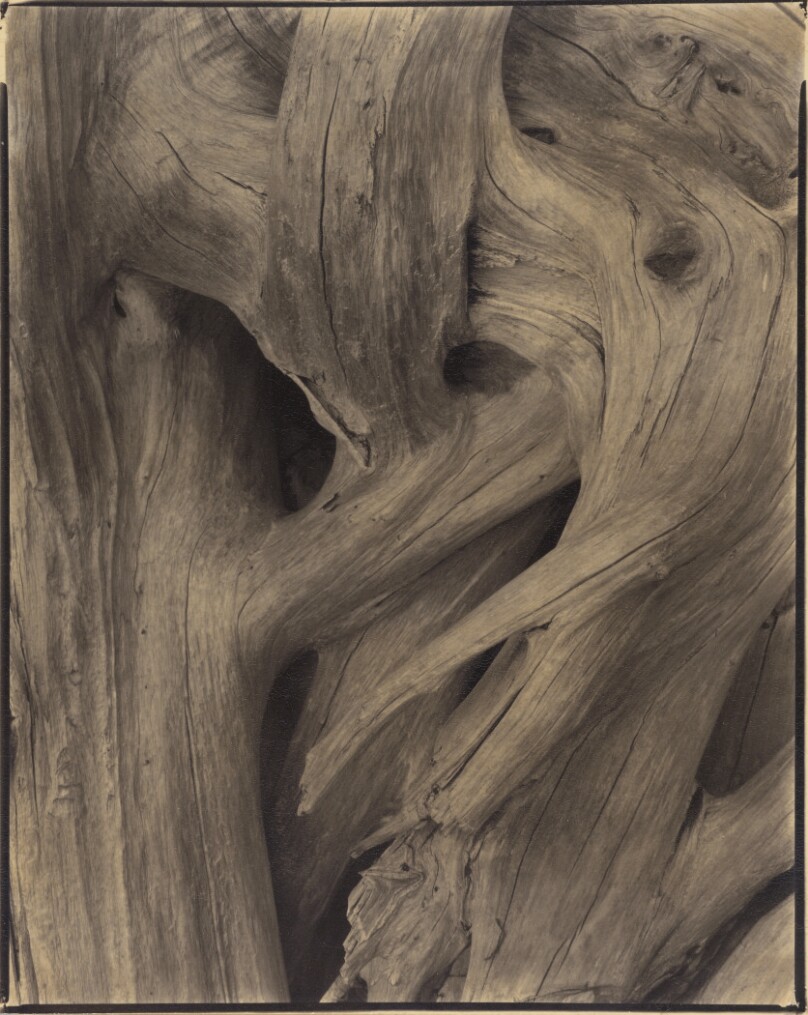
Driftwood, Maine
Creator
Paul StrandAmerican Photographer · 1890–1976
All works by this person →Paul Strand began photographing in New York in the 1910s. During the early 1920s he received recognition for both his painting and his photography. He visited New Mexico in 1926 and, beginning in 1930, returned for three consecutive summers, making portraits of artist friends and acquaintances. It was there, amidst a community of visual artists and writers, that Strand began to develop his belief
More on Getty ULAN- Date
- 1928
- Medium
- Varnished platinum print
- Culture
- American
- Department
- Photographs
- Institution
- Getty Museum
- Object ID
- 445e39be-35e7-47e5-b37a-13d1f2e446a9
From the Getty Museum record
From 1925 to 1928 Paul Strand made numerous trips to Georgetown Island, Maine, to make photographs and visit his friend, the sculptor Gaston Lachaise (1882-1935). During this time Strand was drawn to elements of nature—tree trunks, pieces of driftwood, and plants. He approached these organic forms much in the same way he had treated the Cubist-inspired still lifes or machine-age subjects ([88.XM.15](https://www.getty.edu/art/collection/object/1040Z3), [86.XM.686.4.1](https://www.getty.edu/art/collection/object/1096V0) and [86.XM.683.59](https://www.getty.edu/art/collection/object/106NSK)). He filled the entire ground glass with close-up views, allowing for minimum depth of field, and brought the subject to the surface of the print, literally exploiting the two-dimensional quality of the photograph itself. But there was a marked shift in his work. He was now rejecting the urban landscape and material objects—products of industrialization—and turning to a more fundamental subject: nature. Strand's nature studies from the 1920s are of organic objects made up of light and dark tones, which he referred to as "chiaroscuro." During this time Strand was influenced by Clive Bell (1881-1964), the British art critic and philosopher of art, who, in his 1914 publication _Art_, advocated the idea of "significant form," which was when "lines and colour combined in a particular way, certain forms and relations of forms, stir our aesthetic emotions." In this example, Strand focused on the subject, at times with a near microscopic zeal, attempting to record the very fiber of its existence. He was beginning to realize that these concentrated studies could, when viewed collectively, define an area, a region, or a country. In his approach to documenting the natural landscape of Georgetown Island, Strand was anticipating a working method he would apply to later pictures in France, Italy, and Scotland, where his focus was on the people who defined these regions (see also [85.XM.200](https://www.getty.edu/art/collection/object/106F4K) and [86.XM.683.104](https://www.getty.edu/art/collection/object/106NTF)). Originally published in _Paul Strand_, In Focus: Photographs from the J. Paul Getty Museum by Anne M. Lyden (Los Angeles: J. Paul Getty Museum, 2005), 34. ©2005, J. Paul Getty Trust.
The authoritative record is held by Getty Museum. LinkedCulture surfaces this object and its connections; it does not alter institutional metadata.
Get printable QR codesHide QR codes
Open QR codes for this object page and the museum record. They stay collapsed until needed.
Related across collections
Semantically similar works from Getty Museum and other institutions.