Getty Museum
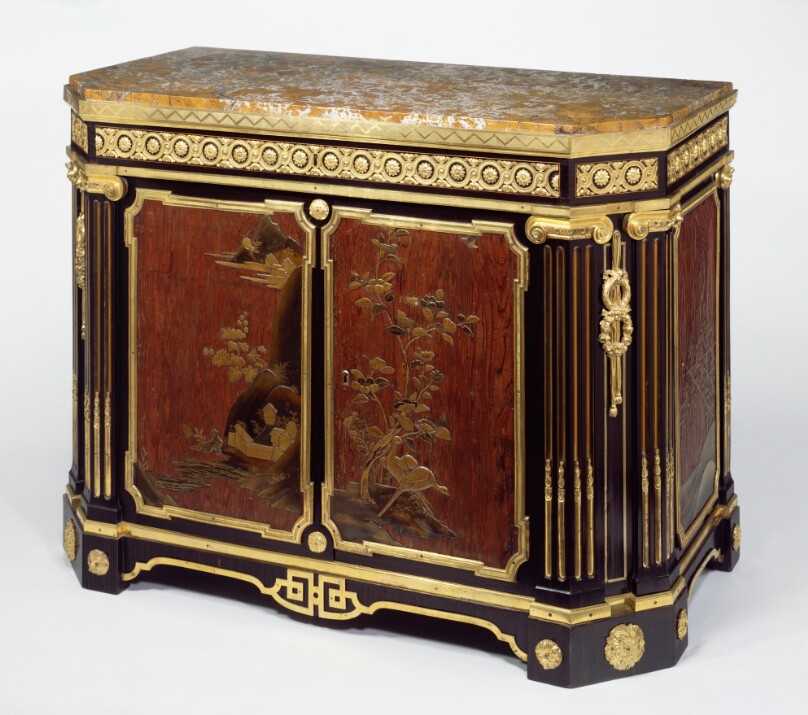
Cabinet
Creator
Joseph BaumhauerFrench Artist · 1772–1772
All works by this person →Nothing is known about Joseph Baumhauer's childhood and training in Germany before his arrival in Paris in the 1740s. His marriage to the daughter of a French furniture-maker probably allowed him to establish himself in Paris at a time when established French cabinetmakers vociferously opposed immigrant craftsmen arriving from Germany and other countries. About 1749 Baumhauer was made a *marchand-
More on Getty ULAN- Date
- about 1765
- Medium
- Oak veneered with ebony, tulipwood, maple, Japanese cedar, and amaranth; set with panels of seventeenth-century Japanese lacquer; gilt-bronze mounts; jasper top
- Culture
- French
- Department
- Decorative Arts
- Institution
- Getty Museum
- Object ID
- 4649f037-9ea0-40f9-a8f6-ee1626861b47
From the Getty Museum record
The combination of rare and expensive materials used on this cabinet indicates that it was a particularly expensive commission. The four Japanese lacquer panels date from the mid- to late 1600s and were created with a technique known as *kijimaki-e*. For this type of lacquer, artisans sanded plain wood to heighten its strong grain and used it as the background of each panel. They then added the scenic elements of landscape, plants, and animals in raised lacquer. Although this technique was common in Japan, such large panels were rarely incorporated into 1700’s French furniture. Copper fills the ridges in the piece’s corner columns, giving an added rich color and contrast to the gilt-bronze mounts. Yellow jasper, a semiprecious stone, rather than the usual marble, forms the top.
The authoritative record is held by Getty Museum. LinkedCulture surfaces this object and its connections; it does not alter institutional metadata.
Get printable QR codesHide QR codes
Open QR codes for this object page and the museum record. They stay collapsed until needed.
Related across collections
Semantically similar works from Getty Museum and other institutions.