Getty Museum
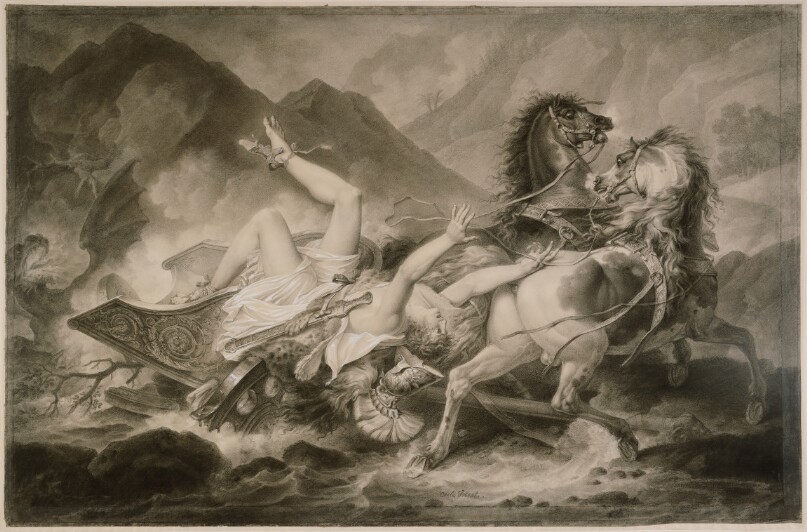
Death of Hippolytos
Creator
Carle VernetFrench Artist · 1758–1836
All works by this person →In addition to being a painter and lithographer, Carle Vernet was an avid horseman. Just days before his death at the age of seventy-eight, he was seen racing as if he were a sprightly young man. In his own time, Vernet was known primarily as an exceptional painter of horses in full movement--either racing, hunting or in cavalry portraits. Vernet received a conventional artistic education from his
More on Getty ULAN- Date
- 1800
- Medium
- Black chalk stumped and heightened with white; framing line in light brown ink, black chalk and incised
- Culture
- French
- Department
- Drawings
- Institution
- Getty Museum
- Object ID
- 47769de1-1284-483e-8800-20b686127c34
From the Getty Museum record
In a balanced composition that controls the subject's violence, Carle Vernet captured the final dramatic moment of an ancient Greek tragedy. Within the scene's frozen motion, Hippolytos's dramatic yet rigid pose typifies the Neoclassical style. Nevertheless the artist emphasized his technical skill by contrasting the varied soft textures of the frothy clouds of sea spray, the horses' swirling manes and tails, and the leopard skin tied around Hippolytos's waist. Hippolytos's stepmother Phaidra fell in love with him, but he rejected her affections. In revenge, she left a note accusing him of defiling her, and committed suicide. His enraged father Theseus banished Hippolytos and begged the gods to destroy him. As a result, the sight of a sea monster frightened the horses pulling Hippolytos in his chariot. Hippolytos lost control, and the horses dragged the hero to his death. Carle Vernet exhibited this drawing and its pendant, *The Return from the Race,* at the Salon of 1800, where they received wide acclaim. So popular were the scenes that another artist then produced engravings after them, which were exhibited at the Salon of 1808. The two drawings were auctioned in 1817, and did not reappear on the market until in the early 1990s.
The authoritative record is held by Getty Museum. LinkedCulture surfaces this object and its connections; it does not alter institutional metadata.
Get printable QR codesHide QR codes
Open QR codes for this object page and the museum record. They stay collapsed until needed.
Related across collections
Semantically similar works from Getty Museum and other institutions.