Getty Museum
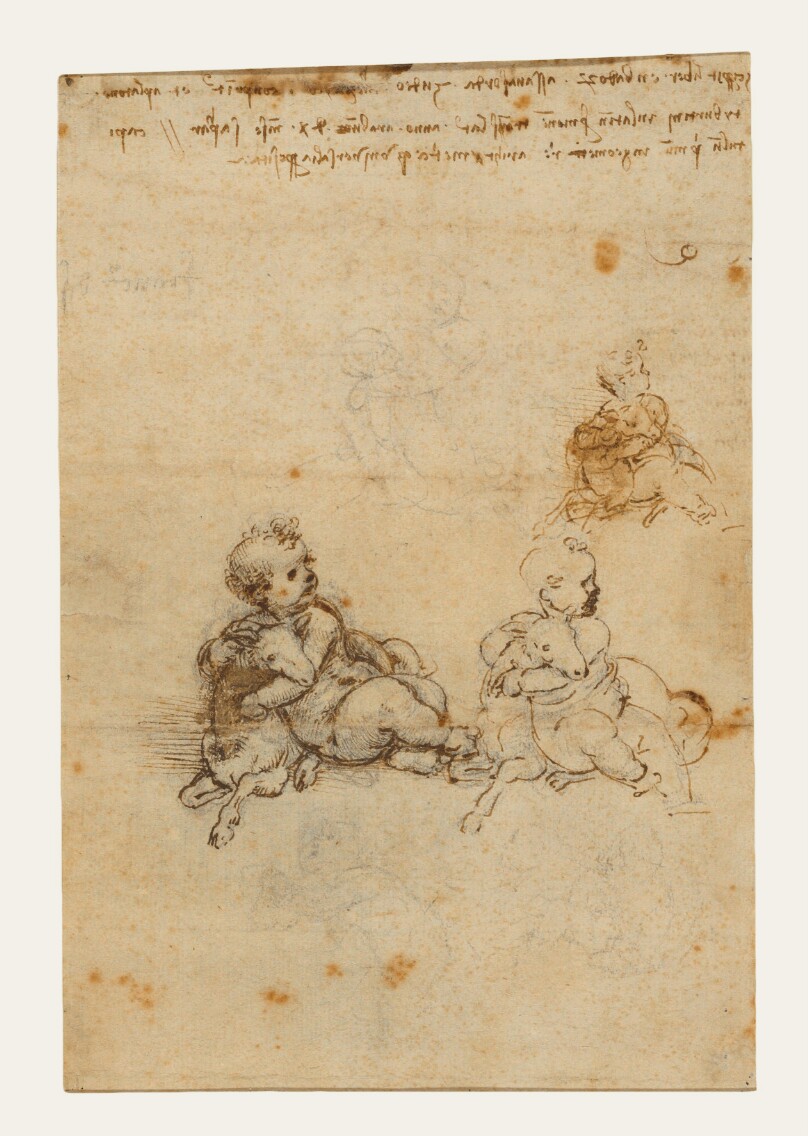
Studies for the Christ Child with a Lamb (recto); Head of an Old Man, and Studies of Machinery (verso)
Creator
Leonardo da VinciItalian Artist · 1452–1519
All works by this person →To examine the life and work of Leonardo da Vinci (1452–1519) is to be immersed in the details of Italian Renaissance court life and to witness the bedrock of western art and science. While Leonardo is now arguably best known for paintings such as the *Mona Lisa* and *The Last Supper*, in the war-ravaged environment of Italian city-states of the period it was his work as a military engineer that l
More on Getty ULAN- Date
- about 1503–1506
- Medium
- Black chalk, pen and brown ink
- Culture
- Italian
- Department
- Drawings
- Institution
- Getty Museum
- Object ID
- 477d1ec7-ec36-46fe-9c9d-4c3fa7b7ecf8
From the Getty Museum record
Leonardo da Vinci did not finish many paintings, but he filled thousands of notebook pages with quick sketches, designs, plans, maps, and detailed anatomical drawings throughout his life. Often these pages contained a scattering of sketches on numerous unrelated projects, seemingly the contents of Leonardo’s thoughts poured onto the page. This sheet includes studies for a child with a lamb (on the *recto*, or front) and studies of machinery (on the *verso*, or back, or reverse), among other sketches. With limited formal schooling, Leonardo learned through close observation and an insatiable curiosity about how things worked. Between 1503 and 1506, Leonardo used black chalk, pen and ink to draw a child and a lamb multiple times, trying out different poses for the figures. He began with many quick sketches in chalk. He then went over some of these in pen and ink, firming up his ideas, as at upper right. The most evolved study is that at center left, in which the child leans back on the lamb, the group rendered more completely in space. Sheets of drawings such as this allowed Renaissance artists to experiment with complex compositions, poses, gestures, and expressions before committing them to wood panel or canvas with paint. As such, drawings were rarely meant to be viewed as finished objects in their own right. Leonardo probably made the drawing in preparation for a painting of the *Virgin and Child with Saint John*, now lost but known through copies. He inscribed some unrelated notes concerning a treatise on geometry at the top of the sheet in his characteristic backwards writing, legible only with the help of a mirror. Some speculated that this right-to-left writing was meant to conceal his ideas, but this is not in fact any kind of da Vinci code. Because he was left-handed, writing in the opposite direction saved Leonardo from smearing ink as his hand moved across the paper. Mirror-writing such as this is often found in left-handed children before they are “corrected.” Leonardo was also an accomplished inventor and engineer, with a detailed knowledge of cranes, levers, pulleys, and gears, and sketches of machinery and parts are seen on the verso side of this sheet. A design for a press or early laminating machine, the adjacent notes concern the wear and tear on the machine, particularly the axel, and a possible solution: a replaceable axel. Some of Leonardo’s more ambitious conceptions, including early thinking about the possibility of tanks, helicopters, submarines, and other military weapons, were never realized in his time.
The authoritative record is held by Getty Museum. LinkedCulture surfaces this object and its connections; it does not alter institutional metadata.
Get printable QR codesHide QR codes
Open QR codes for this object page and the museum record. They stay collapsed until needed.
Related across collections
Semantically similar works from Getty Museum and other institutions.