Getty Museum
The Destruction of Jerusalem
Creator
Boucicaut MasterFrench Illuminator · 1390–1430
All works by this person →In the early 1400s, the Boucicaut Master was the leading master of manuscript illumination in Paris and one of the most influential artists working in the International style in northern Europe. The Boucicaut Master appears to have supervised a talented team of artists who produced manuscripts commissioned by the king of France, high-ranking aristocrats, and the wealthy bourgeoisie. He probably al
More on Getty ULAN- Date
- about 1413–1415
- Medium
- Tempera colors, gold leaf, gold paint, and ink
- Culture
- French
- Department
- Manuscripts
- Institution
- Getty Museum
- Object ID
- 47e3d6dd-edc2-4a0c-9679-94b1a75c8e4a
From the Getty Museum record
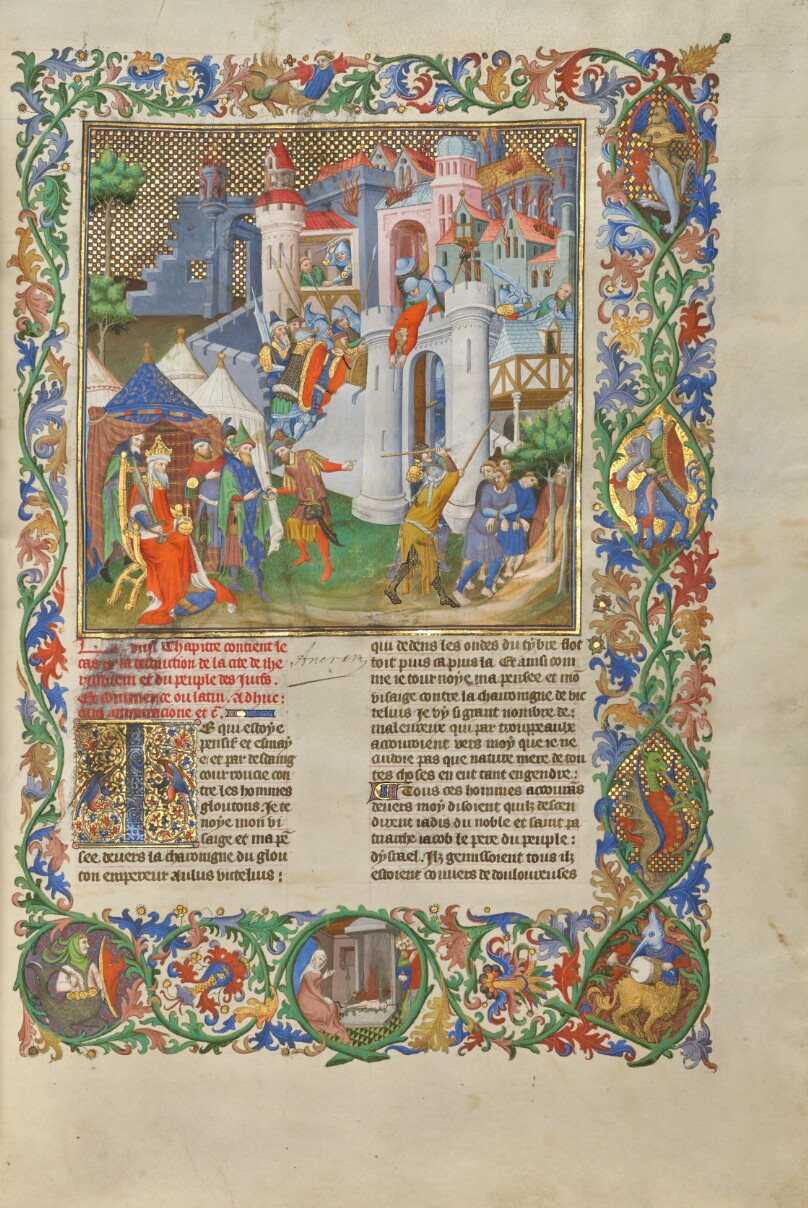
In the miniature depicting the Siege of Jerusalem in 70 A.D., the Roman Emperor Titus, who directed the battle, sits enthroned in a tent while his soldiers storm the city. As is typical for the art of this period, the scene is anachronistic: the figures wear armor of the 1400s, and the city of Jerusalem is a medieval walled city with battlements, wood-and-plaster houses, and even a Gothic church. To give the illusion of recessed space, the artist used an intuitive rather than a mathematical perspective, stacking the farther buildings on top of those in the front. Despite this innovative method for representing space, he also used an un-naturalistic background of checkered squares for the sky, instead of blue paint. This miniature complements the only other full-page miniature in the manuscript, "Adam and Eve," implying a parallel between The Fall and the eventual destruction of Jerusalem. Just as Adam and Eve were punished for disobeying God, medieval Christians believed that the destruction of Jerusalem resulted from the Jews' failure to accept Jesus as the Messiah.
The authoritative record is held by Getty Museum. LinkedCulture surfaces this object and its connections; it does not alter institutional metadata.
Get printable QR codesHide QR codes
Open QR codes for this object page and the museum record. They stay collapsed until needed.
Related across collections
Semantically similar works from Getty Museum and other institutions.