Getty Museum
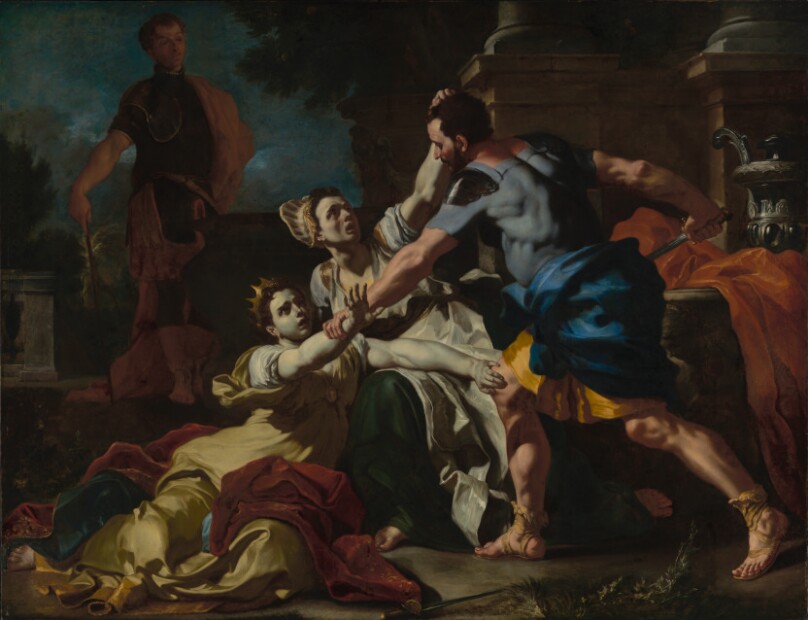
Death of Messalina
Creator
Francesco SolimenaItalian Artist · 1657–1747
All works by this person →Francesco Solimena settled in Naples in 1674 and became the unchallenged head of the Neapolitan school of painting during the first half of the 1700s. He modeled his painting on the exuberant Baroque style of his predecessor, Luca Giordano, modified by the classical tendencies of Roman decorator Pietro da Cortona. The brownish shadows that are such an identifiable element of Solimena's style are i
More on Getty ULAN- Date
- about 1704/1712
- Medium
- Oil on canvas
- Culture
- Italian
- Department
- Paintings
- Institution
- Getty Museum
- Object ID
- 47e7b674-1b74-424f-83aa-3cf5ad7fd653
From the Getty Museum record
Solimena here represents the murder of Messalina, third wife of the Roman Emperor Claudius, who had a reputation for promiscuity. Though the emperor forgave Messalina’s adultery, others saw this as a weakness, and a Roman officer ordered her assassination. The dynamic composition illustrates the moment in which a soldier thrusts a sword toward the frightened empress, who grasps his arm in a helpless attempt to fend off the attack. This may be the only painted representation of the death of Messalina, a story from the *Annals* of Tacitus. The subject provided Solimena with an opportunity to engage with a dramatic narrative, whose intensity he heightened by illuminating the figures in the darkness with stark, white light and painting them on a monumental scale. According to his eighteenth-century biographer, Bernardo de' Dominici (1683–1759), Solimena painted this subject for a series of five canvases of historical and mythological subjects for the Procurator Canale in Venice.
The authoritative record is held by Getty Museum. LinkedCulture surfaces this object and its connections; it does not alter institutional metadata.
Get printable QR codesHide QR codes
Open QR codes for this object page and the museum record. They stay collapsed until needed.
Related across collections
Semantically similar works from Getty Museum and other institutions.