Getty Museum
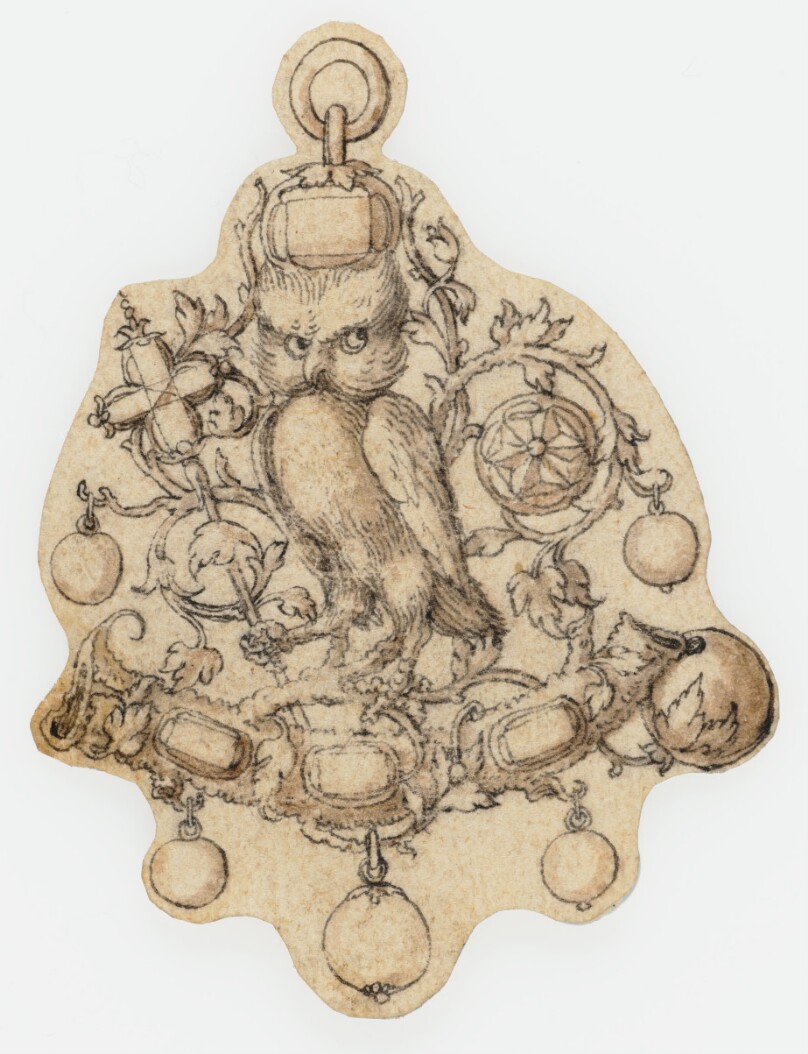
Design for a Pendant Jewel
Creator
Theodor de BryGerman Artist · 1528–1598
All works by this person →Born to a wealthy Protestant family and trained in his native Liège as a goldsmith and engraver, Theodor de Bry fled the Netherlands around 1570 due to religious persecution. After moving to the free city of Strasbourg, de Bry left for England in 1586. There he made some of his best-known works, engraved copies after scenes from the New World. While de Bry was in England, his family moved permanen
More on Getty ULAN- Date
- about 1580–1590
- Medium
- Pen and black ink and brown wash
- Culture
- German / Flemish
- Department
- Drawings
- Institution
- Getty Museum
- Object ID
- 4807976e-d815-4c0f-bb37-1c89850949d5
From the Getty Museum record
This cleverly conceived pendant displays a diminutive owl perched regally amid jewel-encrusted vines. Small spherical pearls hang from the ends of the foliage, suspended from small loops so that they could swing freely. In the Renaissance, goldsmiths began to experiment with a variety of new cuts for gemstones. A table-cut stone rests on top of the owl's head, and three others lie along the branch at the bird's feet. The intricate and unusual cuts of the jewels on either side of the owl, in the shape of a quatrefoil and a rosette, suggest that someone commissioned this drawing to show a possible setting for actual stones. Contemporary paintings and drawings reveal that pendants were among the most popular forms of jewelry in the Renaissance. Women in particular favored pendants, wearing them suspended from a chain around their necks or pinned to a sleeve, where the dangling pearls and sparkling gemstones would catch the eye with their movement and brilliance.
The authoritative record is held by Getty Museum. LinkedCulture surfaces this object and its connections; it does not alter institutional metadata.
Get printable QR codesHide QR codes
Open QR codes for this object page and the museum record. They stay collapsed until needed.
Related across collections
Semantically similar works from Getty Museum and other institutions.