Getty Museum
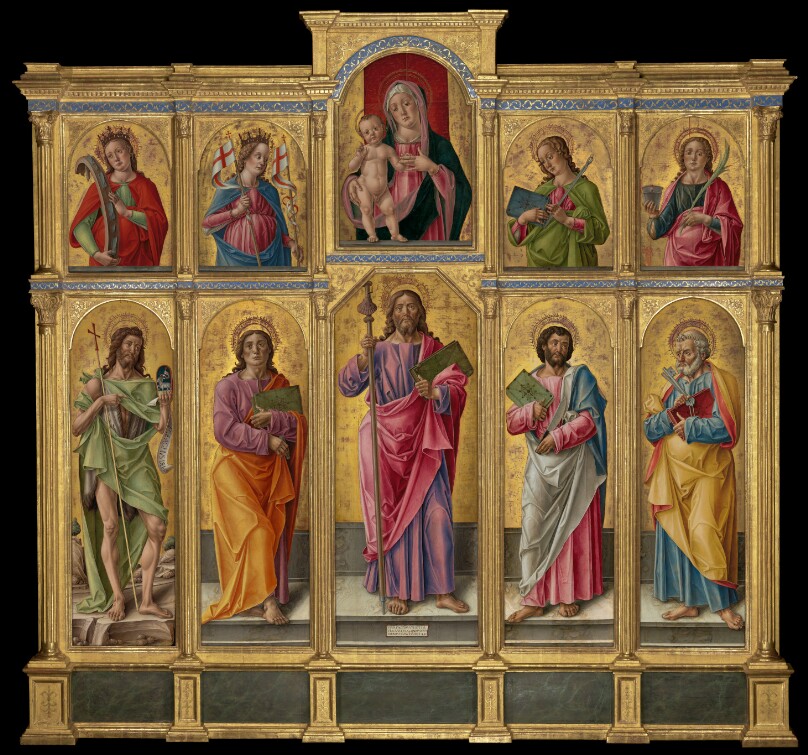
Polyptych with Saint James Major, Madonna and Child, and Saints
Creator
Bartolomeo VivariniItalian Artist · 1432–1499
All works by this person →Bartolomeo Vivarini was the second member of a family of painters from the Venetian island of Murano who sustained over fifty years of considerable prestige and commercial success during the second half of the fifteenth century. He studied under his elder brother Antonio, with whom he collaborated after 1450. He probably trained in Padua as well and, in his early works especially, his debt to Andr
More on Getty ULAN- Date
- 1490
- Medium
- Tempera and gold leaf on panel
- Culture
- Italian
- Department
- Paintings
- Institution
- Getty Museum
- Object ID
- 489d0bf5-04c6-422b-b52c-11a2510d9f98
From the Getty Museum record
Bartolomeo Vivarini's late works are notable for their use of bright, dissonant colors and figures whose firm linear outlines lend them the appearance of sculptures or wood carvings. This polyptych was made for a parish church dedicated to Saint James the Greater and the Virgin *Assunta* (the Virgin ascending to heaven) in Vallata, a town north of Bergamo, Italy. Saint James stands in the center, holding a pilgrim's staff with the symbolic scallop shell and a book. Starting at the lower left, Saint John the Baptist wears his customary tunic of animal skins and a pale gray-green mantle and stands in a rocky setting along the river Jordan, unlike the other figures who stand before a marble ledge. Next to him is Saint John the Evangelist. At the lower right, Saint Bartholomew holds a book and a knife, the symbol of his martyrdom, and alongside, an elderly Saint Peter holds the keys to the kingdom of heaven. In the central panel of the upper tier, the Virgin holds the Christ Child, who raises his right arm in blessing. At the top left, Saint Catherine of Alexandria holds a broken wheel with spikes, the symbol of her martyrdom, and Saint Ursula clasps two rods with banners. To the right of the Virgin, Saint Apollonia holds a book and a pincer with a tooth, a reference to the torture of teeth-pulling that she endured, and Saint Lucy holds an oil lamp that alludes to the significance of her name, derived from the Latin “lux” meaning light.
The authoritative record is held by Getty Museum. LinkedCulture surfaces this object and its connections; it does not alter institutional metadata.
Get printable QR codesHide QR codes
Open QR codes for this object page and the museum record. They stay collapsed until needed.
Related across collections
Semantically similar works from Getty Museum and other institutions.